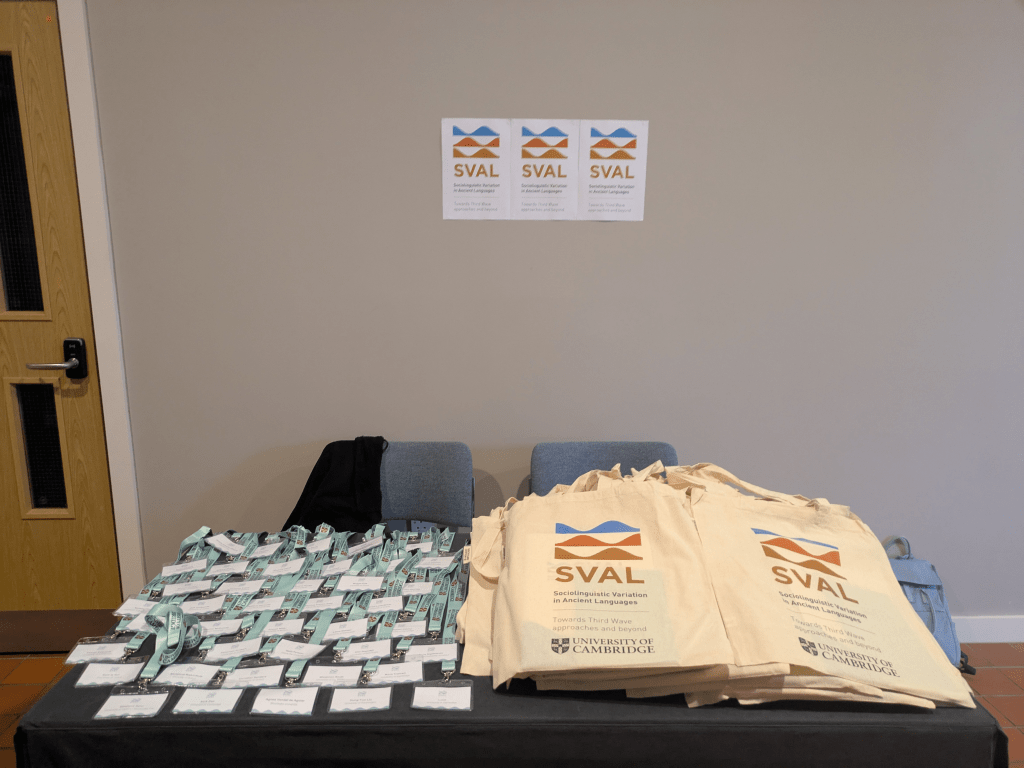
Written by Sólveig Hilmarsdóttir (Cambridge) and Dalia Pratali Maffei (Gent)
We, the organisers of the conference Sociolinguistic Variation in Ancient Languages (https://svalconference.wordpress.com/), want to thank the Philological Society warmly for their generous support of our initiative. The three-day conference took place in Cambridge on March 26-28 and it was held in the Faculty of Classics and at Jesus College.
The aim of the conference was to create and foster a conversation about the methods and perspectives needed to advance sociolinguistic approaches to ancient languages. Early career scholars in particular were encouraged to submit abstracts. We sought to focus particularly on Third Wave approaches to linguistic variation; this is a movement in sociolinguistics associated with the work of Penelope Eckert (see e.g., Eckert 2008). Work within the Third Wave has emphasised the perspective of the social meaning of linguistic variants and argued that linguistic variants are not directly correlated to social categories or a specific meaning, but that their meaning is unspecified and dynamic (Hall-Lew, Moore and Podesva 2021). One of the central concepts is the ‘indexical field’, i.e. the set of potential meanings linked to a linguistic variant (Eckert 2012). As society changes, speakers can associate new meanings with linguistic variants and, in reverse, new contexts of usage can activate new meanings, both at a conscious and at an unconscious level.
The conference programme was spread over three days and it was organised into five different thematic sessions which followed the themes of the seventeen papers we were able to accept:
*Language and Identity (Sung Min Park; Giuseppina di Bartolo and Liana Tronci; Matthew Glass; Shoni Lavie-Driver)
*Writing Practices and Social Meaning (Josh Brown; Victoria Almansa-Villatoro; Laura Nastasi; Luca Rigobianco)
*Metalinguistic Perspectives on Variation (Serena Barchi; Eleonora Cattafi; Joseph Miller; Ezra la Roi)
*Variation in Literary Sources (Agnes Vendel de Aguiar; Hung-Yun Liu)
*Registers and Language Choices (Siu Pong Cheng; Irene Chioni; Eleonora Selvi)
The programme also featured three keynote presentations which focused on different aspects of the conference theme, i.e., modern sociolinguistic theory, politeness in Latin and Greek and Greek sociolinguistics:
*Penelope Eckert (Stanford) gave the paper ‘Where does the indexical field live?’
*Eleanor Dickey (Reading) gave the paper ‘Politeness versus Classicism in Latin’
*Klaas Bentein (Gent) gave the paper ‘‘Literary’ stylization in ‘non-literary’ Ancient Greek texts: A digitally oriented, multi-modal approach
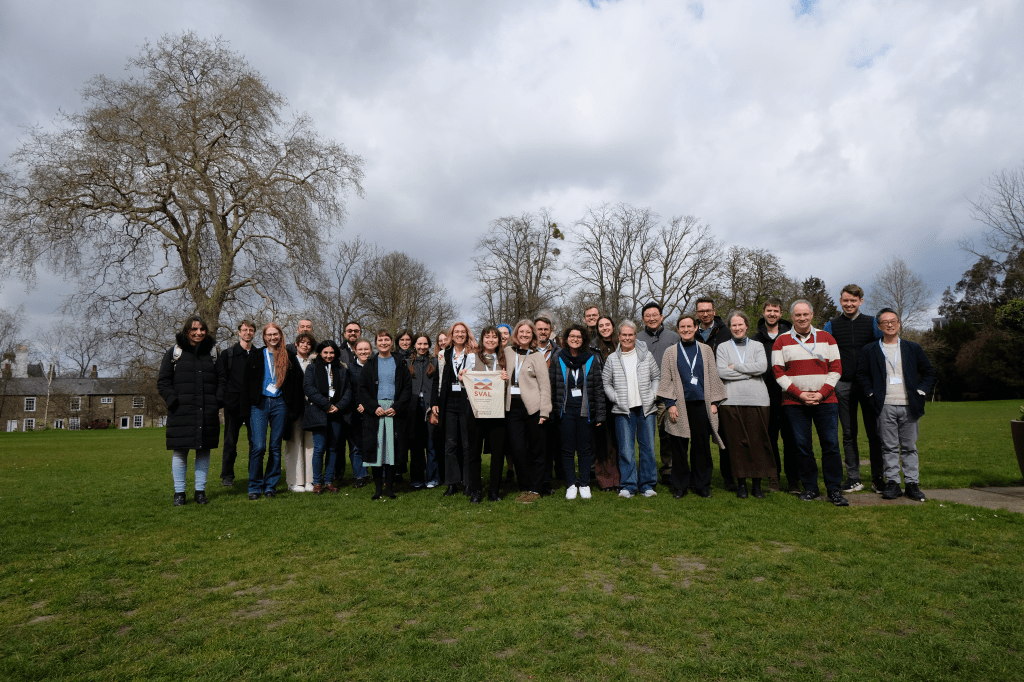
We had around 80 participants, including speakers, chairs and our two MPhil student helpers (Hanna Turi and Eleanor Jones). The conference speakers and attendees came from all over the world, from 20 countries and 50 different institutions. Most were in the room with us but several joined virtually.
The majority of the presenters were early career researchers, i.e., PhD students and postdoctoral scholars. Overall, half of the participant body was made up of early career researchers and undergraduate and master᾽s students. We were particularly pleased to be joined by so many junior academics and students.
The dialogue at the conference was vibrant throughout and featured constructive comments and questions both in the Q&A sessions as well as in informal discussions during the breaks. It was particularly enjoyable to be able to foster a dialogue between scholars from ancient world studies and scholars from modern sociolinguistics. We are grateful to Jesus College for hosting our conference dinner mid-way through the conference and to staff at the Faculty of Classics and Jesus College for facilitating catering during breaks. Several aspects of the conference were made possible through the generosity of two fellows at Jesus College, James Clackson and Véronique Mottier. In addition to the generous support from the Philological Society, the conference also received funding from the Faculty of Classics (Cambridge); Cambridge Language Sciences; The Historical Sociolinguistics Network and FWO.
We want to extend our further thanks to the members of our scientific committee who helped us review abstract and chair several of the conference sessions: Klaas Bentein (Gent); Eleonora Cattafi (Gent); James Clackson (Cambridge); Giovanbattista Galdi (Gent); Ezra la Roi (Gent); Chiara Monaco (Gent); Tomaž Potočnik (Cambridge). Finally, we are extremely grateful to Leonardo Manente who designed the conference logo.