Written by Eve Suharwardy
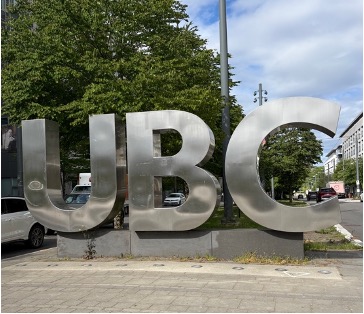
In May 2026, I was generously awarded a Fieldwork and Travel Bursary by the Philological Society to attend SULA-TripleA. It was a four-day event which was hosted by the University of British Columbia (UBC) in Vancouver, combining the SULA (Semantics of Under-represented Languages of the Americas) and TripleA (Semantics of Languages of Africa, Asia, Australia and Oceania) conferences for the first time. There were 59 oral presentations, 15 poster presentations, as well as a thought-provoking panel on indigenous perspectives of linguistics research and language revitalisation (see programme here). The intention of the conference was to bring together researchers working on languages or dialects which are under-represented in the literature on formal semantics. Therefore, its aims align closely with my doctoral research which focuses on semantics, its interfaces with syntax and pragmatics and linguistic fieldwork on the Austronesian language, Malay (Austronesian, Western Malayo-Polynesian; Malaysia).
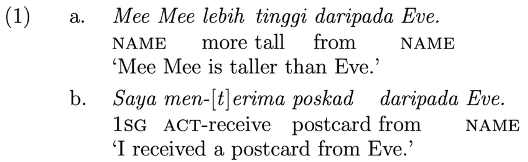
My presentation was based on research that was carried out as part of my PhD thesis on comparatives. The title was The Semantic Typology of Comparative Standards, Revisited. I presented original fieldwork data from Malay which provides further evidence of a two-way typology of strategies used to compose comparative meaning: compositional and pragmatic. Whilst the pragmatic strategy is dependent on the linguistic context to build meaning, the compositional strategy requires specific syntactic dependencies. I put forward three diagnostics for the pragmatic strategy and show that the comparative proper in Malay passes these diagnostics. They are: (1) wide distribution of the standard marker (i.e. outside the comparative proper), (2) (narrow and) wide readings of comparatives with syntactic islands, (3) clause boundary effects. See (1a) for a basic comparative and (1b) for illustration of the first diagnostic.
Overall, these observations lead to interesting questions and possible connections to Stassen’s (1985) classifications of comparative types, leaving exciting opportunities for future research.
The conference allowed me to share my research with a specialised audience of formal semanticists and it also enabled me to raise the profile of research on Malay, a language that, despite being widely spoken, remains under-represented in formal theoretical discussions.
Finally, I would like to sincerely thank the Philological Society for the ongoing support that they have provided to me and many other early career academics. In addition to receiving this financial assistance, I have also been fortunate enough to give a talk (entitled Comparative Constructions at the Interface between Syntax and Semantics: Lessons from Malay) at the society’s Early Career Researcher Panel in November 2024, which allowed me to refine research that has gone on to form a crucial part of my PhD thesis.

