The Philological Society is the oldest learned society in Great Britain devoted to the scholarly study of language and languages. It is also a registered charity (no. 1014370). It was established in its present form in 1842, consisting partly of members of a society of the same name established at the University of London in 1830 “to investigate and promote the study and knowledge of the structure, the affinities, and the history of languages”. As well as encouraging all aspects of the study of language, PhilSoc has a particular interest in historical and comparative linguistics, and maintains its traditional interest in the structure, development, and varieties of Modern English.
On
31 May, the ‘Linguistics in Modern Foreign Languages’ project held a conference
at Anglia Ruskin University, funded by Faculty of Arts, Humanities and Social
Sciences at Anglia Ruskin University, the British Academy and the Philological
Society.
The conference
brought together exam boards, publishers, advocacy groups and academics and
teachers to learn about findings from the project so far
and to explore outcomes of comparable international initiatives. The
‘Linguistics in MFL’ project assesses the potential for the inclusion of
linguistic topics in the secondary school languages curriculum. It aims to
introduce students to linguistics and deepen their interest in language,
including its historical, cultural and social reflexes.
Talks were given by Teresa Tinsley, author of the British Council’s Language Trends surveys and Chris Pountain, member of the A-level Content Advisory Board for MFL, amongst others. The full programme is available here.
Discussants at
the event included Dora Alexopoulou, Editor of Language, Society and Policy,
Victoria Dutchman-Smith, Commissioning Editor (MFL), OUP, Bernadette Holmes,
Director of Speak to the Future, Rhona Thompson, Curriculum Manager for
Languages at AQA, and four teachers: Sophie Hentschel, from Thirsk School and
Sixth Form College, Olly Hopwood, from Westminster School, Susan Stewart, Head
of Multilingualism at International School of London and Janette Swainton, Head
of MFL at Longsands Academy, St Neots.
The PhilSoc
grant allowed us to offer travel bursaries for teachers to attend the event,
and they did so in great numbers from all over the UK. Many commented on how
inspiring they had found the event and how it has made them think about their
teaching practice.
Claire Robinson
from Suffolk One (a state VI form college) said:
Just wanted to thank you rather in
haste for a great day on Friday. I really enjoyed it, and even though I
wasn’t quite sure what to expect I found it very inspiring. My particular
take-aways were:
Linguistics really delivers on equity – this came home to me as a really
pressing need after Teresa Tinsley’s talk which showed how uptake is narrowing
to become the preserve of elite schools, and again as a huge opportunity
highlighted by the fact that anyone can ‘do’ linguistics in relation to their
own L1, thus giving the lie to students who think it’s ‘posh’ to talk about
language.
Mary Wenham’s talk has inspired me to resurrect some materials I used to
use years ago to introduce L2 teaching, as I’m offering a ‘Tongue Twisters’
session on our ‘Raising the Bar’ day when we invite Year 6 students from
primary schools in Ipswich to join us for a taste of sixth form life – I’ll let
you know how it goes!
For more information about the project, click here.
English allows for a predicative phrase
to occur after the prepositions for and as in constructions like the following:
(1) We took her for a friend. (2) They left her for dead.
(3) I regarded her as a genius. (4) She rates his work as excellent.
The phrases introduced by for and as in these constructions introduce either a noun phrase or
adjective phrase constituent that is predicated of the postverbal noun phrase
in each case. I will call the V + NP + [PP P+NP/AdjP] construction
the oblique predicative construction,
and the complement of the preposition an obliquepredicative complement. The
construction with for is the older
one, and is found in many unrelated languages, including Gothic, Greek, Latin,
Russian, Spanish, Dutch and German, as Jespersen (1909-49, IV: 386) has shown.
In this paper I will trace the history of predicative oblique constructions involving for and as and a number of additional prepositions from Old English onwards. I will then discuss the huge range of constructions in which predicative for appears, and how these differ from constructions with as, which gradually became dominant in Present-Day English. By looking at a range of data I will investigate whether the claim that for and as are interchangeable, made by the OED, Jespersen and Poutsma, is valid. I will argue that for a number of reasons it is unsustainable. I will look at one of these reasons in detail, namely the observation that for has acquired a subtly specialised meaning which has come to differentiate it from as.
This paper will be read at the Annual General Meeting of the Philological Society in Cambridge, Murray Edwards College, Buckingham House Seminar Room, on Saturday, 15 June 2019, 4.15pm.
These are interesting times for both the scientific and the public understanding of multilingualism. Old prejudices about learning more than one language in childhood are still widespread, yet new misconceptions about the ‘bilingual advantage’ treat language learning as a panacea. We need two types of ‘bridges’ to debunk old and new myths: bridges that connect different research fields to help understand the interacting factors affecting multilingualism, and bridges to bring a balanced picture of multilingualism research to people from all sectors of society who need to make informed decisions. In this lecture, I will describe how the research and public engagement centre Bilingualism Matters is successfully building both types of bridges worldwide.
The annual Anna Morpurgo Davies Lecture, organised in co-operation with the British Academy, will take place on Friday, 10 May, 4.15pm, at the Royal Society, 6-9 Carlton House Terrace, London, SW1Y 5AG. Tickets are available from the British Academy website. A video recording will be made available in due course.
EDIT: As of Thursday 19th September, The Poor Man of Nippur has been shortlisted in the Research in Film Awards 2019. This film is one of only five films shortlisted in the Best Research Film category. The winners of the Awards will be announced in a ceremony on Tuesday 12th November.
The Poor Man of Nippur, the world’s first film in Babylonian, was launched on YouTube by Cambridge Assyriology in November 2018. The Philological Society, through an Outreach grant, was one of the project’s sponsors.
The spark that led to the film was struck in
an Akkadian (i.e. Babylonian) language class, in which one of the students
suggested it would be ‘fun to dramatise’ the story. And, indeed, it’s perfect for dramatisation: multiple
speaking roles, a fairly straightforward plot, no special effects (no gods!), and
manageable length. One of the scenes
which would have been hardest to film, the butchering of the goat, had
helpfully been broken off the tablet.
You have to wonder whether a prescient scribe two thousand years ago
decided to help us …
More seriously, I think we were all also aware that in the years 2017–2018 there was a special resonance for a film about a ‘poor man’ to be made by a team at a UK University. With the United Nations calling the UK Government’s approach to poverty “punitive, mean-spirited and callous”, any highlighting of the issue, even in a medium as unusual as ours, feels like it has a streak of Resistance.
And that fact that the story is (as most
people think, but some dispute) comical gave it a light-heartedness that helped
compensate for our lack of experience.
What
is the motivation behind the production?
There were lots of motivations that came
together. Here are some of them:
we all wanted to have some fun!
we were curious to see how the
final product would look
it was a new way to think about
a piece of Babylonian literature
it was an opportunity to
present Ancient Mesopotamia in a new way: in museums it always comes across as
terribly static, and one can forget that it was full of real people who went
about real lives (both boring and colourful, just like us today)
more specifically: very few
people realise that Babylonian is a language we understand quite well; a film
is a great way to spread this message
it gave students a new way to
experience and think about a story they had studied on paper
the film constitutes a lasting resource
that can be used in Babylonian courses worldwide (there are, especially in
Germany, more of them than you might think!)
And of course our biggest hope of all was
that we might tempt some intellectually curious young people, with an interest
in languages and the ancient world, to think seriously about studying
Assyriology at University.
What
material did you use as a guideline?
The film basically follows the wording on the manuscript from the site of Sultantepe (ancient Huzirina). You can read an edition of it here.
We changed a few small things, e.g. when three characters repeat the word ‘goat’, that the Guard has just said: the repetitions aren’t in the story. And when the fake Doctor is tying the Mayor up, we smuggled in some lines from the incantation series Maqlû; that’s why they’re not subtitled – they’re not part of the story’s original wording.
A breakthrough idea came from Zach Long who suggested that we could reassign lines from the narrator to narrators-within-the story. This made it much more interesting for the viewer, and also closer to the experience of listening to a storyteller, which is probably how the story often circulated in antiquity.
What
about pronunciation?
We were essentially applying what you might
call the ‘modern Assyriological conventional pronunciation of Babylonian’. This has been put together by many scholars,
over a long period of time, and is still undergoing refinement. The main sources of information are:
Comparison with other Semitic languages Sometimes, Babylonian (and Assyrian) words are virtually identical to those in Arabic or Hebrew, e.g. Bab./Assyr. kalbum and Arab. kalbun, both meaning ‘dog’. Regular patterns of sound correspondence have also been found, so that e.g. the letter ayin (‘) disappears, turning neighbouring a into e. Thus Bab./Assyr. emēdu ‘to stand’ is cognate with Hebrew ‘āmad ‘he stood’.
A bit of linguistic common sense Thus it is not hard to see how imtahhar ‘he received each one’ might morph into indahhar.
Spelling patterns on Babylonian documents For instance, questions often contain a word written with an extra vowel (e.g. a-na-ku-ú for usual a-na-ku, representing anāku ‘I’). This is suspected to reflect interrogative intonation.
Rare but very helpful cases in which Babylonian words are written in the Aramaic or Greek script Examples of the latter, so-called ‘Graeco-Babyloniaca’, can be seen here.
Do
you see a pedagogical value for UG / PG students in this production?
You can see the students talking about their experience in the video below.
For my part, something I put a lot of
emphasis on as a teacher of Babylonian and other Mesopotamian languages is that
they are not just tables of verbs and lists of vocabulary, but actual languages: they lend themselves to
different intonations depending on context and mood, they were probably
accompanied by lots of gestures, and, above all, while learning they need to be
spoken aloud. The film was a great way
for us all to experiment with this way of thinking about things.
The film was also a great way for the
Mesopotamian community at my University to come together and collaborate on
something, which is an excellent motivator.
What
do you hope your viewers will take away from watching the video?
Thanks to an army of incredibly generous
volunteers, the film can be viewed with subtitles in 19 languages. Such a powerful reach can potentially take
Mesopotamian culture to people who weren’t even aware it existed, and maybe
encourage them to look into it further.
That would be hugely gratifying.
But, even for people who are already aware of Mesopotamia, we hope the film will give them a new perspective about it. And that it will generally excite and nurture people’s curiosity about the ancient world and ancient languages.
The Philological Society has a fund to support Community and Public Engagement projects such as the above. For more information and an application form, please visit the PhilSoc website.
by Richard Ashdowne (University of Oxford; Hon. Secretary for Membership)
In pursuit of its charitable goals, and as funds permit, the Philological Society supports the work of researchers in linguistics and philology by financing the publication of a series of original research monographs, including those whose specialised topic may fall outside the remit of commercial publishers. The series is called Publications of the Philological Society and it is currently edited by Susan Fitzmaurice.
All current members of the Society are entitled to electronic access to all the publications in this series since 2016. A list of recent publications can be found on the Society’s publisher’s website under ‘Monograph Series’.
In addition to electronic access, full members of the Society (but not student associate members) are eligible to request one printed copy of any publications in this series published during the current or previous calendar year without charge, provided that any membership subscription due for the relevant year has been paid. Requests should be made using this online form.
Long-standing members of the Society will be aware that this represents a change from the previous blanket distribution of hard copies of these publications, but the Society remains committed to ensuring that entitled members who wish to receive printed copies can easily do so.
The first two titles to be published under the new arrangement were first made available electronically in 2016. They are The Syntax and Semantics of the Perfect Active in Literary and Koine Greek by Robert Crellin and Revitalising Languages in Provence: A Critical Approach by James Costa. Both Robert Crellin and James Costa have written about their individual books for this blog; you can find the entries here and here. Electronic access to these titles is available for all members of the Society. The Society regrets the time taken to establish the process for requesting printed copies of these titles. It will therefore accept requests for printed copies of these two titles from full members whose membership was current in either 2016 or 2017; such requests should be made before the end of 2019.
There are several further publications forthcoming in this series and details of these will be circulated to members by e-mail as they are released.
The Philological Society encourages all researchers, whether or not they are members, to submit proposals for research monographs for inclusion in the series. All proposals are subject to a rigorous reviewing process. Our standards are extremely high and only proposals with a very positive recommendation from the reviewers are considered for publication. Prior to submitting a proposal, potential authors should discuss their proposal with the series editor.
by Robin Meyer (University of Oxford; Hon. Secretary for Student Associate Members)
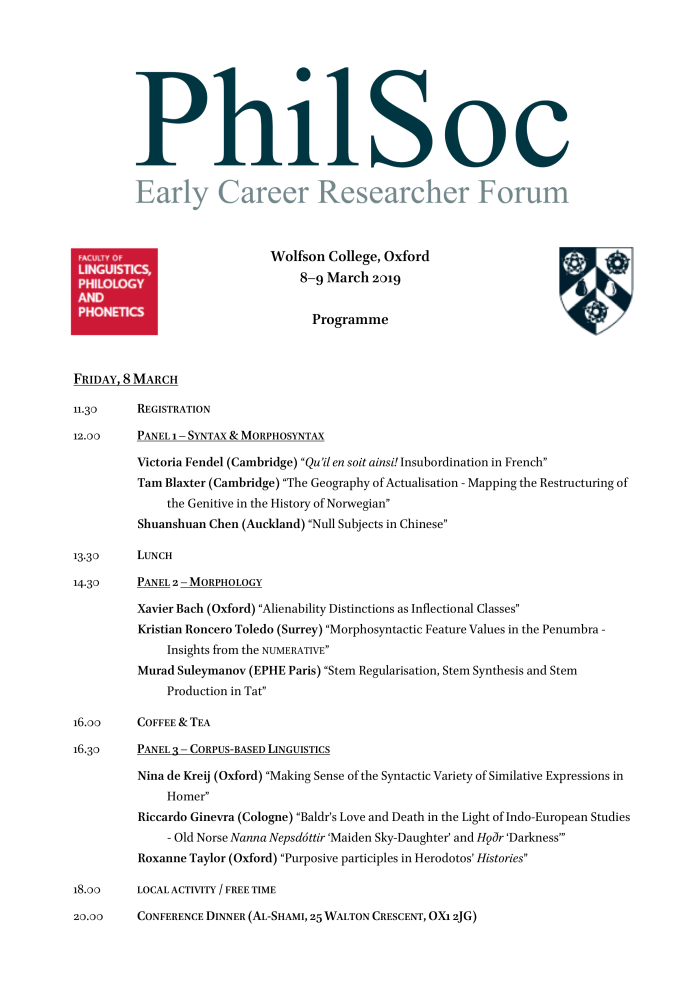
PhilSoc is pleased to announce the programme for this year’s Early Career Researcher Forum, to be held on 8–9 March 2019. Twenty Early Career Researchers (late-stage doctoral students and post-docs) will present their research in 20-minute talks or posters.
The programme of the Forum is available here as pdf. Abstracts of all talks, brief academic biographies of the presenters, and a registration form can be found here.
by Larry Hyman (University of California, Berkeley)
In this talk my starting point is to frame the different functions of vowel length (lexical, morphological, syntactic, pragmatic) in terms of how they compare with other phonological properties, in particular tone, which has been claimed to be able to do things that “nobody” else can do (Hyman 2011). Rather than providing a cross-linguistic typology, I focus on the different functions of vowel length in Bantu—as well as how these functions have changed. Although Proto-Bantu had a vowel length contrast on roots which survives in many daughter languages today, many other Bantu languages have modified the inherited system. In this talk I distinguish between four types of Bantu languages:
Those which maintain the free occurrence of the vowel length contrast inherited from the proto language;
Those which maintain the contrast, but have added restrictions which shorten long vowels in pre-(ante-)penultimate word position and/or on head nouns and verbs that are not final in their XP;
Those which have lost the contrast with or without creating new long vowels (e.g. from the loss of an intervocalic consonant flanked by identical vowels);
Those which have lost the contrast but have added phrase-level penultimate lengthening.
I will propose that the positional restrictions fed into the ultimate loss of the contrast in types (3) and (4), with a concomitant shift from root prominence (at the word level) to penultimate prominence (at the intonational and phrase level). In the course of covering the above typology and historical developments in Bantu, I will show that there are some rather interesting Bantu vowel length systems that may or may not be duplicated elsewhere in the world and that vowel length is probably second only
to tone in what it can do.
This paper was read at the Philological Society meeting at SOAS, University of London, Djam Lecture Theatre (DLT, Main SOAS Building), on Friday, 15 February, 4.15pm.
by Melanie Green (Sussex) & Gabriel Ozón (Sheffield)
Cameroon Pidgin English (CPE) is an expanded pidgin/creole spoken in some form by an estimated 50% of Cameroon’s 22,000,000 population (Simons & Fennig 2017). CPE is spoken primarily in the Anglophone west regions, but also in urban centres throughout Cameroon. As a predominantly spoken language, CPE has no standardised orthography, but enjoys a vigorous oral tradition, not least through its presence in the broadcast media. The language has stigmatised status in the face of French and English, prestige languages of Cameroon, where it also co-exists with an estimated 280 indigenous languages (Simons & Fennig 2017).
We describe the spoken corpus of CPE, a British Academy/Leverhulme-funded pilot study (Green et al. 2016, Ozón et al. 2017). The corpus consists of 30 hours of recordings made in five locations, resulting in a total of 240,000 words (80 texts of 15 minutes/3,000 words). Proportions of text types are guided by the International Corpus of English project (Nelson 1996), and the texts contain mark-up and part-of-speech-tagging. The corpus files, which are freely available from the Oxford Text Archive, include sound files (*.mp3 and *.wav), raw and annotated text files, participant metadata, a field manual, a tagging manual and a spelling list.
We then briefly describe some case studies of linguistic phenomena that the pilot corpus allows us to investigate, focusing on grammatical and lexical phenomena, as well as codeswitching, demonstrating that while a small corpus provides a robust test-bed for the investigation of grammatical phenomena, a larger dataset is required for the full investigation of lexical and sociolinguistic phenomena. Finally, we outline our plans for a 1-million-word corpus, a project for which a funding application is in preparation.
This paper was read at the Philological Society meeting at SOAS, University of London, on Friday, 18 January 2019, 4.15pm. A video recording of the presentation can be found below; the slides are available here.
Nelson, Gerald. 1996. The design of the corpus. In Sidney Greenbaum (ed.). Comparing English worldwide. The International Corpus of English. Oxford: Clarendon Press, 27–35.
Ozón, Gabriel, Miriam Ayafor, Melanie Green and Sarah Fitzgerald. 2017. A spoken corpus of Cameroon Pidgin English. World Englishes 36: 427–447.
Simons, Gary F. and Charles D. Fennig (eds.). 2018. Ethnologue: Languages of the World, Twenty-first edition. Dallas, Texas: SIL International.
On 16 November, a panel of three Early Career Researchers will convene to present their research on language change in its socio-historical context; the presentations will be followed by a round table discussion chaired by Ranjan Sen (Sheffield). The speakers are: Christien Wallis, Claire Childs, and George Bailey; abstracts of their talks can be found below.
The presentations and round table discussion will take place at the University of Sheffield, Humanities Research Institute, 4.15pm.
Traditional accounts of Old English (‘OE’) (Campbell, 1959; Hogg, 1992) often focus on early or otherwise dialectally marked manuscript texts for evidence of the history of the language. Such manuscripts are chosen as the basis of this evidence because they are closest to the original author’s or translator’s work, and are felt to reflect ‘real’ OE in a way that later copies do not (Miller, 1890: v-vi). Where more than one manuscript of a text exists, those which diverge most from the most conservative versions are rarely discussed in detail in general histories.
This paper presents an alternative way of viewing the development of OE, through the more sociolinguistically-orientated lens of scribal copying. A text with several surviving manuscript witnesses allows us to see what linguistic forms were deemed acceptable to individual language users/writers (i.e. features which were copied literatim), and which were not (i.e. those emended or updated by later copyists) (cf. Laing, 2004).
The OE translation of Bede’s Historia ecclesiastica is one such text, surviving in four main copies, whose scribes diverge to varying degrees from the Mercian dialectal character of the translator’s (now lost) original text. The paper focuses on one case study, that of plural, preterite subjunctives, which in the earliest manuscripts commonly appear with denasalisation (e.g. hie wolde instead of hie wolden ‘they wanted’). A range of strategies is used by the scribes studied and this talk will show examples of the different responses of the Bede scribes to this feature when they copied the text.
This paper shows how evidence not normally considered in larger histories of the language can usefully be brought to bear on ideas of standardisation in the pre-Conquest period. In the absence of direct metalinguistic comment, the actions and decisions of copyists and correctors have much to tell us about attitudes to correctness and linguistic norms in the period.
The present-day interaction of longitudinal changes: Stative possession and negation
This talk will focus on the modern-day variation between stative possessive HAVE and HAVE GOT in negative contexts, which is the result of two intersecting historical changes. Firstly, DO-support as a means of expressing negation arose in English around the 15th century, but not immediately in stative possessive contexts (Warner 2005). Secondly, stative HAVE GOT came to be used as an alternative to HAVE in around the 16th century (Lorenz 2016: 489). It was not until the 19th century that DO-support became possible with stative HAVE (Hundt 2015: 70). Contemporary studies of British English have indicated that HAVE GOT is becoming increasingly used for the expression of stative possession in affirmative contexts (Tagliamonte 2003), but DO-support is also thought to be rising (Trudgill et al. 2002: 6). With these two tendencies seemingly pulling in different directions – since HAVE GOT is incompatible with DO-support (*I don’t have got any money) – how does this manifest itself in present-day British English?
To answer this question, I will present initial findings from a quantitative variationist analysis of HAVE (GOT) in negative contexts in British English, based on a 2.5-million-word sample of conversational speech from the British National Corpus 2014 (Love et al. 2017). The results reveal that while HAVEN’T GOT was the favoured way of negating a stative among speakers aged 60+, this decreases in apparent-time to the extent that DON’T HAVE becomes the majority form among younger speakers. Although British English is thought to be more variable in terms of the syntactic status of HAVE – i.e. it can behave like an auxiliary or a lexical verb – HAVE is actually rarely contracted and thus has the syntactic properties of a lexical verb, just as in Canadian English (D’Arcy 2015). My findings allow two independent observations of subject-type constraints on contraction (McElhinny 1993) and stative possession variation (Tagliamonte et al. 2010) from the literature to be reconciled. More broadly, my analysis shows how insights gained from separate analyses of single linguistic variables can be explained as part of a larger system within the grammar.
When sound change isn’t led by social change: The case of Northern English (ng)
Incorporating sociolinguistic evaluation into explanatory models of language variation and change has become increasingly popular in recent years (e.g. Eckert 2000; Zhang 2005; Podesva et al. 2015), dating back to Labov’s (1963) influential study of Martha’s Vineyard. However, not all objects of linguistic variation can accrue social meaning (Eckert & Labov 2017), and there remain a number of apparent limitations relating to its role in the incrementation and propagation of sound change (Bermúdez-Oteroforthcoming). This paper bears directly on this debate by reporting on a recent change in Northern English /ŋɡ/ clusters, which sees increasing post-nasal [ɡ]-presence in words likewrongandhangwhen in pre-pausal position (Bailey 2018). Post-nasal /ɡ/-deletion progressed along a systematic pathway of change throughout the Modern English period, following an ordered set of stages laid out by the life cycle of phonological processes (Bermúdez-Otero & Trousdale 2012). However, this new pre-pausal behaviour does not represent the next natural stage along the same pathway of change laid out by the life cycle, but is rather an entirely separate and unpredicted innovation. As such, it is amenable to an analysis in which external factors – such as sociolinguistic evaluation – play a central role.
Independent evidence from a matched-guise task reveals another source of apparent time change: the indexical strength of [ŋɡ] as a feature of northern dialects is increasing over time. However, this does not translate to uniform evaluation, with no evidence of a shared evaluative norm among these subjects. Furthermore, despite the change in production being restricted to pre-pausal contexts, this change in the social meaning of (ng) is not concentrated on any particular environment, suggesting that the two are operating at different levels of granularity and that there is no causal link between them. Consequently, these results cast further doubt on the extent to which social meaning is involved in producing macroscopic patterns of sound change.