written by Khouloud Benassar (Hassan II University of Casablanca, khouloud.benassar-etu@etu.univh2c.ma), recipient of a travel and fieldwork bursary from the Philological Society
With support from the Philological Society’s Travel Bursary, I attended the 52nd Colloquium on African Languages and Linguistics (CALL 2023), which took place at Leiden University, Netherlands, from 28th–30th August 2023. The colloquium had sixty-three presentations, studied various African Languages, and covered broad topics in linguistics, including phonetics, phonology, morphology, syntax, and semantics.
As part of the Wednesday morning session of the colloquium, I gave a 20-minute presentation entitled ‘Sensory Metaphors in Moroccan Arabic: A Cognitive Approach’, followed by 10 minutes of discussion. In this presentation, I investigated how our senses—vision, hearing, touch, smell, and taste—give rise to abstract concepts in Moroccan Arabic, leading to what is called sensory or perception metaphors, such as KNOWING IS SEEING, which have previously been studied by cognitive linguists such as George Lakoff and Mark Johnson (1980, 1999), Eve E. Sweetser (1990) and Christopher Johnson (1999).
The presentation also discussed whether sensory metaphors are universal, since they are based on our biological propensities, or if there is a place for cross-linguistic and cross-cultural variation and diversity. Based on data analysis, I argued that Moroccan Arabic shares many sensory metaphors with other languages, supporting the universality hypothesis. However, a comparison of sensory metaphors in Moroccan Arabic with those in other languages, as studied by various scholars, reveals significant variation. Therefore, it is important to consider both cognitive and cultural dimensions when studying sensory metaphors.
My participation in the colloquium enabled me to get valuable feedback on my research from various researchers in the field including Professor Maarten Mous and Professor Maarten Kossmann. Other researchers additionally mentioned that some metaphors discussed in Moroccan Arabic are also used in other languages; for example, the OBEYING IS HEARING metaphor is also used in German.
I am grateful to the Philological Society for supporting my PhD research with a travel bursary to participate in person in the 52nd Colloquium on African Languages and Linguistics. This opportunity has allowed me to meet and be inspired by a community of linguists from outside my home country.
Johnson, Christopher. 1999. ‘Metaphor vs. conflation in the acquisition of polysemy: the case of see’. In Cultural, Psychological and Typological Issues in Cognitive Linguistics, edited by Masako K. Hiraga, Chris Sinha, and Sherman Wilcox. Vol. 152. Current Issues in Linguistic Theory, IV. Amsterdam: John Benjamins Publishing Company.
Lakoff, George, and Mark Johnson. 1980. Metaphors We Live By. Chicago: The University of Chicago Press.
Lakoff, George, and Mark Johnson. 1999. Philosophy in the Flesh: The Embodied Mind and Its Challenge to Western Thought. New York: Basic Books.
Sweetser, Eve E. 1990. From Etymology to Pragmatics: Metaphorical and Cultural Aspects of Semantic Structure. Cambridge: Cambridge University Press.
An event supported by PhilSoc: 17th November 2023, Weston Library, Oxford, 3-6 p.m.
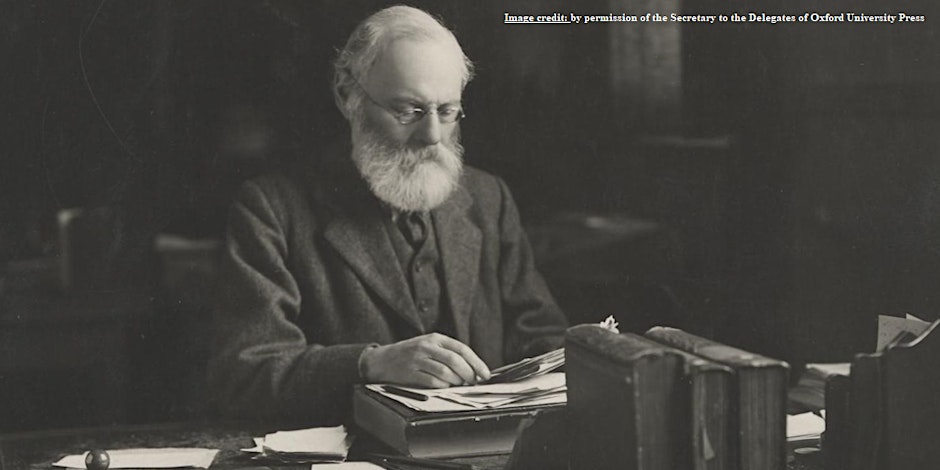
It has been Henry Bradley’s fate to be remembered as ‘only’ the second Editor of the Oxford English Dictionary, always overshadowed by James Murray. This event aims both to celebrate and recontextualize his achievements – not just as a lexicographer, but as a writer, historian, and scholar in a variety of contexts. When he died in 1923, his former OED assistant J. R. R. Tolkien paid tribute to him, in Old English, as a sméaþoncol mon (a ‘man of subtle thought’). One hundred years after his death we offer a long-overdue reappraisal of his life and scholarship in a series of papers.
written by Frances Dowle (University of Oxford), recipient of a travel and fieldwork bursary from the Philological Society
With the generous support of the Philological Society’s Travel Bursary, I was able to attend the 28th International Lexical-Functional Grammar (LFG) Conference, which took place this year at the University of Rochester, NY from 21st to 24th July this year.
The funding from the Philological Society allowed me to travel in person to present my poster on complementizer-verb interactions in Welsh.
Presenting my poster at the 28th International LFG Conference
My poster sought to provide an explanation for why the modern day main clause complementizers /mi/ and /vɛ/ cannot occur with certain forms of the verb ‘be’ in Welsh (Borsley et al., 2007: 35). I argued that the behaviour of the forms in question could be explained with reference to their diachronic development (Jones, unpublished). In south Welsh dialects, the forms excluded from occurring with a main clause complementizer have clearly developed as a result of the phonological erosion of the old affirmative complementizer /ə(r)/. The erosion leads to the complementizer surviving only as the onset consonant of the vowel-initial finite ‘be’ verb forms:
A similar process of erosion took place with the negative complementizer:
(2) nɪd + ɔɪð > dɔɪð
C.NEG + be.IMPERFECT.3SG > NEG.be.IMPERFECT.3SG
These phonological changes resulted in the development of specialised forms of the verb ‘be’: the affirmative ‘r-be’ forms and the negative ‘d-be’ forms. The old, vowel-initial forms of ‘be’ were retained only after other types of complementizer, such as os ‘if’. When new affirmative complementizers emerged in Welsh, speakers did not begin to use these complementizers with the ‘r-be’ form, even though the origin of these forms is opaque to modern speakers of the language. I argued that because forms like /rɔɪð/ occupy the same position in a clause as sequences of overt complementizers like os ‘if’ and a vowel-initial verb form, speakers can acquire the knowledge that forms like /rɔɪð/ function as both complementizer and verb. In other words, the ‘r-be’ forms like /rɔɪð/ are assigned two categories in the c-structure (tree structure in LFG): both C (complementizer) and I (inflected verb). In LFG, this dual category status of a single word can be modelled using Lexical Sharing (Wescoat 2002). Familiar principles of category assignment and complementary distribution then explain why this ‘r-be’ form cannot co-occur with either a complementizer or a finite verb (since words of the same category generally cannot cooccur outside of coordination structures). Further details can be found on the 28th International LFG Conference website (https://sas.rochester.edu/cls/lfg23/program/), where a .pdf version of my poster is available.
As well as having the opportunity to present my work, I also gained a lot from being able hear about others’ work, and from the many follow-up conversations that resulted from the huge range of interesting talks. I was particularly interested to hear about Elaine Ui Dhonnchadha’s work on implementing a computational grammar of Irish in XLE (a computational implementation of LFG). I was particularly interested to hear her proposals for modelling mutations in Irish, as this is an aspect of computational grammar development that presents unique challenges, and is also pertinent to Welsh. I left her talk feeling inspired and I hope to start exploring this aspect of LFG work more in the future. There was also a special session at the conference on the theme of lexical integrity, which is particularly relevant to my doctoral research and the poster that I presented, since Lexical Sharing is one of several recent challenges to the idea of lexical integrity that has surfaced within LFG.
I am very grateful to the ever welcoming and supportive LFG community for sharing their time, energy and expertise with me across this fantastic week. I had so many wonderful discussions, ranging from detailed theoretical topics to general advice on career development. This is truly a very special academic community.
Some of the in-person attendees of the 28th International LFG conference. I am second from the left. Photo by Dan Siddiqi.
I am incredibly grateful to the Philological Society for their generous travel bursary, without which I would not have been able to attend this wonderful conference.
References
Borsley, R., Tallerman, M. & Willis, D. (2007) The Syntax of Welsh. Cambridge: Cambridge University Press.
written by Vasiliki Vita (SOAS University of London), recipient of a travel and fieldwork bursary from the Philological Society
1. Introduction
As a Micronesianist, I was not sure how my contribution at a conference about African Linguistics would be significant. However, when I was invited to work with Tom Jelpke and John Kyamanywa in Uganda, I thought this would be an excellent opportunity to share knowledge and learn more about Uganda and its languages. Thanks to a Philological Society bursary, I managed to travel to Uganda for 10 days in order not only to fulfill the goals of a British Institute in Eastern Africa Thematic Research Grant, but also attend the Languages Association of Eastern Africa 3rd Conference on “Empowering Communities through Language Research and African Linguistics for Sustainable Development”. In the title, I use wayfinding as defined by Iosefo, Harris & Holman Jones (2020: 23), “an embodied, practical, adaptive and relationally driven practice, … [that] calls on researchers to immerse themselves in journeys of discovery and transformation that value [Indigenous] cultural knowledges and acknowledge [their] blind spots”. In the case of this journey, the war[1]was not our piko[2]. It was the Boda Bodas, local motorcycle taxis, that carried us through this journey. I am also using the plural “we” because I will be talking about this journey as one that “cannot be viewed as belonging to any one person, and wayfinding is never done on one’s own” (Iosefo, Harris & Holman Jones 2020: 21).
2. LiVanuma and stories
LiVanuma is a language spoken in Bundibugyo, Western Uganda, near the border with the Democratic Republic of Congo. According to CCFU (2015), the BaVanuma ethnic group is estimated to have fewer than 25,000 people in Uganda, many of whom do not speak the language (Kyamanywa & Jelpke forthcoming). Building on their research, Kyamanywa and I embarked on a journey to document family histories, experiences, and languages. The aim is to compile a biographical (hi)storybook to tell the stories of BaVanuma people in Uganda in their own language (Jelpke, Kyamanywa & Vita 2023).
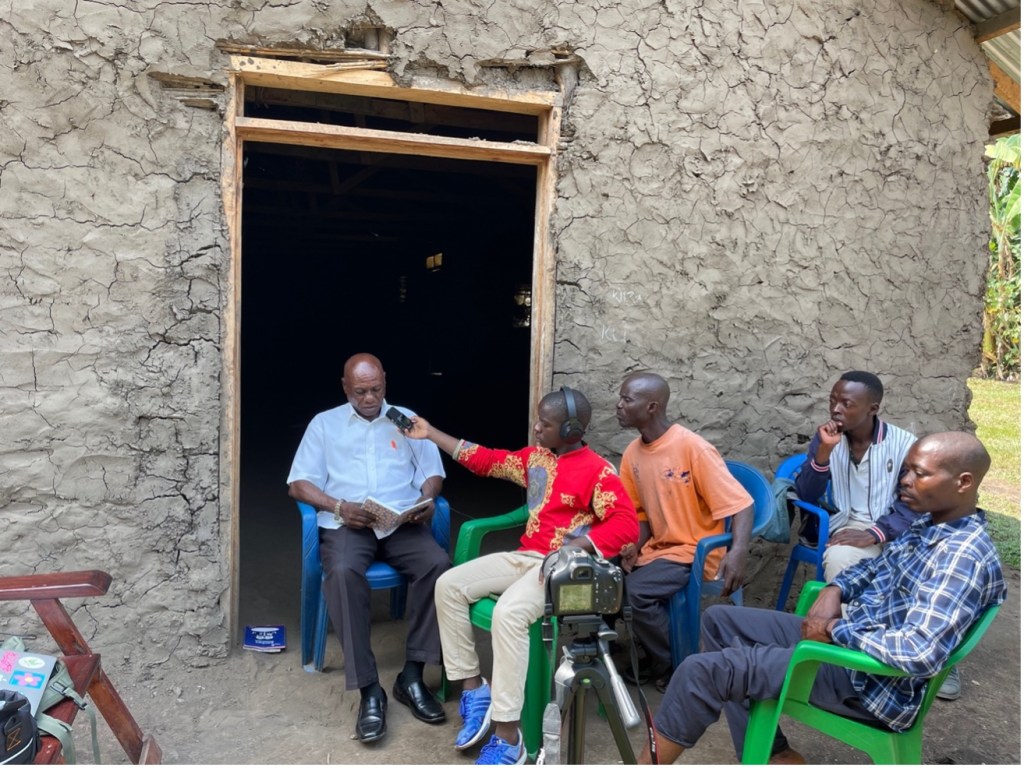
Figure 1. Making the first recording in Burondo 2 (from left to right: Bamuroho Masagazi, John Kyamanywa, Mustafa Katikiro, Michael Akiiza, Robert Musinguzi).
3. Wayfinding in Bundibugyo
To document these stories, we flexibly travelled on Boda Bodas from village to village to reach BaVanuma people who were willing to share their story (see Figure 1 for example). We must recognize the contribution of local coordinators for reaching out to various speakers and getting us in touch with them. Later, attending the conference, Wizlack-Makarevich (2023) referred to this kind of language documentation as the “helicopter method”, of going from place to place, gathering data, and relying on local intermediaries to help make the connections.
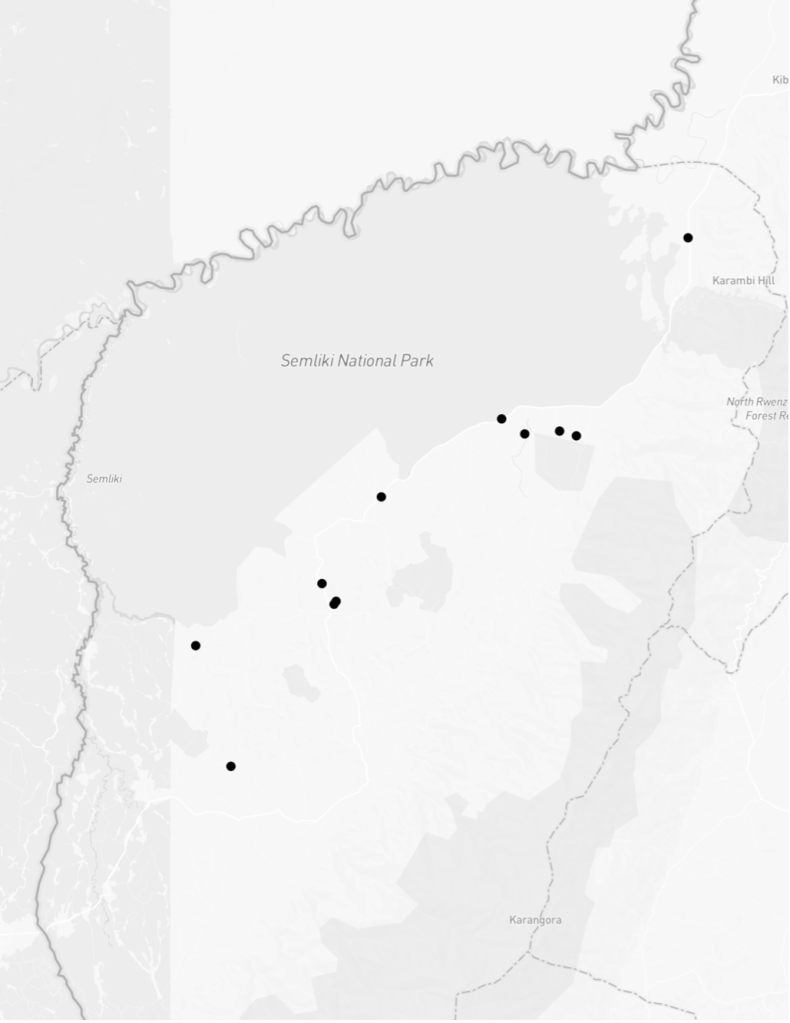
The piko here might physically be a different one, but it is still a war that allowed us “to stay in continual communication with the world around” us (Rogers 2020: 153), and “to move from stillness, bringing the island to [us] through ‘be-coming’” (Spiller 2016: 31). Like Pacific wayfinders we used our war as “the geographical centre of navigational orientation” (Eckstein & Schwarz 2019: 30) and removed “the lines on the map that segregate and compartmentalize” (Iosefo, Harris & Holman Jones 2020: 21) our world (see Figure 2 for a map of our journey with the black dots symbolizing the villages we visited).
The documentation process included making audio and video recordings of speakers narrating family stories, talking about their relatives, experiences living in Uganda and what the LiVanuma language means to them in terms of personal and community identity, as well as wellbeing. After narrating their story, speakers were encouraged to listen to their story and write it down (Figure 3). Participants in Kyamanywa and Jelpke (forthcoming)’s project had expressed an interest in writing the language.
Figure 3. Bamuroho Masagazi writing his family story (from left to right: Bamuroho Masagazi, John Kyamanywa, Mustafa Katikiro, Michael Akiiza, Robert Musinguzi).
4. Kampala and LAEA 3
The journey back to Kampala was a tiring one with us taking a different war this time and 10 hours to reach our destination. John and I talked about the mountains in the Bundibugyo District and reminisced about our journey through them. As Conquergood (2002: 146), Iosefo, Harris & Holman Jones (2020: 23) put it, our wayfinding was not just “moving and inhabiting”, but “a relational practice with the earth and sky”, “anchored in practice and circulated within a performance community”. After getting enough rest, we prepared for a full two days of conference talks learning about the work of colleagues in Africa.
In the first plenary talk, Nyaga (2023) focused on promoting mother tongue education and encouraged everyone to speak African languages at home. Kyamanywa and Jelpke’s talk then started, where they presented the preliminary results on documenting the LiVanuma sociolinguistic landscape. It was interesting to see people’s reactions in the audience, with many Ugandan researchers noting that they had never heard of the BaVanuma people and their language before. As wayfinders, we share stories in true embedded and embodied fashion through relationship and collective engagement with multiple ways of knowing (Gounder 2015).
What I found most interesting, was the plenary on the second day by Alena Witzlac-Makarevich. Wizlack-Makarevich (2023) encouraged for the multi-modal documentation of African languages, which comparatively to other places around the world is lagging (Lüpke 2019). She talked about the importance of data governance and recognizing the value of corpora in language maintenance and promotion, especially for endangered languages.
My talk was also on the second day. Listening to other researchers, I realized once again, that boundaries are fluid, and knowledge is to be shared regardless of where it was acquired. “Hyper-collaboration” in the sense used in Di Carlo et al. (2022) and Vita, Nestor & Marino (2023) focuses on the value of the network that can be activated at any time for activities that benefit the group most impacted. Language-related initiatives and activities presented at the conference also showcase the fact that they all start with documenting and reaching out to tradition but are borderless and rooted in the desire for belonging (see for example Okurut, Kiguli & Tibasiima (2023) discussing the music of an expatriate Ugandan artist).
5. Conclusion
Our wayfinding in Uganda was not limited by borders and lines on the map. It was active, intimate, hands-on, and participatory, like the ‘traditional’ knowledges of Pasifika people (Iosefo, Harris & Holman Jones 2020). Attending the 3rd Conference of the Languages Association of Eastern Africa was an invaluable experience not only for sharing our work, whether that is with John and Tom, the Young Historians of Sonsorol or the virALLanguages initiative, but also discovering the work of African colleagues and further work on the documentation and maintenance of linguistic diversity. My wayfinding continues and I am thankful for all the individuals who consider me worthy to invite to the journey.
Endnotes
[1] Sonsorolese word for “canoe” which is nowadays used to describe any means of transport, including airplane and car
Di Carlo, Pierpaolo, Leonore Lukschy, Sydney Rey & Vasiliki Vita. 2022. Documentary linguists and risk communication: views from the virALLanguages project experience. Linguistics Vanguard. De Gruyter Mouton. https://doi.org/10.1515/lingvan-2021-0021.
Eckstein, Lars & Anja Schwarz. 2019. The Making of Tupaia’s Map: A Story of the Extent and Mastery of Polynesian Navigation, Competing Systems of Wayfinding on James Cook’s Endeavour , and the Invention of an Ingenious Cartographic System. The Journal of Pacific History 54(1). 1–95. https://doi.org/10.1080/00223344.2018.1512369.
Gounder, Farzana (ed.). 2015. Narrative and Identity Construction in the Pacific Islands (Studies in Narrative). Vol. 21. Amsterdam: John Benjamins Publishing Company. https://doi.org/10.1075/sin.21.
Iosefo, Fetaui, Anne Harris & Stacy Holman Jones. 2020. Wayfinding as Pasifika, indigenous and critical autoethnographic knowledge. In Wayfinding and Critical Autoethnography. Routledge.
Jelpke, Tom, John Kyamanywa & Vasiliki Vita. 2023. Cultural-linguistic priorities of a minority community: folk history, language documentation, and orthography development with the BaVanuma people of Bundibugyo, Western Uganda. British Institute of Eastern Africa Annual Thematic Research Grants 2023-2024.
Kyamanywa, John & Tom Jelpke. forthcoming. LiVanuma linguistic vitality: A sociolinguistic documentary project.
Lüpke, Friederike. 2019. Language Endangerment and Language Documentation in Africa. In H. Ekkehard Wolff (ed.), The Cambridge Handbook of African Linguistics, 468–490. 1st edn. Cambridge University Press. https://doi.org/10.1017/9781108283991.015.
Nyaga, Susan. 2023. Comparative issues in mother tongue advocacy in Africa: can negative attitudes towards African languages be changed? In The Third Conference of the Language Association of Eastern Africa. Kampala, Uganda.
Okurut, Lazarus, Susan Kiguli & Isaac Tibasiima. 2023. Place and Belonging in the songs of Madoxx Ssemanda Ssematimba. In The Third Conference of the Language Association of Eastern Africa. Kampala, Uganda.
Rogers, Christine. 2020. Almost always clouds: Stitching a map of belonging. In Wayfinding and Critical Autoethnography. Routledge.
Vita, Vasiliki, Daphne Nestor & Lincy Marino. 2023. Experiences from documenting Ramari Dongosaro in a multilingual context. In. Online.
Wizlack-Makarevich, Alena. 2023. Creating and utilizing corpora for language description and development: lessons learned from three projects across the African continent. In The Third Conference of the Language Association of Eastern Africa. Kampala, Uganda.
PhilSoc meeting of Saturday 18th March at Murray Edwards College, Cambridge
The recording of PhilSoc’s recent meeting is now available to view on the society’s YouTube channel. The lecture was held in the Buckingham House Lecture Theatre, Murray Edwards College, and the speaker was Professor Kasia M. Jaszczolt (University of Cambridge):
There is no doubt that cross-linguistic investigations into temporal reference inform psychologists about the properties of the human concept of time. But it is not common to go further: from linguistic externalisations of the human concept of time to the properties of ‘real’ time as it is discussed in philosophy of physics. In this talk I combine what I call ‘linguistic time’ (timeL), ‘epistemological time’ (timeE) and ‘metaphysical time’ (timeM) to show that an insight into semantic properties of markers of temporality in various, tensed and tenseless, natural languages helps explain the apparent conflict between the dynamic, flowing timeE and static timeM – ‘real’ time that does not flow but instead consists of relations of static precedence and succession (on the so-called ‘B theory’, McTaggart 1908). I present some arguments for the modal foundations of the human concept of time (time as supervenient on epistemic modality, Jaszczolt, e.g. 2009, 2020, in press) and conclude that on the level of universal semantic (modal) building blocks, timeE is essentially static – it only flows on the level of their language- and culture-specific combinations that produce complex temporal concepts. I conclude by presenting formal representations of temporal reference, using the contextualist theory of Default Semantics.
Select references:
Jaszczolt, K. M. 2009. Representing Time: An Essay on Temporality as Modality. Oxford: Oxford University Press.
Jaszczolt, K. M. 2020. Human imprints of real time: From semantics to metaphysics. Philosophia 48: 1855–1879.
Jaszczolt, K. M. In press. ‘Does human time really flow? Metaindexicality, metarepresentation, and basic concepts’. In: K. M. Jaszczolt (ed.), UnderstandingHuman Time. For Oxford Studies of Time in Language and Thought. Oxford: Oxford University Press.
McTaggart, J. McT. E. 1908. The unreality of time. Mind 17. Reprinted in J. McT. E. McTaggart. 1943. Philosophical Studies. London: Edward Arnold. 110–131.
Virtual meeting of 2nd December 2022, hosted by the University of Edinburgh
The recording of PhilSoc’s most recent meeting is now available to view on the society’s YouTube channel:
This meeting took the form of an early career researcher panel, chaired by Ricardo Napoleão de Souza (University of Edinburgh), and addressed the following question: ‘Is the study of change in languages with little or no historical record fundamentally different from similar work on languages with a lengthy written tradition?’
To this day, there remains a close association between historical linguistics and Indo-European, in part due to the wealth of written sources which scholars can use in historical research on the family. For some, this goes as far as an assumption—often implicit—that historical work based primarily on spoken data is less reliable, accurate, or viable than that based on written sources. These attitudes persist, despite the venerable and successful tradition of historical work on languages without a written record—some of which in fact predates Sir William Jones’s famous ‘common source’ discourse in 1786, heralded as the beginning of Indo-European studies.
In response to this, three early career researchers shared their experiences of using primary spoken data collected in the field to investigate language change, bringing their research perspectives to bear on methodological, conceptual and experiential issues in historical work with unwritten languages.
Speakers: Ryan Gehrmann (Payap University): ‘Tonogenesis in Mainland Southeast Asia: Reconciling the historical evidence and the comparative evidence’ Tatiana Reid (University of Edinburgh): ‘Untangling the origins of floating suprasegmental component in Nuer’ Laura Arnold (University of Edinburgh): ‘From areal linguistics to historical sociolinguistics: Identifying contact events in northwest New Guinea’
written by Alessandra Serpone (independent scholar)
With support from the Philological Society’s Martin Burr Fund, I was able to attend the 34th Deutsche Orientalistentag (DOT) which took place 12–17th September 2022 at the Freie Universität Berlin. It is the representative conference of German Oriental Studies and is held once every three to five years. This year it was attended by about 1,200 participants from more than 60 countries. All the represented disciplines (e.g. Egyptology, Ancient Oriental Studies, Semitic Studies and Philology, Hebrew Studies, Arabic Studies and Philology, and African Studies) were grouped into 24 sections, and there were presentations by scholars at all phases of their careers.
Attendance at this meeting represented a great opportunity to me, as an early career scholar, to present and discuss my current research with an audience of specialists outside my usual academic network. In addition, I had the opportunity to be inspired by interesting talks closely related to my historical and diachronic interests. As I am mainly focused on ancient Semitic languages, I also found it very stimulating to be exposed to diverse aspects of modern Semitic languages research, such as that on Neo-Aramaic and Modern South Arabian.
I presented a paper titled Diachronic Considerations on the Personal Marker y– in the Semitic Prefix Conjugation on the first day, as part of the Semitistics Section. As it represents a preliminary overview of my ongoing research, it was highly beneficial for me to receive feedback from the specialized audience, which belonged to both the Semitic and the Afro-Asiatic areas. I found it very helpful to receive comparative remarks and suggestions about how my current work could further develop.
In my talk, I addressed the third-person marker y- of the Semitic prefix conjugation diachronically. Unlike the first and second person markers, it does not bear any resemblance to the independent personal pronouns. Therefore, it does not lend itself to an easy etymological explanation. To determine its origins, I offered some preliminary comparative notes where the theme /y-/ is attested outside the verbal paradigm, as in the demonstrative and relational marker in South Ethiopic, and the interrogative theme in Phoenician, Hebrew, and Ugaritic. What I find rather critical in historical terms are a group of nominal forms (e.g. personal and place names) starting with y-. Although they are traditionally interpreted as ‘transpositions métonymiques de formes verbales’ (Cohen 1970: 34; see also von Soden 1966: 182), e.g. Yi-ṣḥaq = ‘he laughs’, I claim that comparative and historical facts may suggest a different interpretation. I argue that the theme /y-/ goes back to an ancient ‘determinative-relative’ pronoun before a grammaticalization process made it acquire its inflectional status (cf. Pellat 1957: 186; Garbini 1984: 84–88; Garbini & Durand 1994: 109–110), e.g. Yi-ṣḥaq ‘the one who laughs’.
The Martin Burr Fund provided conference support which helped with the cost of travel and accommodation in Berlin. I am thankful to the Philological Society for the opportunity to refine my current research, along with the methodologies applied, and to strengthen my academic network.
References
Cohen, D. 1970. Études de linguistique sémitique et arabe. The Hague: Mouton.
Garbini, G. 1984. Le lingue semitiche. Studi di storia linguistica. Napoli: Istituto Universitario Orientale.
Garbini, G. & Durand, O. 1994. Introduzione alle lingue semitiche. Brescia: Paideia.
Pellat, C. 1957. Review of L’Arabe classique. Esquisse d’une structure linguistique, by H. Fleisch. Arabica 4(2).183–188.
Soden, W. von. 1966. Jahwe ‘Er ist, Er erweist sich’. Die Welt Des Orients 3(3).177–187.
written by Professor Aditi Lahiri & Professor Martin Maiden (University of Oxford)
Every two years The International Conference for Historical Linguistics (ICHL) brings together historical linguists and specialists in related fields to explore advances in areas such as methods and practices of linguistic reconstruction, formal approaches to language change, historical sociolinguistics, computational approaches to historical linguistics, contact and areal linguistics, interfaces between historical linguistics and other disciplines, and many other related areas. ICHL25 was held at the University of Oxford (1–5 August 2022) and involved 421 participants whose oral presentations and posters covered all these areas. Reports we received from participants suggested that the conference was a great success.
The Philological Society sponsored a reception on the final day, which was attended by 383 participants, and also provided Martin Burr Fund support for a student based in the US to present a paper (see James Tandy’s report: https://blogphilsoc.wordpress.com/2022/08/18/25th-international-conference-on-historical-linguistics-ichl25-oxford/). At the final session of the conference, Professor Aditi Lahiri and Professor Martin Maiden thanked the Society for their contribution. Professor Maiden introduced Professor Lutz Marten, the editor of the Transactions of the Philological Society (TPhS), who then presented a comprehensive account of the society’s goals, encouraging participants to join the society if they were not already members. Professor Marten also discussed the goals of TPhS, pointing out its breadth of coverage and relevance for historical linguistics research. Since there were more than 100 students registered at the conference, Professor Marten also provided information about the Robins Prize, encouraging potential applicants to submit their written work to the competition. Providentially, the winner of the previous Robins Prize, Dr Emily Lindsay-Smith (a leading member of the organising committee), was present and received his congratulations.
written by Sarah Eichhorn (University of Nottingham), Recipient of PhilSoc’s Burr Fund Travel and Fieldwork Bursary for PhD research
Within the field of sociolinguistics, growing attention has been paid to regional and minority languages in recent decades, particularly as communities and governments are becoming increasingly aware of diversity and multilingualism within their societies. France presents a particularly noteworthy context due to its wealth of regional languages that pre-date Standard French—such as Breton, a Brythonic Celtic language—as well as an increasing presence of minority languages like Arabic, which have come to the country more recently via immigration, and are now being passed on to subsequent French-born generations through familial transmission. Despite the linguistic diversity of France, French government language policy heavily favours monolingualism in French, which has historically led to and continues to perpetuate the marginalization of regional and minority languages. However, many regional languages have seen a resurgence in efforts toward revitalization—e.g., through the establishment of immersion schools (Adam 2020), or more militant efforts such as protests and marches. This has led to an increase in visibility and numbers of speakers. Efforts have also been made toward including languages like Arabic as foreign language options in schools (Soriano 2019).
Most research to date focuses on regional OR minority languages, and very little comparative research has been conducted to explore the similarities and differences between the two kinds of language communities (see Filhon 2010). This gap in research has driven the development of my PhD, which seeks to explore a comparative analysis of the Breton-speaking and Arabic-speaking communities in Brittany. The issues I am examining are:
How two different communities of language users define and describe their experiences with regard to language. I use the term ‘language user’ rather than ‘speaker’ in order to encompass all individuals of any kind of proficiency in a given language. Many of the Breton language users interviewed for my research are enrolled in language courses and would thus not yet consider themselves full ‘speakers’ of the language, while many Arabic language users speak what they consider to be a ‘dialect’, and do not consider themselves to know ‘true’ Classical/Standard Arabic;
whether the language communities interact or intersect; and
how they deal with challenges such as French language policy and educational provision.
Through transcribed interview extracts and questionnaires, I am seeking to shed light on how these issues shape the sociolinguistic landscape of France, and Brittany in particular. My two-part research methodology comprises:
An online questionnaire in two versions (one for Breton and one for Arabic), distributed to language users across France. I am currently in the process of collecting and analysing responses.
Semi-structured interviews conducted with language users across Brittany.
With funding from the Philological Society I undertook eleven weeks of fieldwork in Brittany during May to August 2022. I spent one week in Nantes—a diverse city that, although administratively no longer part of Brittany, is historically considered part of the region and is a hub for Breton language revitalization—and 10 weeks in Rennes, the vibrant capital of Brittany and an even greater hub of Breton revitalization and diversity. I also occasionally travelled to cities such as St-Brieuc and Guingamp for interviews. In total, I conducted interviews with 29 Arabic language users and 27 Breton language users, with a generally equal distribution of age groups between 16 and 65+. The majority of Breton language users have learned or studied Breton in school or in adulthood, and only three learned the language at home. The vast majority of Arabic language users have grown up speaking the language, although it must be noted that most individuals speak a particular dialect, such as Moroccan Arabic or darija, while Classical/Standard Arabic is generally learned in school or at cultural/religious associations (see Caubet 2007, 2008).
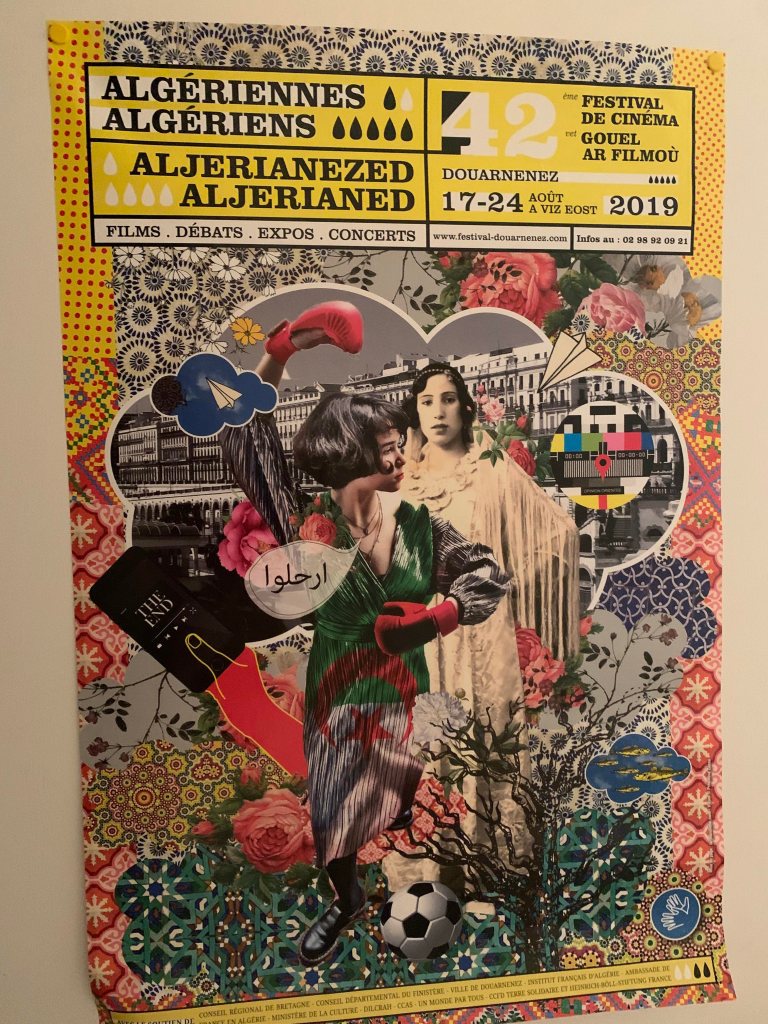
I am currently in the earliest stages of data analysis, however some preliminary themes and comparisons have arisen already, such as a tendency for users of both languages to employ the word richesse ‘richness’ to describe their feelings toward their multilingualism. Also, a particularly surprising overlap occurred when I attended several events at an Algerian cultural association and met and interviewed individuals from the Kabylie region, who compared the situation of the indigenous Kabyle language in Algeria to that of Breton in Brittany, and found solidarity with their Breton neighbours and a mutual desire to support linguistic and cultural diversity in both countries.
Figure 1: An example of a cross-cultural Breton-Algerian cinema festival that took place in 2019
The experience of interviewing such a range of individuals and collecting their fascinating stories was rewarding and exciting, and I look forward to cross-analysing the data alongside the questionnaire results.
References
Adam, C. (2020). Bilinguisme scolaire : Familles, écoles, identités en Bretagne. Berlin: Peter Lang GmbH.
Caubet, D. (2007). L’arabe maghrébin-darja, « langue de France », dans les parlers jeunes et les productions culturelles : un usage banalisé ? In Pratiques linguistiques des jeunes en terrain plurilingue (pp. 25–46). L’Harmattan.
Caubet, D. (2008). Immigrant languages and languages of France. Mapping Linguistic Diversity in Multicultural Contexts, 163–194.
Filhon, A. (2010). Transmission familiale des langues en France : Évolutions historiques et concurrences. Annales de démographie historique, 119 (1), 205–222.
Soriano, É. (2019). L’arabe à l’école : Hiérarchie des mobilités géographiques, inégalités des conditions linguistiques. Recherches En Didactique Des Langues et Des Cultures, 16(2), 1–20.




 The Philological Society Blog