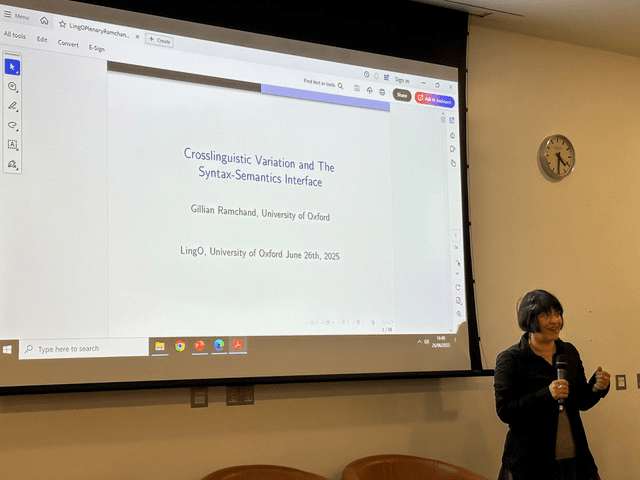
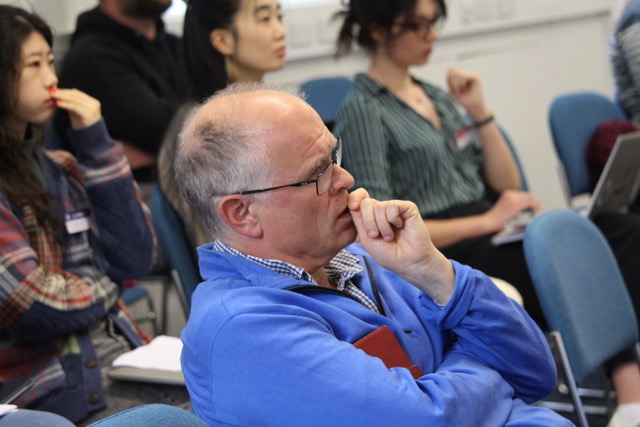
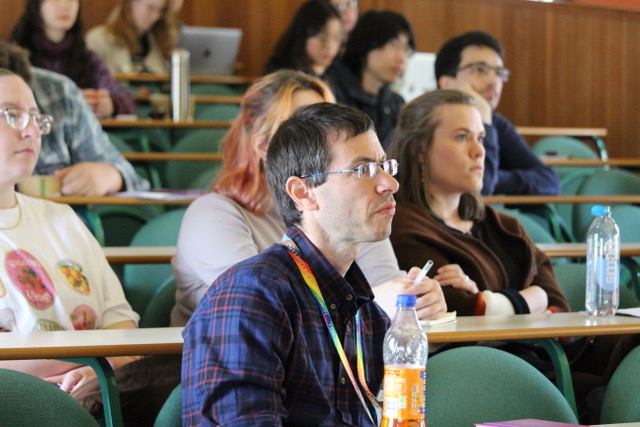
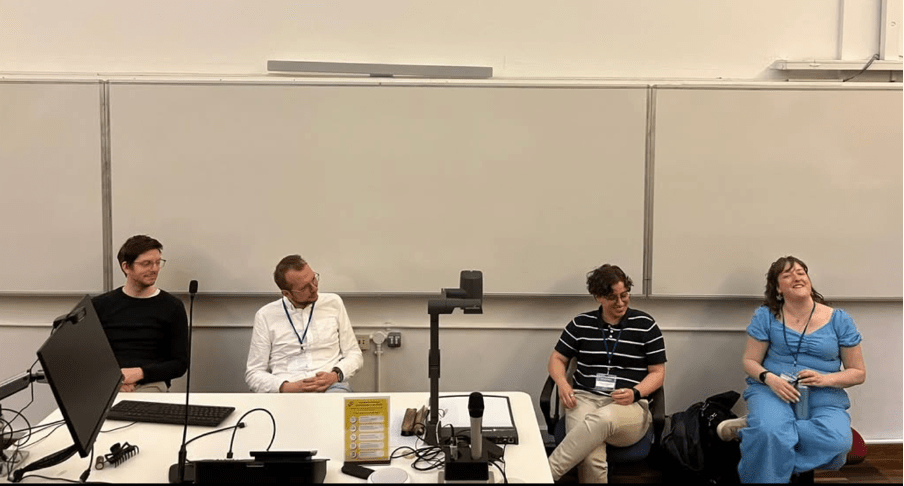
On 25–26 June 2025, we were very delighted to welcome over 50 early-career linguists from across the UK and beyond to Oxford for LingO 2025, the annual Postgraduate Conference in Linguistics is a student-led conference held by Faculty of Linguistics, Philology, and Phonetics, University of Oxford. The two-day event brought together students and researchers to share ideas, showcase ongoing research, and build connections in a very inclusive and friendly environment.
The conference opened with a warm welcome from the committee and our faculty chair, Prof. Colin Phillip. We were very honoured to have Dr. Sebastian Schuster (University College London) and Professor Gillian Ramchand (University of Oxford) as our keynote speakers. Dr. Schuster discussed the question ‘How Well do Large Language Models Encode Context-Sensitive Meaning?’, and Prof. Ramchand talked us through ‘Cross linguistic variation and the Syntax-Semantics Interface’. This year’s programme included 11 talks and 12 posters across various areas of linguistics. We were thrilled by the diversity of topics and research methods, and especially impressed by the enthusiastic engagement shown by all the presenters.
Beyond the academic programme, we organised a library tour of Oxford’s Taylor Institution Library and an informal drinks reception and student meet-up, which gave attendees the chance to explore the city and connect with peers in a relaxed setting.
We are very grateful to The Philological Society for making this event a great success. The support from PhilSoc greatly contributes to keeping the registration fee low, encouraging broader participation and enabling us to create an inclusive platform where students can share their research.
LELPGC25 was held from 4th to 6th June 2025 at the University of Edinburgh. The conference provided a supportive and intellectually rich space for masters and PhD students in linguistics to share their work, develop professionally, and connect with others in the field. The programme featured plenary talks by Nadine Dietrich, Itamar Kastner, Tamar Keren-Portnoy, Dan Lassiter, and Marieke Meelen. These talks addressed a wide range of linguistic topics, from syntax and semantics to phonological development, and linguistic pedagogy.
The conference hosted student talks and posters, with broad range of subfields represented including psycholinguistics, phonology, historical linguistics, and computational linguistics. These sessions allowed students to engage with cutting-edge research and receive valuable feedback from both peers and more experienced scholars. A key aim of the LELPGC is to foster cross-subfield dialogue, and the variety of sessions helped ensure that participants could engage with ideas beyond their own specialisations, contributing to a more integrated and dynamic research environment. The LELPGC, which has been held annually since 1994, continues to serve as a key opportunity for students to present research in a constructive environment and build connections across institutions and research traditions.
In order to provide attendees with a range of development opportunities we hosted four workshops. Kenny Smith’s session on experimental design provided students with an introduction to key skills in experimental linguistics. The other workshops focused on career development with Anne Mucha discussing the ins and outs of postdoc applications, and current LEL PhD students leading panel discussions on making the most of your PhD and in conjunction with Chris Cummins, applying to PhDs.
Thanks to the generous support of the Philological Society, we were able to offer bursaries to five student presenters. The recipients included masters and PhD students from Universities in the UK and mainland Europe. The bursaries helped mitigate travel and accommodation costs. For many students, especially those travelling from outside the UK or lacking institutional funding, the financial support was a decisive factor in their ability to attend. The support made it possible for students to take part in both the academic and social dimensions of the event thus facilitating professional development and the creation of a postgraduate research community in Linguistics.
We are sincerely grateful to the Philological Society for their contribution to LELPGC25. Their support helped to ensure that the conference remained inclusive and accessible, enabling broader participation and supporting the development of the next generation of researchers in linguistics.
The 2025 Edinburgh Theoretical Historical Linguistics (ETHL) Seminar was the first event organised under the ETHL name (although we hope there will be more!). The two day mini-summer school ran on the 16th and 17th of April at the University of Edinburgh and was created by PhD students there. ETHL aimed to promote study at the intersection of Theoretical and Historical linguistics by providing historical linguists an opportunity to develop their understanding of theory in historical work as well as encouraging theoretical linguists to consider the relevance of diachronic development to linguistic theory.
Four masterclasses in various aspects of theoretical historical linguistics were taught by leading theoretical historical linguists: Laura Grestenberger, Patrick Honeybone, Ranjan Sen, and George Walkden. Laura and Ranjan taught specific masterclasses in historical theories, respectively, Distributed Morphology and the Life Cycle of Phonological Processes. While George and Patrick discussed philosophical issues of theoretical historical linguistics addressing the locus of change and what it means to do reconstruction (spoiler: historical reconstruction is not all that different to modelling the synchronic grammar). Finally, Theresa Biberauer’s plenary talk synthesised some of the ideas raised in the masterclasses in addressing the position of generative historical linguistics within 21st century linguistics.
In addition to the taught sessions, students were given the opportunity to present their own research in the innovative ‘snap-talk’ sessions. These 10 minute talk sessions served the same purpose as a poster but tailored to theoretical research which relies more heavily on verbal argumentation.
ETHL was widely attended with around 50 academics from all career stages, from undergraduate to professor! As such ETHL reached its target audience with the sessions being expertly pitched so every audience member could gain something from it – regardless of their linguistic background. ETHL also proved to be an excellent community building event bringing together theoretical and historical linguists in a specialised venue, the first of its kind.
ETHL would not have been possible without the support of the Philological Society for which we are very grateful. Funding from PhilSoc contributed to the expenses of our three (in person) external speakers allowing us to broaden the scope of expertise beyond that at Edinburgh. Furthermore, this support allowed us to keep the registration fee low for our attendees making the event widely accessible.
On the first and second of May we, the committee of the Manchester Forum in Linguistics, had the pleasure of seeing our hard work come to fruition. The Manchester Forum in Linguistics (MFiL) is a yearly two-day conference aimed at PhD students and early career researchers. We are thankful to The Philological Society for providing financial support for this event.
At nine on the first of May our first presenters registered, suddenly it felt real! Our conference had officially started. After our first plenary talk by Dr Alexander Göbel on ‘Intonation and its meanings: Three case studies’, we had our first round of oral presentations. We had three parallel sessions: one on phonetics & phonology, one on semantics and one on forensic & experimental linguistics. Lunch proved a great opportunity for attendees to ask further questions and to discuss these first talks and academic life in general with each other. It was very beneficial to talk with researchers outside our own institution about these things; the international perspective that our global presenters could provide was especially insightful.
In the afternoon we had two more parallel sessions on psycholinguistics and discourse analysis. It was then time for our poster session. We had four wonderful posters on a variety of topics. We finished the first successful day with another plenary talk ‘RP or more? A way forwards for understanding social stratification and English accent variation’ by Dr Caitlin Halfacre. However, the conference fun had not ended quite yet! We were able to continue interesting and thought-provoking conversations over dinner.
The following day we started with a plenary talk ‘Appraisal for intelligence analysis: Exploring the utility of a qualitative methodology in forensic and security contexts’ by Dr Madison Hunter, after which we had our final round of oral presentations. We had two parallel sessions on sociolinguistics and language acquisition. All presenters and attendees could then attend two workshops: ‘Academic Publishing in Linguistics’ which was organised in cooperation with the Languages Editorial Office and delivered by MDPI UK and ‘How to use LaTex in Linguistics Writings’ which was delivered by Eve Suharwardy. These workshops gave practical guidance that will benefit the research that people are undertaking.
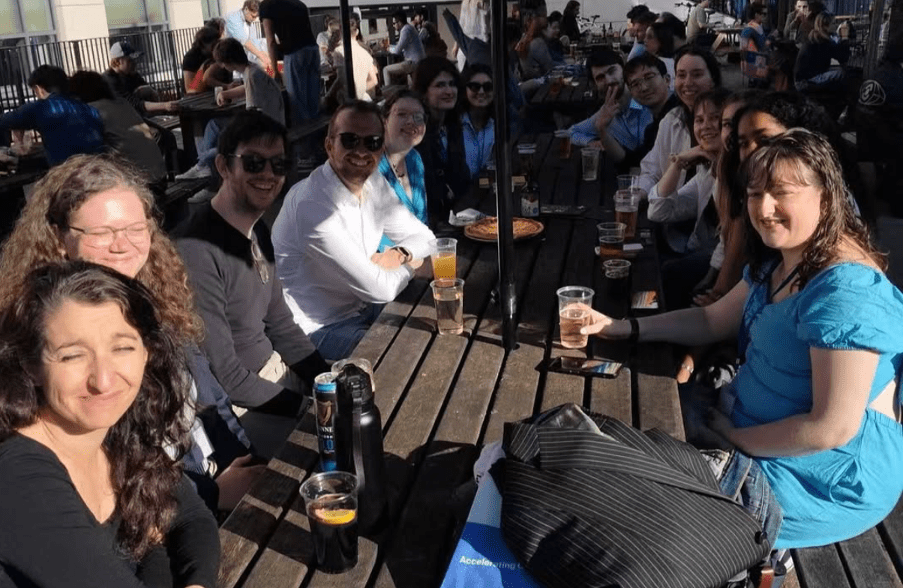
It was then time for our final plenary talk by Dr Mathew Gillings on ‘(Im)politeness variation and corpus linguistics’. We finished the day with a career panel ‘Insights into starting a career in academia’ with our plenary speakers Dr Alexander Göbel, Dr Caitlin Halfacre, Dr Madison Hunter and Dr Mathew Gillings. They gave honest and thoughtful advice, leaving everyone with a better understanding of the current job market. After officially closing the conference, we went over to the pub to unofficially close the conference in the sunshine as well. It was a fitting ending to an amazing two days.
We would like to thank all our presenters and attendees for coming, we had a great time!This conference was funded by the North West Consortium Doctoral Training Partnership, part of the Arts and Humanities Research Council. We would also like to thank our other funders, namely the Linguistics and English Language department and ArtsMethods of the University of Manchester, and of course The Philological Society.
We were able to waive fees for the conference due to the funding that we received
Careers panel with Dr Alexander Göbel, Dr Mathew Gillings, Dr Madison Hunter and Dr Caitlin Halfacre (from left to right)
Written by Xinyu Zhu (Newcastle University), recipient of a travel and fieldwork bursary from the Philological Society.
On March 6th and 7th, 2025, I attended the Mind Your Manner Adverbials! (MiMA!) workshop held at Utrecht University. This workshop marked the culmination of the Mind Your Manner Adverbials! project, providing a platform to share its findings and bringing together both junior and senior researchers to discuss the grammar of manner adverbials. With the generous support of PhilSoc’s Travel and Fieldwork Bursary, I had the opportunity to give an oral presentation on my ongoing PhD research, which is closely related to the topic of manner adverbials. The topic of my presentation is the syntax of reduplicated AABB pattern manner adverbials in Mandarin.
Adverbial phrases (i.e., zhuàngyǔ) in Mandarin, especially adverbs and some adjectives being used as adverbials, are commonly introduced by an adverbial particle de1 and occur at the pre-verbal position between the subject and the predicate, as shown in (1).
(1) a. Zhāngsān jímáng-de pǎo-huí-le jiā
Zhangsan hurriedly-DE1 run-back-ASP home
‘Zhangsan ran back home in a hurry.’
b. Lǐsì kāixīn-de chàng-zhe gē
Lisi happy-DE1 sing-PROG song
‘Lisi is singing happily.’
The adverb jímáng ‘hurriedly’ in (1a) and the adjective kāixīn ‘happy’ in (1b) are followed by the adverbial particle de1(i.e., jímáng–de1 ‘hurriedly’ and kāixīn-de1 ‘happily’). Not only that, but certain adverbials in Mandarin can undergo reduplication. These typically include adverbs, adjectives, and some onomatopoeic expressions. For example, reduplicable adverbials (i.e., the simple form) such as jímáng-de1 ‘hurriedly’, kāixīn-de1 ‘happily’, and huālā-de1‘crashing sound’ can be reduplicated to forms like jíjímángmáng-de1 ‘hurriedly’ kāikāixīnxīn-de1 ‘happily’, and huālālā-de1 ‘crashing sound’ (i.e., the reduplicated form). Typologically, adverbial reduplication has been mainly classified into six patterns based on the reduplication of morphemes in a phrase, namely, AA (e.g., gāng ‘just now’ to gānggāng ‘just now’), ABB (e.g., jímáng ‘hurriedly’ to jímángmáng ‘hurriedly’), AAB (e.g., duànhū ‘definitely’ to duànduànhū‘definitely’), ABA (e.g., yuè ‘more’ to yuèláiyuè ‘more and more’), AABB (e.g., yǒngyuǎn ‘forever’ to yǒngyǒngyuǎnyuǎn ‘forever’), and ABAB (e.g., xiāngdāng ‘quite’ to xiāngdāngxiāngdāng ‘quite’. The reasons and effects of adverbial reduplication have long been a hot topic, with most attributing reduplication to the strengthening of tone and changing of semantics, such as adding and subtracting meanings (Zhang, 2014). Nevertheless, my research mainly focuses on the syntactic implications of reduplication, which have not yet been systematically investigated. That is, reduplicated forms exhibit greater distributional flexibility. More specifically, reduplicated forms can be fronted, postposed, or even used as freestanding phrases, whereas their simple counterparts are typically restricted to an in-situposition, maintaining adjacency to the predicate (Zhou, 2009; Pan, 2014; Zhang, 2014). Consider reduplicated adverbial fronting as an example:
Both the simple form (i.e., cōngmáng–de) and reduplicated form (i.e., cōngcōngmángmáng-de) can occur in-situ (i.e., right before the VP líkāi-le). However, the reduplicated form can also be fronted to the sentence-initial position whereas the simple form cannot. To address the research question of why reduplicable manner adverbials, which in their unreduplicated form can only occur near verbs, gain a more flexible distribution after reduplication, my presentation reported on the following aspects.
First, I select the AABB pattern reduplicated manner adverbials as the primary subject of my research, as their simple forms (i.e., the AB pattern) are mostly standalone adverbials. Moreover, not like functional adverbials, such as temporal adverbs that already have a freer distribution (Cinque, 1999; Ernst, 2020), manner adverbials in Mandarin generally occur between the subject and predicate, making them more suitable for examining the syntactic differences between simple and reduplicated forms. Other patterns of reduplication, such as AA, ABB, or ABA, are set aside because certain parts of their simple forms cannot be used independently, often requiring a verb as a root morpheme or not existing as standalone words. Then, a total of 33 reduplicated AABB manner adverbials were collected from the reduplicated adverbials corpus that I designed with my co-supervisor (Zhu and Zhang, under review). Using this dataset, I conducted further searches for sentences containing these manner adverbials in the CCL (Zhan et al., 2019) corpus. The findings indicate that, compared to their simple counterparts, reduplicated forms often exhibit six variable syntactic distributions. A summary table is provided below.
Table 1 Variable positioning of AABB manner adverbials
Generally, I categorise the syntactic distribution of AABB manner adverbials into five main types. The first type is sentence-medial, which refers to the default position, typically adjacent to the verb (pre-verbal), as well as the pre-adverbial position when multiple adverbials appear in a sentence. The second type is sentence-initial, where the adverbials are fronted. The third type is sentence-final, where the adverbials are postposed. The fourth type involves the post-déposition, in which reduplicated adverbials can directly follow the post-verbal particle dé (i.e., 得), whereas their simple forms must co-occur with degree modifiers and are prohibited from appearing with de1 alone. The fifth type is freestanding, where the adverbials can function as standalone adverbial phrases.
Second, since the adverbial particle de1 in Mandarin has been proposed to inflect the distribution of adverbs (Larson, 2018), I descriptively investigated the co-occurrence of de1 and reduplicated manner adverbials at their various positions based on the corpus data and drew the following findings.
Co-occurrence
AABB + de1
AB + de1
Adjacent pre-verbal
OPTIONAL
OBLIGATORY
Sentence-initial
OBLIGATORY
N/A
Sentence-final
OBLIGATORY
N/A
Post-dé
OPTIONAL
PROHIBITED
Freestanding
OPTIONAL
N/A
Pre-adverbial
OPTIONAL
N/A
Table 2de1 and reduplicated manner adverbials
The co-occurrence of de1 with reduplicated AABB manner adverbials is generally optional, except in two cases, when these adverbials appear in sentence-initial or sentence-final positions, where de1 is typically required. In contrast, for simple forms, the attachment of de1 is generally obligatory in the default adjacent pre-verbal position. It is worth noting that a certain number of simple-form manner adverbials can also occur directly in the post-dé position based on the findings from the CCL corpus, but in such cases, the presence of de1 is strictly prohibited.
Third, degree adverbs in Mandarin (e.g., hěn ‘very’ and fēicháng ‘extremely’) also reflect an interesting phenomenon with reduplication. The simple forms of reduplicated manner adverbials are normally able to co-occur with those degree adverbs while the reduplicated forms cannot, wherever they occur. A similar pattern can also be observed with AABB reduplicated adjectives in relation to degree adverbs.
Given the descriptive overview above, I preliminarily proposed a syntax-phonology-semantics interfaces account to explain the variable positioning of AABB reduplicated manner adverbials. Two hypotheses were put forward: 1) the AB pattern reduplicable manner adverbials get subjective/evaluative semantic features when reduplicated into the AABB pattern, which is henceforth licensed at the periphery (e.g., CP) /functional (e.g., vP) level of Mandarin; 2) variable positioning also demands certain phonological patterns in the occupied elements, which reduplicated forms can fulfil, but not their simple counterparts. More research will be continuously carried out.
Overall, I was delighted to participate in this workshop and received a great deal of valuable feedback from many attendees. As a second-year PhD student, it was incredibly helpful to have the opportunity to present my current research to fellow scholars with shared research interests. I am sincerely grateful to PhilSoc for awarding me the travel and fieldwork bursary, and I would like to thank the audience at the MiMA workshop for their insightful suggestions and ideas regarding my research.
References
Cinque, Guglielmo. 1999. Adverbs and functional heads: A cross-linguistic perspective. Oxford University Press.
Ernst, Thomas. 2020. The syntax of adverbials. Annual Review of Linguistics 6(1).89-109.
Larson, Richard. 2018. AP-de Adverbs in Mandarin. Studies in Chinese Linguistics 39(1).1-28.
Pan, Victor Junnan. 2014. Deriving special questions in Mandarin Chinese: a comparative study. In Jong-Un Park & Il-Jae Lee (eds.), Comparative syntax: proceedings of the 16th Seoul international conference on Generative Grammar, 349-368. The Korean Generative Grammar Circle.
Zhan, Weidong, Rui Guo, Baobao Chang, Yirong Chen & Long Chen. 2019. The building of the CCL corpus: its design and implementation. Corpus Linguistics 6(1). 71-86.
Zhang, Yisheng. 2014. Xiandai Hanyu fuci yanjiu [A study on modern Chinese adverbs]. Beijing: The Commercial Press.
Zhou, Jun. 2009. Fuci chongdieshi de leixingxue yanjiu [A typological study on the reduplication of adverbs]. Hunan Normal University MPhil thesis.
In January 2025, I attended the annual meeting of the Linguistics Society of America (LSA) through the generous support of PhilSoc’s Martin Burr Fund. The 2025 LSA meeting convened in Philadelphia for four days, where researchers from North America and beyond met to discuss issues in all areas of linguistics. I attended the LSA to give a joint conference presentation with Samuel Andersson, postdoc working on phonology at Yale University.
Our presentation was on the historical morphophonology of Tibetic verbs, investigating two instances of morphological neutralisation. Old Tibetan had highly complex syllable structure, and different cells in the paradigm are associated with overlapping sets of exponents (e.g. in Table 1 below, where b- is seen in both the past and future stems, g- in both the present and future stems, etc). Modern Tibetic varieties all exhibit erosion of the Old Tibetan syllable structure, and also restructure the verbal paradigm by losing the future stem and shifting from Old Tibetan’s tense-and-mood-based paradigm into an aspect-and-mood-based one (Table 2).
Table 1. Example verbs from Old Tibetan.
Present
Past
Future
Imperative
to revere
‘khur
bkurd
bkur
khurd
to trickle
gtig
btigs
btig
gtigs
to cross a river
rgol
brgald
brgal
rgold
to scatter
‘gyed
bkyes
dgye
khyes
Table 2. Reflexes of Old Tibetan verbs into two modern Amdo varieties, Themchen (data from Haller, 2004) and Labrang (data from Liu, 2024).
Gloss
Pres > Impf
Past > Pf
Fut > ∅
Ipv > Ipv
Old Tibetan
to beg (for food or money)
slong
bslangs
bslang
slongs
Themchen
/ʂtsuŋ/
/ɸtsaŋ/
––
/ʂtsuŋ/
Old Tibetan
to pour
blug
blugs
blug
blugs
Labrang
/lə/
/lux/
––
/lux/
Old Tibetan
to make descend
‘bebs
phab
dbab
phobs
Labrang
/pʰa/
/pʰu/
––
/pʰu/
The features make the Tibetic verbal system a prime locus for examining diachronic interactions between form and function. The two phenomena we discussed demonstrated different ways in which the two interact.
The first phenomenon we examined was the loss of the future stem, which we argued was due to the form of the future stem being the least ‘morphologically informative’ than the other paradigm cells. We quantified the informativity of different verb stems using the measure of ‘conditional entropy’ proposed by Ackerman and Malouf (2013). Conditional entropy is calculated from a morphological paradigm and its possible forms (we used a table of different known verb classes in Old Tibetan), uses information on how many different ways the same paradigm cell can be expressed (e.g. in the verb class summary we used, the Old Tibetan present stem can be expressed in nine different ways, which combine the exponents ‘-, g-, -d, -o-, and [+voice] in different ways), and calculates how difficult it is to correctly guess a verb’s realisation in one paradigm cell, given knowledge of that verb’s realisation in a different paradigm cell (e.g. the Old Tibetan present stem is hard to guess, because it has more possible realisations than the other stems). Our conditional entropy calculations showed that the future stem of an Old Tibetan verb is the most easily guessable when one knows one of the verb’s other stems, and knowing the future stem is the least condusive to guessing the verb’s other stem forms. We suggested that the future stem’s lesser informativity according to conditional entropy may have contributed to its loss. For example, when the verb paradigm restructured from a tense-and-mood-based one to an aspect-and-mood-based one, speakers may have preferred to repurpose the other more morphologically informative stems.
The second phenomenon we looked at was the causes of paradigm syncretisms in modern varieties of the Amdo subgroup. We found that modern Amdo varieties allow for all patterns of morphological syncretism (i.e. all three stems have the same form, any two of the three stems have the same form to the exclusion of the third stem, all three stems have different forms). Syncretisms occur either through regular sound change (Table 3, Example 1), or through paradigm extention (Table 3, Example 2). Surprisingly, while regular sound change can give rise to all syncretism patterns, levelling never leads to syncretisms between the imperfective and imperative stems at the exclusion of the perfective stem). We hypothesised that this is an instance of semantic dissimilarity constraining the syncretism of paradigm forms. We also linked this to the literature on *ABA constraints, i.e. the idea that three-cell morphological paradigms often have a dispreferred pattern of two-cell syncretisms (e.g. Andersson, 2018), since Amdo verbs provide an instance of a synchronic ABA syncretism that is diachronically dispreferred.
Table 3. Regular sound change and paradigm extension as causes of verb stem syncretism in modern Amdo varieties.
Gloss
Pres > Impf
Past > Pf
Fut > ∅
Ipv > Ipv
Example 1: the imperfective and perfective stems syncretise because -n and -nd are neutralised by regular sound change.
Old Tibetan
to listen (hon)
gsan
gsand
gsan
gsand
Themchen
/çsan/
/çsan/
––
/çson/
Example 2: the imperfective and perfective stems syncretise. This must be through extension of the perfective form /ɖʐaŋ/, since the regular reflex of Old Tibetan present sbyong is */ɖʐoŋ/.
Old Tibetan
to learn
sbyong
sbyangs
sbyang
sbyongs
Labrang
/ɖʐaŋ/
/ɖʐaŋ/
––
/ɖʐoŋ/
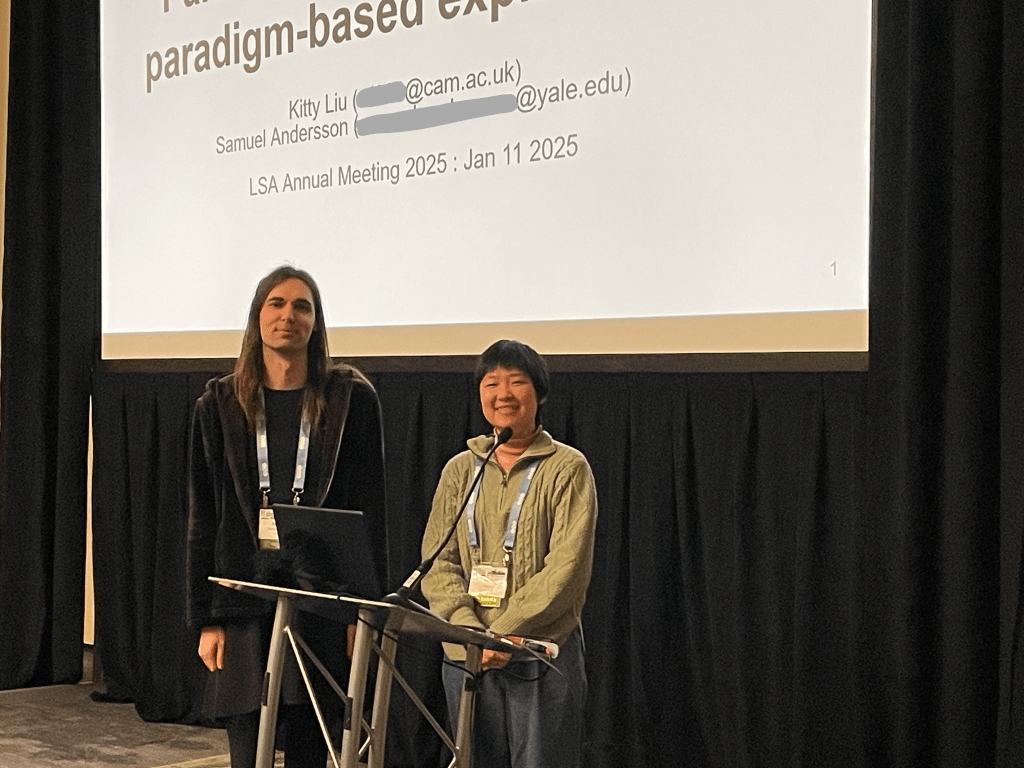
Kitty (right) and Samuel (left) at the 2025 LSA Annual Meeting.
We got lots of positive feedback to our presentation (including from Ackerman and Malouf, whose 2013 paper we drew on), as well as comments on additional Tibetic-internal diachronic factors that we should take into account. Since our presentation lay at the intersection of several subfields (Tibetic linguistics, language change, theoretical linguistics), it was a very valuable opportunity to present at the LSA where our audience had a broad range of interests and specialties.
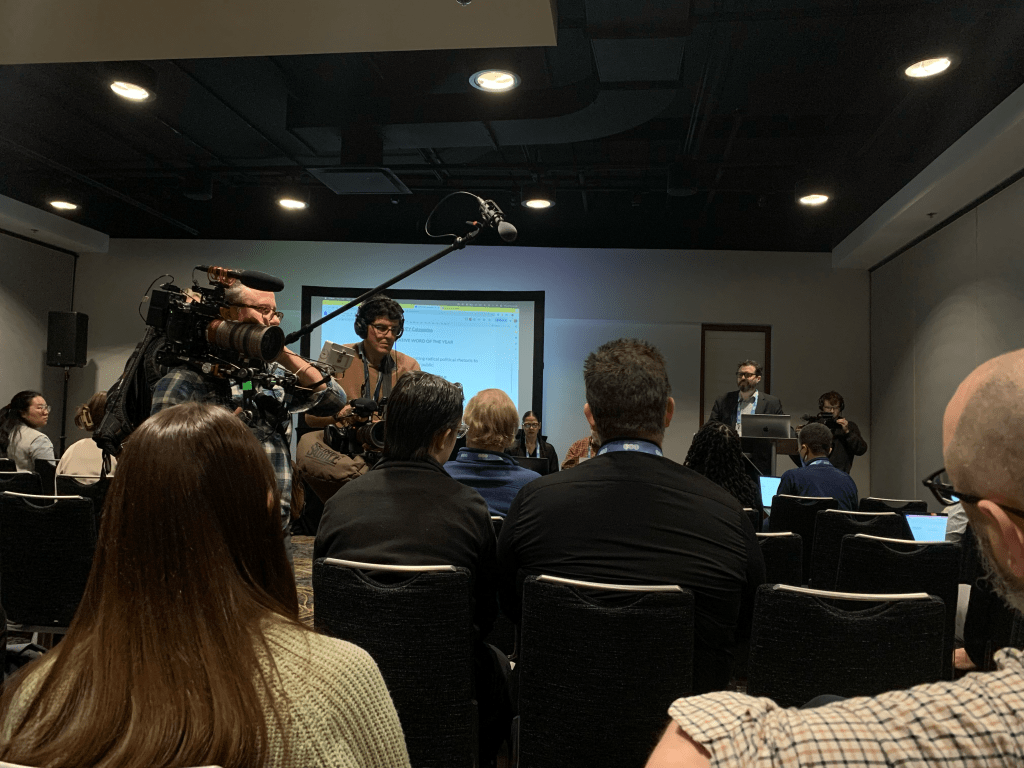
The material for our presentation came from my research for my MPhil thesis, which I completed at the University of Cambridge in 2024, supported by one of PhilSoc’s Masters bursaries. Samuel had contributed to some of the analyses in my MPhil through many inspiring conversations about morphological paradigms, as well as their superior grasp of Python, so we decided to give a joint presentation on those findings to acknowledge their collaborative nature. On top of giving our presentation and receiving feedback, I also greatly enjoyed attending a wide range of event at the LSA, including Chris Geissler’s presentation on the consonant classification system described by medieval Tibetan grammarians, and LSA President Marlyse Baptista’s plenary on a postcolonial and non-exceptionalist reconceptualisation of creole languages. I also got to attend the American Dialect Society’s Word of the Year selection process, which is held at the LSA each year. Nominations for 2024’s Word of the Year included brat (after Charli XCX’s 2024 album), sanewashing (presenting extreme political rhetoric as reasonable), yap (to chatter), and the overall winner rawdog (to undertake an action without customary protection) (Zimmer, 2025).
Intense media coverage of Word of the Year nominations.
I am very grateful to PhilSoc for enabling me to attend the 2025 LSA meeting. I am very happy to have presented my research there and connected with other attendees about our work.
References
Ackerman, F., & Malouf, R. (2013). Morphological organization: The Low Conditional Entropy Conjecture. Language, 89(3), 429–464. https://doi.org/10.1353/lan.2013.0054
Andersson, S. (2018). (*)ABA in Germanic verbs. Glossa: A Journal of General Linguistics, 3(1). https://doi.org/10.5334/gjgl.733
Haller, F. (2004). Dialekt und Erzählungen von Themchen: sprachwissenschaftliche Beschreibung eines Nomadendialektes aus Nord-Amdo. Bonn: VGH Wissenschaftsverlag.
Liu, K. W. (2024). Verb paradigms in Tibetic: Morphophonology in diachronic perspective (MPhil thesis). University of Cambridge. Retrieved from https://doi.org/10.17605/osf.io/z9sr2
Written by Beth Beattie (University of Glasgow), recipient of a travel and fieldwork bursary from the Philological Society.
The Forum for the Regional Languages of Scotland and Ulster (FRLSU) is an organisation dedicated to researching and promoting the languages used across Scotland and Ulster. It has a broad scope, covering historical and contemporary language, as well as spoken, written, and signed forms of communication. The primary languages which FRLSU works with are Irish, Scottish Gaelic, and Scots, and these languages receive a generous portion of FRLSU’s advocacy efforts. The FRLSU conference held at Ulster University from 29th to 30th November 2024 was the first conference held since the pandemic, and it was dedicated to the memory of the Belfast poet and critic John Hewitt with the aim of highlighting work that shines a spotlight on Scotland and Ulster’s minority languages. This is one of the aims of my own research on Older Scots, so I applied, and was accepted, to present my research at this conference and contribute towards improving the standing of Scots in academic research.
My presentation was based on a subset of my PhD research, titled ‘Establishing a Scottish Reformation Discourse: A corpus-based approach.’ There has been next to no research using corpus methods on Scottish Reformation discourse; existing research either explores the different uses of Scots and English in texts (Gribben, 2006), or focuses on the language of specific individuals (Mullen, 2021). Corpus methods are beginning to be applied to English religious discourse, but after having first been touched on over forty years ago, this methodology is only now beginning to be more thoroughly explored (Hudson, 1981; Smith, 2020; 2021; forthcoming). This paper aimed to build on this developing area of research to establish the extent to which the lexical choices of Scottish Reformation writers were different to those in England.
To answer this question, I created a 260,000-word corpus of sixteenth-century Scottish religious polemic texts and compared it with an equivalent corpus of English texts from the same period. The creation of the Scots corpus was of particular relevance to the FRLSU conference attendees because I had to contend with technical and ideological challenges presented by the multilingual nature of sixteenth-century Scotland. Aside from those written in Latin, the surviving texts from this period are written in Older Scots and Early Modern English. These two languages have many linguistic similarities, due to both deriving from different dialects of Old English, but they are different enough to present challenges when features in the same corpus.
There are no corpus tools that are compatible with both Scots and English. One option was to translate the Scots texts into English, which would make the entire corpus compatible with existing English-trained software. However, as is a problem with all translation, meanings of English words do not map perfectly onto Scots words. This is a significant challenge when exploring word choice. Furthermore, you have the ideological issue of effectively ‘erasing’ Scots to make way for English. The growth in Scots language awareness and activism meant that this option is not suitable within the current landscape of Scots scholarship, so I instead chose to keep the Scots texts in Scots and customise or develop software trained on Scots for pre-processing. I created a custom spelling normalisation training for VARD2 trained on Older Scots (Baron and Rayson, 2008), and I also presented preliminary information on the Older Scots part-of-speech tagger I am currently building. After this, I then grouped Scots and English together manually, which worked well because this was a short study, but I am exploring ways to do this automatically for my PhD thesis.
Scottish Keyword
Scottish rel. freq.
English rel. freq.
Log ratio
English Keyword
Scottish rel. freq.
English rel. freq.
Log ratio
Melchizedek
315.02
24.03
3.71
signify
40.39
431.01
-3.42
vocation
226.17
17.62
3.68
English
56.54
551.18
-3.29
Reformation
201.94
17.62
3.52
sense
48.46
424.6
-3.13
Calvin
452.34
43.26
3.39
believed
64.62
480.68
-2.9
debate
193.86
19.23
3.33
proved
44.43
323.66
-2.86
justly
274.63
28.84
3.25
justified
44.43
323.66
-2.86
ministry
197.9
24.03
3.04
another
76.74
546.37
-2.83
verity
553.3
78.51
2.82
works
133.28
938.92
-2.82
latter
218.09
32.05
2.77
among
96.93
578.41
-2.58
woman
791.59
121.77
2.7
Jews
72.7
434.21
-2.58
command
379.64
59.28
2.68
comes
44.43
259.57
-2.55
expressly
214.05
33.65
2.67
often
44.43
257.96
-2.54
universal
335.21
52.87
2.66
image
68.66
395.76
-2.53
punishment
234.25
40.06
2.55
needs
72.7
413.38
-2.51
Satan
266.55
46.47
2.52
saints
84.81
469.46
-2.47
Table 1: Comparison of top fifteen keywords in Scottish and English subcorpora
For exploring the lexical choices of the corpora, I identified the most frequent and statistically significant words and phrases in each corpus. The results of the lexical keyness analysis are shown in Table 1, which shows the relative frequencies and log ratio (binary log of the ratio of relative frequencies) of the keywords of each subcorpus. The Scottish texts feature higher frequencies of explicitly religious words than the English, such as religious figures like Melchizedek and Satan. Contemporary issues are also present in the Scottish corpus, demonstrated by the overuse of ‘Reformation’ and ‘Calvin.’ There are explicitly religious terms in the English corpus as well, like ‘image’ and ‘saint.’ These words play key roles in discussions surrounding the veneration of saints and their images in the Church of England. Despite both corpora having the same proportion of Catholic- and Protestant-aligned texts, Protestant-coded words like ‘Calvin’ and ‘godly’ appear more frequently in the Scottish corpus, and Catholic-coded words like ‘sacrament’ and ‘saints’ in the English. These patterns are also found in the two- and three-word phrases, indicating that there are fundamental differences in religious discourse in Scotland and England at the national level.
I received encouraging feedback on my presentation at the FRLSU conference and I was able to discuss potential avenues for further research. These include adding a qualitative angle to my research, as a mixed-method approach to this topic would help to bring together existing research and corroborate my findings so far. I was also able to discuss my research more broadly with experts in the field, and through the FRLSU network I have found a mentor for a postdoctoral research project following my PhD. Thanks to the PhilSoc travel grant, I was able to gain so much from attending this conference, and I am incredibly grateful for PhilSoc’s assistance.
References
Baron, A. and Rayson, P. (2008) VARD 2: A tool for dealing with spelling variation in historical corpora. In: Proceedings of the Postgraduate Conference in Corpus Linguistics. Aston University, Birmingham.
Collinson, P. (1983) Godly People: Essays On English Protestantism and Puritanism. History Series. London, The Hambledon Press.
Gribben, C. (2006) John Knox, Reformation History and National Self-fashioning. Reformation & Renaissance Review, 8 (1), pp. 48–66.
Hudson, A. (1981) A Lollard sect vocabulary? In: Benskin, M. and Samuels, M.L. eds. So Meny People Longages and Tonges: Philological Essays in Scots and Mediaeval English Presented to Angus McIntosh. Edinburgh, Middle English Dialect Project, pp. 15–30.
Mullan, D.G. (2021) Scottish Catholic Responses to Reformation Teachings after 1558. In: A Companion to the Reformation in Scotland, c. 1525-1638. Leiden, Brill, pp. 177–203.
Smith, J.J. (2020) Godly vocabulary in Early Modern English religious debate. In: Jonsson, E. and Larsson, T. eds. Voices past and present – Studies of involved, speech-related and spoken texts: In honor of Merja Kytö, Studies in Corpus Linguistics. Amsterdam, John Benjamins Publishing, pp. 95–112.
Smith, J.J. (2021) Lexical choices in Early Modern English devotional prose. Journal of Historical Pragmatics, 22 (2), pp. 263–281.
Yadomi, H. (2019) Language, identity and community: A sociolinguistic analysis of language practice of early modern English preachers. PhD Thesis, University of Glasgow. Available from https://theses.gla.ac.uk/id/eprint/75164.
Written by Rhiannon Smith – Recipient of a Philological Society bursary.
This September, I had the opportunity to travel to Munich for the 15th International Colloquium on Late and Vulgar Latin thanks to the generous support of the PhilSoc Travel and Fieldwork Bursary. This conference was my final opportunity to present my research in front of an audience of academics before handing in my PhD.
My research focuses on the creation and use of Greek-influenced paradigms on Greek and Latin women’s names in Latin inscriptions. I presented a paper entitled ‘How should women’s names decline in Latin inscriptions?’ There are three possible grammatical paradigms which can be used in Latin with Greek female names in ‑e.
Nominative
-e
-e
-e
Accusative
-en / -em
-enem
-etem
Genitive
-es
-enis
-etis
Dative
-e
-eni
-eti
Ablative
-e
-ene
-ete
The first of these is the transliterated Greek first declension and the second two are created in Rome. Although all these paradigms should only be used with names that have nominatives in ‑e, I have found 278 unique Latin cognomina (which should have nominatives in -a) in these three paradigms. The nine most popular Latin cognomina are Iuliana, Marciana, Aeliana, Rufina, Aproniana, Claudiana, Clementiana, Feliciana and Sabiniana. My data showed that names suffixed in ‑iana were most popular in the paradigms ‑e, ‑enis and ‑e, ‑etis whereas names not suffixed in ‑iana were mostly found in ‑e, ‑es. There is something about Latin cognomina in ‑iana which was specifically drawing them to nominative ‑e, ‑e, ‑enis and ‑e, ‑etis. For example, almost 20% of epigraphic attestations of Marciana are found with a non-standard/Greek-influenced ending (Smith 2024:31-48). However, the same patterns are not visible in the data for genitive ‑es. The most popular names in genitive ‑es match the most popular overall Latin cognomina and it appears that only genitive ‑es has transplanted to Latin cognomina, rather than the full paradigm. I argue that this is almost certainly related to another ending, genitive ‑aes which I analyse in more detail in my thesis.
The second half of my paper focused on Greek female cognomina found in the three paradigms given above. One of the only theories on the alternation between ‑e, ‑enis and ‑e, ‑etis is given by Adams: “when the ending of the nominative is -ne, -eti(s) is preferred, whereas when the nominative has any consonant other than n before the final eta, it is -eniswhich is overwhelmingly in the majority”. This is a very plausible suggestion; a form with stem-final n would be more awkward to pronounce with ‑e, ‑enis (for example Irenenis, Ireneni).
The table below lists the 10 most popular Greek cognomina in ‑e found in the paradigms ‑e, ‑enis and ‑e, ‑etis
-e, -enis
-e, -etis
1.
Nice
Cyriace
2.
Tyche
Irene
3.
Agape
Eutychiane
4.
Auge
Hermione
5.
Chreste
Zosime, Philumene
6.
Zosime
7.
Calliste
Eutyche
8.
Philete
Semne
9.
Trophime
Phile
10.
Syntyche
Cale, Euphrosyne, Hedone
The ‑e, ‑etis paradigm does appear to have more cognomina with stem-final n which does appear to support Adams’ theory. However, he fails to take into account the time periods in which ‑e, ‑enis and ‑e, ‑etis were used. In my paper I showed that ‑e, ‑enis was most strongly used from 0-200 CE whereas ‑e, ‑etis was most prominent in 300-400 CE.
Using my data from Greek cognomina in genitive ‑es as a control group, I compared the proportion of different stem-final consonants in each paradigm. I concluded therefore, that in the Christian period where all three paradigms were attested, stem-final consonant does appear to have an effect on paradigm choice, although this appears to be a tendency rather than a rule. Names with stem-final n are very rare in ‑e, ‑enis but equally common in ‑e, ‑etis and genitive ‑es, whereas names with stem-final t are only found in -e, -enis. Stem-final p is also most common in -e, -enis in this time period. There are some Greek cognomina suffixed in ‑iane in the ‑e, ‑etis dataset. Greek names suggested in ‑iane are more likely to decline in -e, -etis than to take any other endings. Other cognomina with stem-final n but not suffixed in ‑iane can choose fairly freely between genitive ‑es and -e, -etis, although they avoid -e, -enis for phonological reasons. Cognomina with stem-final p and t avoid -e, -etis due to phonological similarities.
In the pre-Christian Imperial period, it is not accurate to describe an alternation of –e, -enis and ‑e, ‑etis, as Adams does. In the -e, -etis dataset, there are only 17 Greek cognomina attested before 300 CE. Therefore, there is simply not enough use of this paradigm to suppose that speakers were actively choosing between -e, -enis and -e, -etis in this time period. We are thus seeing only alternation between -e, -es and -e, -enis. The distributions for ‑e, ‑es and ‑e, ‑enis are mostly similar; the main difference is that names with stem-final n rarely use ‑e, ‑enis.
It was incredibly fulfilling to me to be able to present the culmination of my research to eminent academics and to share my findings with the wider research community. I had a lovely week exploring Munich, swimming in the river and walking the city, especially enjoying the last of the summer sun before returning to England. Conferences have always been an important way to develop my own research and learn about interesting projects in other areas that I might not have been otherwise aware of, and again, I am grateful to the Philological Society for providing the funding to allow me to take part in LVLT 2024.
Bibliography
Adams, J. N. (2003). Bilingualism and the Latin Language. Cambridge; Cambridge University Press.
Nuorluoto, T. (2023). Latin Female Cognomina. A Study on the Personal Names of Roman Women. Helsinki; Societas Scientiarum Fennica.
Smith, R. K. (2024). Marciana: A Case Study in Greek-Influenced Endings. In Exploring Latin: Structures, Functions, Meaning. De Gruyter.
Solin, H. (1982) Die griechischen Personennamen in Rom: ein Namenbuch. Berlin; De Gruyter.
written by Kitty Liu (University of Cambridge), recipient of the Philological Society’s Anna Morpurgo Davies Masters’ Bursary.
I am grateful to the Philological Society for their generous award of the Anna Morpurgo Davies Masters’ Bursary for the year 2023–24, which allowed me to research morphophonological change in Tibetic languages during my MPhil at the University of Cambridge. This report gives an overview of my research and presents some of my findings.
Tibetic languages are varied, fascinating, and understudied. Diversity within the modern Tibetic family is comparable to that of Romance (Tournadre & Suzuki 2023: 44) and the rich textual traditions and historical status of Old and Classical Tibetan roughly parallel those of Old and Classical Latin. I explored changes affecting the complex syllable structure and verb stem alternations of Old/Classical Tibetan, focusing on the conservative modern Amdo varieties (spoken in and around China’s Qinghai Province). All modern Tibetic varieties show syllable structutre reduction compared to Old/Classical Tibetan. For example, reflexes of bsgrubs ‘complete-PFV’ include /ɣɖʐəp/ (very conservative; Amdo Tibetan) and /˨ʈup/ (very innovative; Central Tibetan) (Bielmeier et al 2018). Old/Classical Tibetan verbs had up to four monosyllabic stem alternants, primarily expressing tense and mood, while modern varieties have up to three, expressing aspect and mood (Zeisler 2004). One stem has thus been lost and the remaining stems’ functions have been restructured during the development of verb paradigms. My thesis explored the intersections between these changes, demonstrating that phonological and morphological developments are often closely interwoven, with the study of one necessitating an understanding of the other.
Investigating these changes led me to incorporate different methodologies, including different approaches to sound change, paradigm-focused approaches in theoretical morphology, computational corpus research and computational corpus linguistics, as well as eliciation sessions over Zoom with a Tibetic speaker from the Amdo region. I really enjoyed getting to work with this wide array of methodologies, and my range of analytical approaches was reflected in the breadth of my findings.
Some aspects of my findings were specific to Tibetic linguistics (e.g. estimating the number of Classical Tibetan verbs in each verb class; developing a hypothesis for contrastive voicing for Old Tibetan nasals), but I also made a number of observations that are of interest for linguistics more generally. I briefly describe two of them here.
Amdo verb paradigms, both in pre-existing and my new data, demonstrate syncretism between any two of the three slots (imperfective, perfective, imperative) at the exclusion of the third. This means that Amdo verbs contravene the *ABA constraint in morphology, which postulates that in three-slot paradigms, there is one two-slot syncretism that is disallowed/-preferred (cf. Andersson 2018). All three combinations of two-slot syncretisms are synchronically prevalent in Amdo verbs, but analysis of sound changes and paradigm levelling show that imperfective-imperative syncretisms are derived from a more restricted set of diachronic processes than imperfective-perfective and perfective-imperative syncretisms. Imperfective-imperative syncretisms (where the perfective is not syncretic with them) appear to only arise due to phonological mergers, and never from the extension of the imperfective form to express an imperative meaning or vice versa. I hypothesise that this is due to the extent of semantic differences between imperfective and imperative stems. This finding adds nuance to existing discussions on *ABA in the morphology literature.
Old/Classical Tibetan verb paradigms are interesting for discussions of calculating paradigm complexity. The Old/Classical Tibetan verb paradigm is considered impossible under older measures of complexity such as Carstairs-McCarthy’s (1994) ‘No Blur Principle’, which involves counting the number of possible realisations for each paradigm slot, as, in Old/Classical Tibetan, each verb paradigm slot has many possible realisations and the realisations for different slots often overlap. However, under Ackerman and Malouf’s (2013) predictability-based quantification of paradigm complexity (‘conditional entropy’), Old/Classical Tibetan achieves an average score on par with paradigms that are possible under the No Blur Principle. Thus, Old/Classical Tibetan verbs lend support to the utility of predictability-based conceptualisations of paradigm complexity including conditional entropy.
Weaving together the topics and methodologies discussed above, my research process showed me the value of interdisciplinarity between different linguistic subfields in diachronic research. My thesis achieved a ‘Pass without corrections’, which is the highest grade for my course. I plan to prepare parts of it for conference presentations and for publication. I am currently a research assistant for the AHRC-funded ‘Emergence of Egophoricity’ project, assisting the construction of part-of-speech-tagged historical Tibetan corpora. I am also planning to apply for a PhD in the upcoming admissions cycle, to further pursue topics in historical Tibetic linguistics and develop the skills I gained in my MPhil.
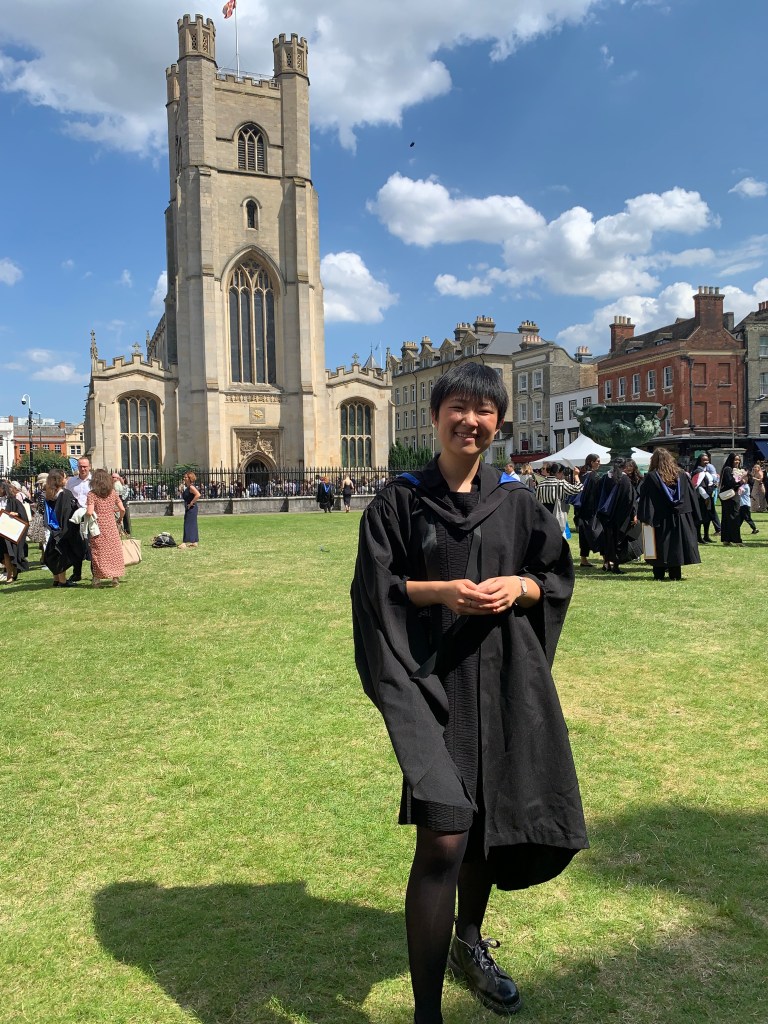
Kitty Liu’s graduation (University of Cambridge)
References
Ackerman, F. & R. Malouf (2013). Morphological organization: The Low Conditional Entropy Conjecture. Language 89(3): 429–464. doi: https://doi.org/10.1353/lan.2013.0054
Andersson, S. (2018). (*)ABA in Germanic verbs. Glossa: a journal of general linguistics 3(1): 119. doi: https://doi.org/10.5334/gjgl.733
Bielmeier, R., G. L. van Driem & M. Volkart (2018). Comparative Dictionary of Tibetan Dialects (CDTD). Volume 2: Verbs. De Gruyter. https://doi.org/10.1515/9783110554076
Carstairs-McCarthy, A. (1987). Allomorphy in inflexion. Croom Helm.
Tournadre, N. & H. Suzuki (2023). The Tibetic Languages: An introduction to the family of languages derived from Old Tibetan. LACITO-Publications. https://lacito.cnrs.fr/the-tibetic-languages/