by Peter Gilliver (Associate Editor, Oxford English Dictionary)
The origins of the Oxford English Dictionary, and indeed its fortunes for much of the period when its first edition was compiled, were so closely bound up with the Philological Society that it is hardly surprising that it was long known in some quarters as ‘the Society’s Dictionary’. Accordingly, the Society’s members may be interested to know something about the new history of the project which has just been published by Oxford University Press.
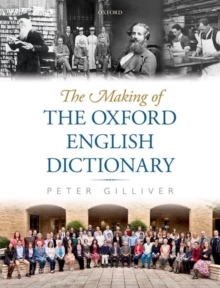
It has been many years in the making. In the late 1990s, about a decade after I took up a position as a member of the Dictionary’s current editorial staff, I began to contemplate the idea of compiling a new history of it. Many will be familiar with some of the other histories of the OED that were already available at that time, or have appeared since: Caught in the Web of Words for example, Elisabeth Murray’s magisterial biography of her grandfather James Murray (which inevitably only manages to tell his story by also telling the story of the work with which his prodigious energies and intellect were taken up for over half his life), or Simon Winchester’s The Meaning of Everything. However, I thought that my own knowledge of the Dictionary, gained through years of constant engagement with its text as a practising lexicographer, might qualify me to take a fresh look at the subject. Moreover, I had already begun to explore the Dictionary’s archives, having become interested in the lexicographical work done by J. R. R. Tolkien as one of my predecessors on the staff (and given a conference paper on the subject in 1992), and I could see that there was a great deal more to be discovered.
I decided that there might be advantages in combining the task of researching and writing the history of the OED with my ‘day job’ as one of the team of lexicographers engaged in preparing the Dictionary’s third edition. Working on the two tasks concurrently has indeed been beneficial to both—the cross-fertilization between ‘doing lexicography’and writing the history of one of its greatest projects has taken place in both directions—but it has also had the disadvantage that it took me fourteen years to complete the book.

It gives me great pleasure to take this opportunity to acknowledge, as I already have done in the preface to the book, the generosity of the Council of the Philological Society in allowing me to consult the Society’s records; many of these records are currently deposited in the archives of Oxford University Press, making it easy to consult them at the same time as the OED‘s own enormous archive. In particular, the minute books for the Society’s meetings—both ordinary meetings, and meetings of the Council—from the earliest years of work on the Dictionary have greatly enriched the story, with fascinating detail about such matters as the protracted behind-the-scenes manoeuvring with key figures in the Society that preceded the eventual signing of contracts with OUP in 1879, and the thorough briefings about the project’s progress during the ensuing decades, which Society members received (usually directly from one or other of the Dictionary’s Editors) at regular ‘Dictionary Evenings’—privileged information, which the Society was often the first to hear, and which in some cases never got written down anywhere else.
The history of the OED has an intrinsic interest to anyone interested in linguistic scholarship, the history of English, and British cultural history more generally; I hope that the Society’s close association with the Dictionary will give further interest to my book for Society members. They certainly have good reason to be proud of the part played by the Society, and by many of its individual members, in the inception and compilation of the Dictionary, arguably one of the greatest philological projects ever undertaken.
‘The Making of the Oxford English Dictionary’ is published by Oxford University Press (ISBN 9780199283620).
 The Philological Society Blog