The Philological Society is the oldest learned society in Great Britain devoted to the scholarly study of language and languages. It is also a registered charity (no. 1014370). It was established in its present form in 1842, consisting partly of members of a society of the same name established at the University of London in 1830 “to investigate and promote the study and knowledge of the structure, the affinities, and the history of languages”. As well as encouraging all aspects of the study of language, PhilSoc has a particular interest in historical and comparative linguistics, and maintains its traditional interest in the structure, development, and varieties of Modern English.
PhilSoc meeting of Saturday 18th March at Murray Edwards College, Cambridge
The recording of PhilSoc’s recent meeting is now available to view on the society’s YouTube channel. The lecture was held in the Buckingham House Lecture Theatre, Murray Edwards College, and the speaker was Professor Kasia M. Jaszczolt (University of Cambridge):
There is no doubt that cross-linguistic investigations into temporal reference inform psychologists about the properties of the human concept of time. But it is not common to go further: from linguistic externalisations of the human concept of time to the properties of ‘real’ time as it is discussed in philosophy of physics. In this talk I combine what I call ‘linguistic time’ (timeL), ‘epistemological time’ (timeE) and ‘metaphysical time’ (timeM) to show that an insight into semantic properties of markers of temporality in various, tensed and tenseless, natural languages helps explain the apparent conflict between the dynamic, flowing timeE and static timeM – ‘real’ time that does not flow but instead consists of relations of static precedence and succession (on the so-called ‘B theory’, McTaggart 1908). I present some arguments for the modal foundations of the human concept of time (time as supervenient on epistemic modality, Jaszczolt, e.g. 2009, 2020, in press) and conclude that on the level of universal semantic (modal) building blocks, timeE is essentially static – it only flows on the level of their language- and culture-specific combinations that produce complex temporal concepts. I conclude by presenting formal representations of temporal reference, using the contextualist theory of Default Semantics.
Select references:
Jaszczolt, K. M. 2009. Representing Time: An Essay on Temporality as Modality. Oxford: Oxford University Press.
Jaszczolt, K. M. 2020. Human imprints of real time: From semantics to metaphysics. Philosophia 48: 1855–1879.
Jaszczolt, K. M. In press. ‘Does human time really flow? Metaindexicality, metarepresentation, and basic concepts’. In: K. M. Jaszczolt (ed.), UnderstandingHuman Time. For Oxford Studies of Time in Language and Thought. Oxford: Oxford University Press.
McTaggart, J. McT. E. 1908. The unreality of time. Mind 17. Reprinted in J. McT. E. McTaggart. 1943. Philosophical Studies. London: Edward Arnold. 110–131.
Virtual meeting of 2nd December 2022, hosted by the University of Edinburgh
The recording of PhilSoc’s most recent meeting is now available to view on the society’s YouTube channel:
This meeting took the form of an early career researcher panel, chaired by Ricardo Napoleão de Souza (University of Edinburgh), and addressed the following question: ‘Is the study of change in languages with little or no historical record fundamentally different from similar work on languages with a lengthy written tradition?’
To this day, there remains a close association between historical linguistics and Indo-European, in part due to the wealth of written sources which scholars can use in historical research on the family. For some, this goes as far as an assumption—often implicit—that historical work based primarily on spoken data is less reliable, accurate, or viable than that based on written sources. These attitudes persist, despite the venerable and successful tradition of historical work on languages without a written record—some of which in fact predates Sir William Jones’s famous ‘common source’ discourse in 1786, heralded as the beginning of Indo-European studies.
In response to this, three early career researchers shared their experiences of using primary spoken data collected in the field to investigate language change, bringing their research perspectives to bear on methodological, conceptual and experiential issues in historical work with unwritten languages.
Speakers: Ryan Gehrmann (Payap University): ‘Tonogenesis in Mainland Southeast Asia: Reconciling the historical evidence and the comparative evidence’ Tatiana Reid (University of Edinburgh): ‘Untangling the origins of floating suprasegmental component in Nuer’ Laura Arnold (University of Edinburgh): ‘From areal linguistics to historical sociolinguistics: Identifying contact events in northwest New Guinea’
written by Alessandra Serpone (independent scholar)
With support from the Philological Society’s Martin Burr Fund, I was able to attend the 34th Deutsche Orientalistentag (DOT) which took place 12–17th September 2022 at the Freie Universität Berlin. It is the representative conference of German Oriental Studies and is held once every three to five years. This year it was attended by about 1,200 participants from more than 60 countries. All the represented disciplines (e.g. Egyptology, Ancient Oriental Studies, Semitic Studies and Philology, Hebrew Studies, Arabic Studies and Philology, and African Studies) were grouped into 24 sections, and there were presentations by scholars at all phases of their careers.
Attendance at this meeting represented a great opportunity to me, as an early career scholar, to present and discuss my current research with an audience of specialists outside my usual academic network. In addition, I had the opportunity to be inspired by interesting talks closely related to my historical and diachronic interests. As I am mainly focused on ancient Semitic languages, I also found it very stimulating to be exposed to diverse aspects of modern Semitic languages research, such as that on Neo-Aramaic and Modern South Arabian.
I presented a paper titled Diachronic Considerations on the Personal Marker y– in the Semitic Prefix Conjugation on the first day, as part of the Semitistics Section. As it represents a preliminary overview of my ongoing research, it was highly beneficial for me to receive feedback from the specialized audience, which belonged to both the Semitic and the Afro-Asiatic areas. I found it very helpful to receive comparative remarks and suggestions about how my current work could further develop.
In my talk, I addressed the third-person marker y- of the Semitic prefix conjugation diachronically. Unlike the first and second person markers, it does not bear any resemblance to the independent personal pronouns. Therefore, it does not lend itself to an easy etymological explanation. To determine its origins, I offered some preliminary comparative notes where the theme /y-/ is attested outside the verbal paradigm, as in the demonstrative and relational marker in South Ethiopic, and the interrogative theme in Phoenician, Hebrew, and Ugaritic. What I find rather critical in historical terms are a group of nominal forms (e.g. personal and place names) starting with y-. Although they are traditionally interpreted as ‘transpositions métonymiques de formes verbales’ (Cohen 1970: 34; see also von Soden 1966: 182), e.g. Yi-ṣḥaq = ‘he laughs’, I claim that comparative and historical facts may suggest a different interpretation. I argue that the theme /y-/ goes back to an ancient ‘determinative-relative’ pronoun before a grammaticalization process made it acquire its inflectional status (cf. Pellat 1957: 186; Garbini 1984: 84–88; Garbini & Durand 1994: 109–110), e.g. Yi-ṣḥaq ‘the one who laughs’.
The Martin Burr Fund provided conference support which helped with the cost of travel and accommodation in Berlin. I am thankful to the Philological Society for the opportunity to refine my current research, along with the methodologies applied, and to strengthen my academic network.
References
Cohen, D. 1970. Études de linguistique sémitique et arabe. The Hague: Mouton.
Garbini, G. 1984. Le lingue semitiche. Studi di storia linguistica. Napoli: Istituto Universitario Orientale.
Garbini, G. & Durand, O. 1994. Introduzione alle lingue semitiche. Brescia: Paideia.
Pellat, C. 1957. Review of L’Arabe classique. Esquisse d’une structure linguistique, by H. Fleisch. Arabica 4(2).183–188.
Soden, W. von. 1966. Jahwe ‘Er ist, Er erweist sich’. Die Welt Des Orients 3(3).177–187.
written by Professor Aditi Lahiri & Professor Martin Maiden (University of Oxford)
Every two years The International Conference for Historical Linguistics (ICHL) brings together historical linguists and specialists in related fields to explore advances in areas such as methods and practices of linguistic reconstruction, formal approaches to language change, historical sociolinguistics, computational approaches to historical linguistics, contact and areal linguistics, interfaces between historical linguistics and other disciplines, and many other related areas. ICHL25 was held at the University of Oxford (1–5 August 2022) and involved 421 participants whose oral presentations and posters covered all these areas. Reports we received from participants suggested that the conference was a great success.
The Philological Society sponsored a reception on the final day, which was attended by 383 participants, and also provided Martin Burr Fund support for a student based in the US to present a paper (see James Tandy’s report: https://blogphilsoc.wordpress.com/2022/08/18/25th-international-conference-on-historical-linguistics-ichl25-oxford/). At the final session of the conference, Professor Aditi Lahiri and Professor Martin Maiden thanked the Society for their contribution. Professor Maiden introduced Professor Lutz Marten, the editor of the Transactions of the Philological Society (TPhS), who then presented a comprehensive account of the society’s goals, encouraging participants to join the society if they were not already members. Professor Marten also discussed the goals of TPhS, pointing out its breadth of coverage and relevance for historical linguistics research. Since there were more than 100 students registered at the conference, Professor Marten also provided information about the Robins Prize, encouraging potential applicants to submit their written work to the competition. Providentially, the winner of the previous Robins Prize, Dr Emily Lindsay-Smith (a leading member of the organising committee), was present and received his congratulations.
written by Sarah Eichhorn (University of Nottingham), Recipient of PhilSoc’s Burr Fund Travel and Fieldwork Bursary for PhD research
Within the field of sociolinguistics, growing attention has been paid to regional and minority languages in recent decades, particularly as communities and governments are becoming increasingly aware of diversity and multilingualism within their societies. France presents a particularly noteworthy context due to its wealth of regional languages that pre-date Standard French—such as Breton, a Brythonic Celtic language—as well as an increasing presence of minority languages like Arabic, which have come to the country more recently via immigration, and are now being passed on to subsequent French-born generations through familial transmission. Despite the linguistic diversity of France, French government language policy heavily favours monolingualism in French, which has historically led to and continues to perpetuate the marginalization of regional and minority languages. However, many regional languages have seen a resurgence in efforts toward revitalization—e.g., through the establishment of immersion schools (Adam 2020), or more militant efforts such as protests and marches. This has led to an increase in visibility and numbers of speakers. Efforts have also been made toward including languages like Arabic as foreign language options in schools (Soriano 2019).
Most research to date focuses on regional OR minority languages, and very little comparative research has been conducted to explore the similarities and differences between the two kinds of language communities (see Filhon 2010). This gap in research has driven the development of my PhD, which seeks to explore a comparative analysis of the Breton-speaking and Arabic-speaking communities in Brittany. The issues I am examining are:
How two different communities of language users define and describe their experiences with regard to language. I use the term ‘language user’ rather than ‘speaker’ in order to encompass all individuals of any kind of proficiency in a given language. Many of the Breton language users interviewed for my research are enrolled in language courses and would thus not yet consider themselves full ‘speakers’ of the language, while many Arabic language users speak what they consider to be a ‘dialect’, and do not consider themselves to know ‘true’ Classical/Standard Arabic;
whether the language communities interact or intersect; and
how they deal with challenges such as French language policy and educational provision.
Through transcribed interview extracts and questionnaires, I am seeking to shed light on how these issues shape the sociolinguistic landscape of France, and Brittany in particular. My two-part research methodology comprises:
An online questionnaire in two versions (one for Breton and one for Arabic), distributed to language users across France. I am currently in the process of collecting and analysing responses.
Semi-structured interviews conducted with language users across Brittany.
With funding from the Philological Society I undertook eleven weeks of fieldwork in Brittany during May to August 2022. I spent one week in Nantes—a diverse city that, although administratively no longer part of Brittany, is historically considered part of the region and is a hub for Breton language revitalization—and 10 weeks in Rennes, the vibrant capital of Brittany and an even greater hub of Breton revitalization and diversity. I also occasionally travelled to cities such as St-Brieuc and Guingamp for interviews. In total, I conducted interviews with 29 Arabic language users and 27 Breton language users, with a generally equal distribution of age groups between 16 and 65+. The majority of Breton language users have learned or studied Breton in school or in adulthood, and only three learned the language at home. The vast majority of Arabic language users have grown up speaking the language, although it must be noted that most individuals speak a particular dialect, such as Moroccan Arabic or darija, while Classical/Standard Arabic is generally learned in school or at cultural/religious associations (see Caubet 2007, 2008).
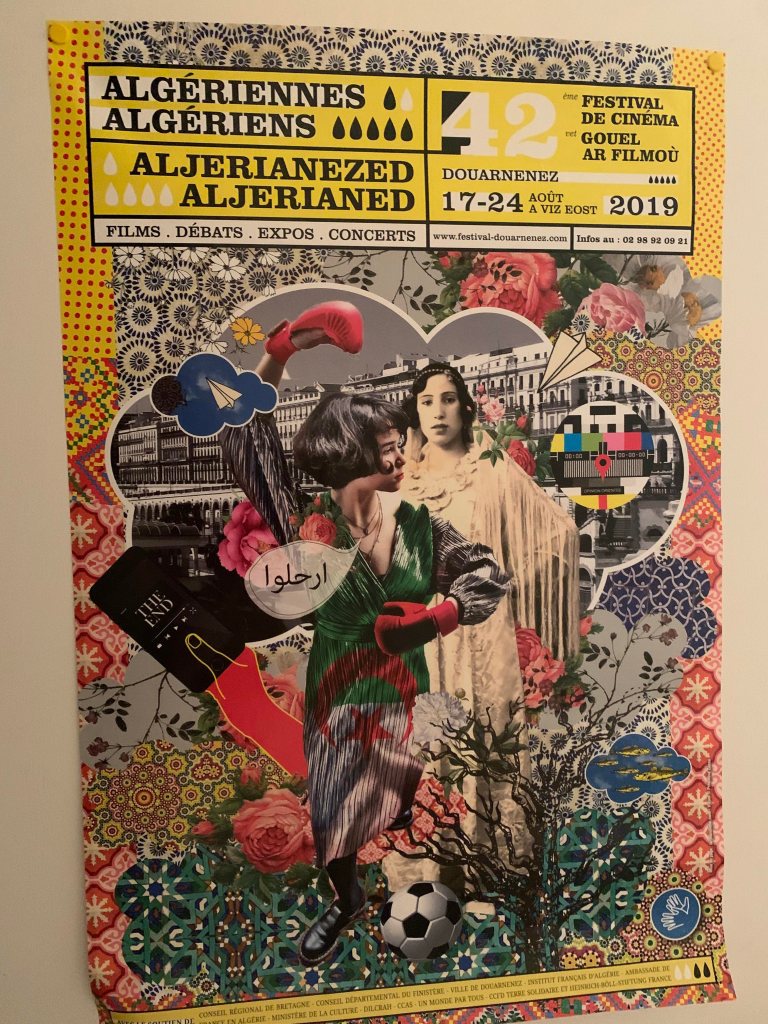
I am currently in the earliest stages of data analysis, however some preliminary themes and comparisons have arisen already, such as a tendency for users of both languages to employ the word richesse ‘richness’ to describe their feelings toward their multilingualism. Also, a particularly surprising overlap occurred when I attended several events at an Algerian cultural association and met and interviewed individuals from the Kabylie region, who compared the situation of the indigenous Kabyle language in Algeria to that of Breton in Brittany, and found solidarity with their Breton neighbours and a mutual desire to support linguistic and cultural diversity in both countries.
Figure 1: An example of a cross-cultural Breton-Algerian cinema festival that took place in 2019
The experience of interviewing such a range of individuals and collecting their fascinating stories was rewarding and exciting, and I look forward to cross-analysing the data alongside the questionnaire results.
References
Adam, C. (2020). Bilinguisme scolaire : Familles, écoles, identités en Bretagne. Berlin: Peter Lang GmbH.
Caubet, D. (2007). L’arabe maghrébin-darja, « langue de France », dans les parlers jeunes et les productions culturelles : un usage banalisé ? In Pratiques linguistiques des jeunes en terrain plurilingue (pp. 25–46). L’Harmattan.
Caubet, D. (2008). Immigrant languages and languages of France. Mapping Linguistic Diversity in Multicultural Contexts, 163–194.
Filhon, A. (2010). Transmission familiale des langues en France : Évolutions historiques et concurrences. Annales de démographie historique, 119 (1), 205–222.
Soriano, É. (2019). L’arabe à l’école : Hiérarchie des mobilités géographiques, inégalités des conditions linguistiques. Recherches En Didactique Des Langues et Des Cultures, 16(2), 1–20.
written by Nicola Swinburne (University of Oxford)
In present day standard English, an auxiliary ‘do’ is employed to support almost all main verbs in the interrogative and negative declarative, exceptions being ‘be’ and (in some dialects) ‘have’. For example:
1. I do not catch the bus to work regularly.
2. I don’t know what the answer is.
3. Did you see Fred last night?
4. Do you have any bananas? (cf. Have you any bananas?)
5. Are you still drinking that tea? (NOT: Do you be still drinking that tea?)
However, in the history of English, as ‘do’-support (DS) was coming into the language, it was used less with stative verbs such as ‘know’ (Ellegård 1953), as if it held on to the remnant active semantics of ‘do’.
Although ‘do’-support is fairly widespread cross-linguistically (Jäger 2006), it was almost unknown in Romance languages until the report by Benincà & Poletto (2004) of an auxiliary fa ‘do’ in the interrogative of the Camuno dialect of Upper Val Camonica at Monno. In the Monno dialect fa ‘do’-support (FS) is largely obligatory and used with all main verbs except ‘have’ and ‘be’ (and ‘know’: Swinburne, 2021)
In work for my recent DPhil thesis, I showed that in fact FS is more widespread than just the Monno dialect, and can be found in communities along 45 km of the Oglio valley and several side valleys (Figures 1, 2, 3).
Figure 1: Maps showing location of Val Camonica and the outline of FS in 2020
Interestingly, in many of the Middle Valley dialects, e.g. Esine (1), interrogatives may be formed in two ways, either with fa, the ‘do’ support verb (FS) (1a: ‘Does she eat the fish for supper’), or with just main verb (SCI) (1b: ‘Eats she the fish for supper’). As Camuno (like Italian) is a null-subject language, the subject is represented by a clitic, (probably just an agreement marker) on the finite verb and any lexical subject is at the end of the sentence.
1.
(a)
Fa=la
mangià
‘l peh
da hena,
Maria?
[FS]
does=scl.3f.sg
eat.infin
the fish
for supper
Maria
(b)
Màngia=la
‘l peh
da hena,
Maria?
[SCI]
eats=scl.3f.sg
the fish
for supper
Maria
‘Is Maria eating /Does Maria (usually) eat fish for supper?’
When such an FS/SCI contrast is available, FS serves pragmatic functions, and is used by the speaker to indicate they have an expectation of the answer and are asking the question to engage the interlocutor and ask for their opinion.
In dialects where use of fa is optional, the support verb appears to be at a lower stage of grammaticalisation. In these dialects it still has — to varying degrees — the meaning of ‘do’, or of ‘activity’, as prototypically carried out by an agentive subject. This is evidenced by the likelihood that FS will be used to support verbs of different semantic classes.
I recently carried out additional fieldwork, supported by a Martin Burr Fund award, to further investigate this variation. I measured the frequency of use of FS through an elicitation experiment (which I had used previously) but with new selection of verbs to define more precisely what speakers considered most important in their choice to use FS. Results (Figure 2), firmly established that primary difference in use of FS is the role that the subject is perceived to take in the event.
Figure 2: Use of FS with different verbs (as named by their Italian cognates) by 19 speakers from Middle Val Camonica.
Greatest percentage FS use is with verbs with effector subjects (red); least FS use is with verbs with experiencer subjects (green: stative verbs). Verbs with theme subjects (blue: unaccusative verbs) are approximately between the two. Causative verbs (yellow) pattern among the non-statives, with most use with verbs where activity, particularly motion, is perceived as part of the causing action (e.g. ‘open X’) and less where any such activity is less prominent (e.g. ‘give X’). The version of ‘open’ without the causing action (anticausative: light blue), ‘open’ (by itself), patterns among the stative verbs. Main verb ‘do’ (darker red) is used with FS at a lower rate than other effector-subject verbs and often considered unnecessary with a support verb that still seems to have the semantic content of ‘do’.
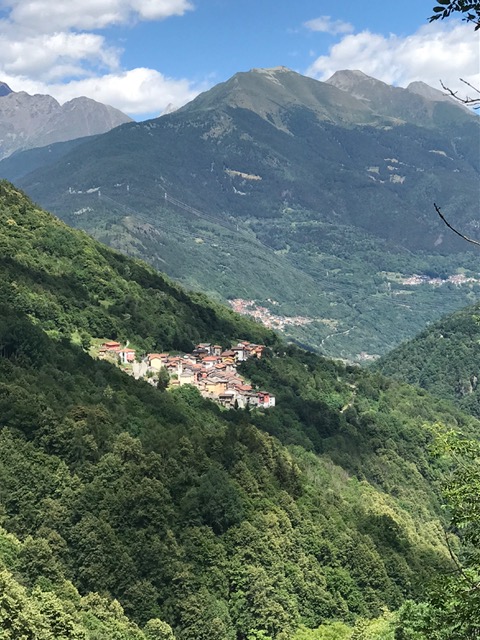
The new fieldwork involved additional speakers from communities where greatest optionality in FS use (i.e. most semantic restrictions) had previously been found, and sampled communities located between zones of optional and obligatory areas in the hope of a better understanding of the final stages of grammaticalisation (Figure 3, 4).
Figure 3: Isolated communities embedded in forest in Val AllioneFigure 4: Densely clustered houses typical of traditional valley communities
What can generally be said is that speakers with most generalised use of FS are found within the more isolated communities although these may be just the people who, during their working lives, interacted mostly with neighbours (who also used FS) rather than outsiders (who didn’t). Speakers with lowest use of FS are from communities with high through-traffic and thus had most contact with outsiders, but there are two different influences: a slow and persistent effect (that built up the pattern), and a more recent and rapid one (that is destroying it).
Speakers who have preserved the most restrictive and highly selective FS use are displaying an original pattern that developed because these communities always were in a dialect contact zone. On top of this, in communities have experienced a rapid recent influx of outsiders due to post-war valley industrialisation, some speakers have changed their dialects during their lifetimes and the overall effect has been to entirely obliterate FS.
The additional phase of the research has helped confirm how use of a ‘do’ support generalises across different types of verbs, and how interactions among speakers can either hasten this generalisation, or stop it in its tracks.
written by James Tandy (University of Texas at Austin)
The 25th International Conference on Historical Linguistics (ICHL25) took place at the Mathematical Institute of the University of Oxford from August 1-5, 2022. It was attended by about 400 scholars from around the globe. This was a time of reunion for many, as one of the first major in-person linguistics conferences since the pandemic began. For me as a younger scholar from the U.S., the conference provided an opportunity to meet many historical linguists from outside my home country.
Because I study Mayan languages, which have limited historical attestation, I find it inspiring to see the depth and specificity of research topics that people are exploring in better-documented language families. It also made me aware of some broader principles and ideas that my future research could engage with. Two talks that particularly stood out to me were one by Tine Breban on actuation (explaining why a given change occurred when it did), and one by Matthew Baerman and Mirella Blum on “incongruent analogy” in Dinka (showing a case where analogical levelling was heavily localized, creating a pattern that was irregular with respect to the whole paradigm).
I presented a paper as part of the Tuesday afternoon workshop The Typology of Contact-Induced Changes in Morphosyntax. My talk “Direct affix borrowing: Evidence from two Mayan perfect suffixes” discussed the perfect participle suffixes -ɓil and -maχ, both of which are common in the Mayan language family. I argued that both suffixes spread areally through direct affix borrowing: rather than borrowing the suffix indirectly by way of morphologically complex loanwords, bilingual speakers transferred the suffix directly from the donor to the recipient language. As a result, the borrowed perfect suffix is fully productive even with native roots in the recipient language. Direct affix borrowing is more likely in situations with heavy bilingualism, and where there are strong structural similarities between the languages (Winford 2005, Seifart 2015, Thomason 2015), factors which are enhanced with closely related varieties such as Mayan languages (Law 2013, 2014).
In the presentation, I focused on the spread of -maχ in the Guatemalan highlands, which had some typologically interesting outcomes. I claim that -maχ originated in the Poqom subgroup as a fusion of the older Mayan perfect suffix *-ʔm with a passive suffix *-aχ. Poqom languages retain -m for the perfect in active voice and -maχ in passive voice (Mó Isém 2006). In spreading westward, following a known salt trade route (Hill and Monaghan 1987), -maχ was borrowed into the closely related languages Uspanteko, Sakapultek, and Sipakapense, and slightly more distant Mam and Tektiteko. In Mam, borrowed -maχ augments the inherited participial form -ʔn (from *-ʔm), leading to double-marked forms in -ʔn-maχ (England 1983). This is an example of “reinforcement multiple exponence” in the terms of Harris (2017), notable in that both suffixes are cognate. In Sakapultek and Sipakapense, -maχ is used in both active and passive voice (Du Bois 1981, Barrett 1999), so that the -aχ portion of –maχ has been bleached of the passive meaning it contributed in Poqom.The full slides for my presentation may be found on my website.
I am grateful to the Philological Society for a travel bursary which helped to defray the cost of my international flight and lodgings in Oxford. This opportunity has allowed me to get feedback on my research from a wider audience and to be inspired by the amazing community of historical linguists.
References
Barrett, Edward Rush, III (Rusty). 1999. A Grammar of Sipakapense Maya. Ph.D. dissertation, The University of Texas at Austin.
Can Pixabaj, Telma. 2006. Jkemik yoloj li uspanteko (Gramática uspanteka). Guatemala: Cholsamaj.
DuBois, John. 1981. The Sacapultec Language. Ph.D. dissertation, The University of California, Berkeley.
England, Nora C. 1983. A Grammar of Mam, a Mayan language. Austin: University of Texas Press.
Harris, Alice C. 2017. Multiple exponence. Oxford: Oxford University Press.
Hill, Robert M. II, and John Monaghan. 1987. Continuities in Highland Maya Social Organization: Ethnohistory in Sacapulas, Guatemala. Philadelphia: University of Pennsylvania Press.
Law, Danny. 2013. “Inherited similarity and contact-induced change in Mayan Languages.” Journal of Language Contact6(2), 271-299.
Law, Danny. 2014. Language Contact, Inherited Similarity and Social Difference: The story of linguistic interaction in the Maya lowlands. Philadelphia: John Benjamins.
Mó Isém, Romelia. 2006b. Fonología y morfología del poqomchi’ occidental. Licenciate thesis. Guatemala: Universidad Rafael Landívar.
Seifart, Frank. 2015. “Direct and indirect affix borrowing.” Language 91(3), 511–532.
Thomason, Sarah G. 2015. “When is the diffusion of inflectional morphology not dispreferred?” In Gardani, Francesco, Peter Arkadiev, & Nino Amiridze, eds., Borrowed Morphology, 27-46. Berlin: de Gruyter.
written by Alex Cairncross (University of Cambridge)
Successful language comprehension requires hearers/readers to resolve ambiguities which can arise at various levels of representation. For example, in (1) there a syntactic ambiguity as the bracketed relative clause (RC) may modify either the son or the doctor. These two readings are known as the high attachment (HA) and low attachment (LA) readings respectively.
a. Gianni ha visto il figlio1 del medico2 [che correva la maratona].
b. Gianni saw the son1 of the doctor2 [that was running the marathon].
Traditional psycholinguistic models assumed that when presented with this kind of ambiguity, a universal principle of locality (e.g. LATE CLOSURE, Frazier 1978) would guide hearers/readers to prefer LA. Since Cuetos & Mitchell (1988) however, we have known that speakers of different languages exhibit contrasting biases in their interpretation of sentences like those in (1). While speakers of languages like English have been found to exhibit the expected LA preference, speakers of languages like Spanish and Italian have been observed to exhibit an unexpected preference for HA.
Following Grillo (2012) and Grillo and Costa (2014), this crosslinguistic difference in attachment biases is due to a hidden structural difference, namely the existence of pseudorelatives (PRs) in some languages but not others. While identical to true RCs on the surface, PRs exhibit a number of structural and semantic differences. Crucially, if the embedded clause in (1) is parsed as a PR, this forces a HA interpretation. Thus Grillo & Costa (2014) suggest their PR-FIRST HYPOTHESIS. This basically states that when we are presented with strings as in (1) we universally prefer PR readings over RC ones, all other things being equal. In a language like Italian or Spanish this would drive the observed HA bias. In a language like English, which lacks PRs, a LA bias with true RCs is expected.
Independently however, it has been observed that prolonged exposure to a second language (L2) during adulthood may affect parser biases in one’s first language (L1), a phenomenon known as attrition. While native speakers of Spanish have been repeatedly shown to exhibit a HA bias (e.g. Cuetos & Mitchell 1988, Carreiras & Clifton 1993, 1999), after migrating to an English-speaking country, previous studies using both online and offline measures have found that native speakers of Spanish begin to exhibit a LA bias in their L1 (Dussias 2003, 2004, Dussias & Sagarra 2007).
Thus, on the one hand it has been argued that we can derive the differences between languages from a set of universal parser biases once PRs are taken into account. On the other, it has been observed that parser biases may change within an individual speaker in certain multilingual contexts. How to reconcile these two positions is unclear as the multilingual studies predated the PR account and so did not take PRs into account. In response, I am conducting a series of experiments to explore the attrition of parser biases in a new language pair, L1-Italian, L2-English. In the stimuli for these experiments, PR availability is always directly manipulated so that we can try and disentangle which parser biases (i.e. locality or PR-firstness) are affected by attrition.
Thanks to the fieldwork funding provided by the Philological Society, I was able to travel to the Italy to conduct an eye-tracking-while-reading experiment with native speakers still living in their L1 community. That experiment serves two purposes. First, it will allow us to test some predictions made by the PR account regarding online language processing. Second, these participants will serve as a control group against which to test L1 Italian speakers living in the UK. Although recruitment of the UK based group is still ongoing, results from the group in Italy do provide partial support for the PR account. In items in which PRs were blocked in Italian, participants exhibited a clear and early online LA bias with true RCs. When PRs were available however, the expected HA bias was not observed in online measures but did surface in the accuracy to comprehension questions for the same items.
References
Carreiras, M., & Clifton, C. (1993). Relative clause interpretation preferences in Spanish and English. Language and Speech, 36, 353–372.
Carreiras, M., & Clifton, C. (1999). Another word on parsing relative clauses: Eyetracking evidence from Spanish and English. Memory & Cognition, 27(5), 826–833. doi: 10.3758/bf03198535
Cuetos, F., & Mitchell, D. C. (1988). Cross-Linguistic Differences in Parsing: Restrictions on the use of the Late Closure strategy in Spanish. Cognition, 30(1), 73–105. doi: 10.1016/0010-0277(88)90004-2
Dussias, P. E. (2003). Syntactic Ambiguity Resolution in L2 Learners: Some effects of bilinguality on L1 and L2 processing strategies. Studies in Second Language Acquisition, 25(4), 529–557. doi: 10.1017/s0272263103000238
Dussias, P. E. (2004). Parsing a first language like a second: The erosion of L1 parsing strategies in Spanish-English bilinguals. International Journal of Bilingualism, 8(3), 355–371. doi: 10.1177/13670069040080031001
Dussias, P. E., & Sagarra, N. (2007). The effect of exposure on syntactic parsing in Spanish–English bilinguals. Bilingualism: Language and Cognition, 10(1), 101–116. doi: 10.1017/s1366728906002847
Frazier, L. (1978). On Comprehending Sentences: Syntactic parsing strategies (Doctoral dissertation). University of Connecticut.
Grillo, N. (2012). Local and Universal. In V. Bianchi & C. Chesi (Eds.), Enjoy linguistics! papers offered to Luigi Rizzi on the occasion of his 60th birthday (pp. 234–245). Siena, Italy: CISCL Press. Retrieved from https://eprints.whiterose.ac.uk/110188/
Grillo, N., & Costa, J. (2014). A Novel Argument for the Universality of Parsing Principles. Cognition, 133(1), 156–187. doi: 10.1016/j.cognition.2014.05.019
written by Prof. Karen Corrigan (Newcastle University)
The International Society for the Linguistics of English (ISLE) has held Postgraduate and Early Career Schools since 2013 in various locations across Germany, the Netherlands and the UK. The themes have varied depending on the expertise of the host institution and have included ‘Englishes in a Multilingual World’, ‘Methods in English Linguistics’, ‘Variation in World Englishes’ and ‘Using the Past to Explain the Present’. The next School will take place between 4th and 8th July 2022. It will be hosted by Prof. Karen Corrigan (current ISLE President and member of Phil.Soc. Council from 2016-2020). The venue will be Newcastle University, UK where Dr Martin Luther King received an Honorary Degree in 1967 and where Barbara Strang became the University’s first female professor in 1964. The Newcastle Summer School will address the theme: ‘The Empire Speaks Back in a Postcolonial Dialect: Decolonising English Linguistics for the 21st Century’. The teaching is designed to encourage participants to rethink global Englishes from decolonising and raciolinguistic perspectives. It offers presentations, workshops and social activities that seriously engage with the colonial and settlement histories of diverse World Englishes with a view to questioning and reshaping how they can best be modelled by the next generation of researchers.
Martin Luther King
The ‘Empire Speaks Back’ is envisaged as a hybrid meeting (i.e. partially online and partially in person). This will allow speakers and participants to choose their mode of delivery or registration according to their own circumstances. It also permits the Summer School to pivot wholly online should public health guidance necessitate doing so.
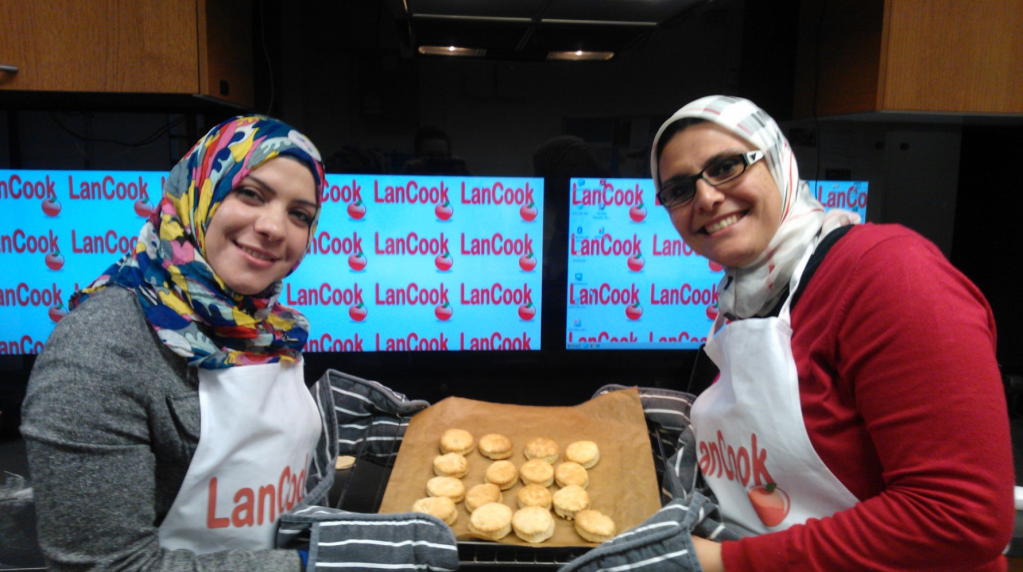
Participants will be actively involved in three kinds of learning opportunity – Presentations, Workshops and Pop-Up Mentoring slots. Presentations will be delivered by leading scholars in postcolonial Englishes around the world. They also have expertise in novel approaches to our understanding of these varieties as products of colonialism, empire and racism. Workshops will provide opportunities to acquire practical skills and expertise for coding, transcribing, visualizing and statistically analysing linguistic data. There will also be hands-on sessions exploring manuscript materials relevant to the history of English and postcolonialism. The importance of acquiring expertise in how to exploit your research to benefit wider publics will be demonstrated in our on-site Digital Kitchen which has been used to teach languages using motion sensor technology. Every early career researcher needs to understand how to navigate the job market. As such, one of the workshops will be devoted to preparing for the next steps in your career. Pop-Up Mentoring slots will be offered as one-time, no strings attached, mentoring sessions that give you the chance to have an informal chat with a mentor about your career, impact or research plans outside of your official support system.
Digital Kitchen
Public health guidance permitting, excursions and social activities will be built into the programme. They include visits to the Holy Island of Lindisfarne and a place name tour of Newcastle which played a key role in both the Slave Trade and the Abolition Movement.




 The Philological Society Blog