The Philological Society is the oldest learned society in Great Britain devoted to the scholarly study of language and languages. It is also a registered charity (no. 1014370). It was established in its present form in 1842, consisting partly of members of a society of the same name established at the University of London in 1830 “to investigate and promote the study and knowledge of the structure, the affinities, and the history of languages”. As well as encouraging all aspects of the study of language, PhilSoc has a particular interest in historical and comparative linguistics, and maintains its traditional interest in the structure, development, and varieties of Modern English.
written by Tomaž Potočnik(UCL), recipient of a travel and fieldwork bursary from the Philological Society
This year, I travelled to Chicago for the Annual Meeting of the Society of Classical Studies, where I read my paper as part of the Greek and Latin Linguistics panel. While reading a paper in front of academics is the main reason to travel to a conference abroad, it is also a chance to experience a new city. I was just as eager to get a feel of the Windy City, to see whether it really is that windy (it is!) and whether that deep-dish Chicago pizza lives up to the hype (it does!).
After spending four years on my PhD thesis, I was anxious to get some feedback on my brand-new project—the interactional aspects of vagueness in Latin. Contrary to what we have been told in elementary school, vagueness is a desirable feature of human communication. Vagueness is, in fact, a part of the speaker’s communicative competence and knowing how to interpret vague expressions is a central feature of everyday conversation (Jucker et al. 2003: 1738). Since this is to some extent true for every language (case studies are accumulating), then it must have been true in Latin as well. The aim of my project, in the wider sense, is to see to what communicative ends vagueness strategies have been used by Latin authors: by Cicero in his letters, by Petronius in his linguistic depiction of different classes of society, and, of course, Plautus and Terence, in their imitations of conversation in Latin.
For the paper I read in Chicago, I focussed on one specific type of vague expressions: placeholders or dummy phrases—the Latin counterparts of words like stuff, business, thingy, and, in the right context, shit! While it is hard to say what the Latin word for stuff was, I discussed examples such as the following one where Olympio is muttering something to himself. When he sees Chalinus, his rival, following him around, Olympio bursts out:
non mihi licere meam rem me solum, ut uolo, loqui atque cogitare sine ted arbitro? ‘I am not going to be allowed to talk and think about my own thing alone, as I please, without you looking over my shoulder?’ (Plautus, Casina 89–90; my free translation)
The speaker’s motivation to use rem is that he does not know how else to describe it—when you are muttering to yourself, thinking you are alone, and someone catches you, it is very hard to find a succinct way to describe what you were doing—in part because it may be quite embarrassing.
The question I was interested in was: Why do placeholders in conversation not interrupt the flow of conversation, since the speaker, semantically, has so little to go on? Why did Chalinus, for instance, not ask: “What thing?”
Part of the answer is that in natural communication, the precise referent assignment—knowing what is meant by each single word—is not a priority; in accordance with the principle of minimising collaborative effort (Clark 1986), both co-interactants exercise a certain degree of tolerance and are willing to sacrifice precise understanding for a higher ideal: that the conversation proceed to the next move as soon as possible—to maintain the flow of the conversation. If it turns out that precise understanding is essential, a speaker always has the option to ask for clarification. This suggests that placeholders, rather than hindering the flow of conversation, actually help to maintain it. This is made possible by rules on conversation structure which all (or most) speakers are implicitly familiar with. It is, ultimately, a manifestation of the fact that conversation is the primordial building block of society (Schegloff 1996: 54)—it is a socially motivated act, whose aim is rarely, if ever, limited to exchange of information.
As I continue working on the project on vagueness, I am grateful to the Philological Society’s Travel and Fieldwork Bursaries program, which enabled me to travel to Chicago and share this work with colleagues from the States—and, after the conference, to enjoy the blues scene that Chicago has to offer and to recreate that iconic scene from Ferris Bueller’s Day Off (1986), where Ferris, Sloane, and Cameron head up to the Sears Tower and lean on the glass panes to get a bird’s view of the city…
References
Clark, Herbert H., Wilkes-Gibbs, Deanna, 1986. Referring as a collaborative process. In: Clark, Herbert H. (Ed.), Arenas of Language Use. University of Chicago Press, Chicago, pp. 107–143.
Jucker, A., S. Smith and T. Lüdge. 2003. ‘Interactive aspects of vagueness in conversation.’ Journal of Pragmatics 35: 1737–1769.
Schegloff, Emanuel A. 1996. Turn organization: one intersection of grammar and interaction. In: Ochs et al., eds. Interaction and Grammar. Studies in Interactional Sociolinguistics. Cambridge University Press. 52-133.
The recording of a past meeting of PhilSoc is now available to view on the Society’s YouTube channel. This meeting was held online and the speaker was Professor Michelle Sheehan (Newcastle).
Causative and perception verbs are highly promiscuous in Romance languages, often permitting many different kinds of reduced non-finite complements. A cross-linguistic comparison reveals that there are nonetheless robust patterns here, with agentive perception verbs permitting only larger Exceptional Case Marking complements and causative verbs tending to permit only smaller clause union complements, and permissive and non-agentive perception verbs sandwiched between these two extremes (see Davies 1995, Soares da Silva 2005). A consideration of long passivisation of these verbs further shows, however, that even complements which appear alike on the surface can behave differently with respect to passivisation both within and across languages. I offer an overview of long passivisation in French, Spanish, Italian and Portuguese and argue that we can nonetheless find patterns in this apparent chaos. Long passives are permitted either where the complements of these verbs are very small (VPs) or where they are large enough to contain a grammatical subject position (TP). Passivisation is blocked where the complements are phasal VoicePs and this follows for principled reasons if we adopt the analysis developed by Sheehan & Cyrino (2022) based on Chomsky’s (2001) Phase Theory.
The recording of a past meeting of PhilSoc is now available to view on the Society’s YouTube channel. This meeting was held in London, at UCL, and the speaker was Professor Amalia Arvaniti, Professor of English Linguistics at Radboud University.
Despite intonation’s relevance for understanding speech, language, and communication, its study is often neglected or reduced to atheoretical phonetic measurements. In the first part of the talk, I will briefly cover the nature and functions of intonation and discuss the reasons why it is often seen as challenging and difficult to study, leading to the aforementioned reductionist approaches. In the second part, I will showcase the ways in which in my research, I try to address these challenges by presenting two complementary studies on the phonological status of high and rising accents (H* and L+H* respectively, in AM terms) in the intonation system of Southern British English. The presence of distinct high and rising accents has been disputed in treatises of English intonation for at least a century, while recent empirical studies provide equally inconclusive evidence. Here, I will present findings on the phonetic nature and information-related function of these accents in spontaneous speech, and present experimental results showing that individual cognitive styles affect how high and rising accents are processed by native speakers. Finally, I will discuss how the combined evidence from production and perception can shed light on this long disputed accentual contrast.
PhilSoc meeting of Friday 16th February 2024 (online)
The recording of PhilSoc’s most recent meeting is now available to view on the Society’s YouTube channel. This meeting was held online and the speakers were Sarah Holmstrom, Joseph Salmons and Charlotte Vanhecke (University of Wisconsin – Madison).
Iambic metrical systems, which have weak-strong feet in contrast to trochaic strong-weak ones, are rare. They represent under 10% of the World Atlas of Language Structures sample and are concentrated in the Americas (Goedemans & van der Hulst 2013). They are generally under-described, and little diachronic research has been conducted on iambic systems. Algonquian, a family of languages stretching over much of northern North America, is one of very few families with a large number of iambic daughters. We provide evidence from this family that can refine our typology of iambic languages. After arguing that Proto-Algonquian was iambic, we investigate how Algonquian languages behave in ways at odds with typological claims about iambic systems. First, iambic lengthening is claimed to be characteristic of iambic systems, but few Algonquian languages have it, while diametrically opposed processes like iambic shortening and change toward typologically dispreferred foot structures are widespread. Second, iambic systems are associated with duration as a cue to prominence while pitch and intensity are typically associated with trochaic systems. However, in Algonquian pitch is a common cue to prominence, which helps motivate the fact that numerous daughters have undergone tonogenesis. Algonquian metrical phonology, diachronic and synchronic, can sharpen our typology of iambic languages in general.
written by Runyi Yao (University of Oxford), recipient of a travel and fieldwork bursary from the Philological Society
With support from the Philological Society’s Travel Bursary, I presented my poster at Sinn und Bedeutung 28 (SuB 28, https://www.ruhr-uni-bochum.de/sub28/) at Ruhr University Bochum, Germany from 5th–8thSeptember 2023. SuB is a world-leading conference in semantics. The Travel Bursary allowed me to attend this conference, share and discuss my research with other linguists.
SuB 28 group photo
In my poster, I presented our study on clause-internal coherence (in collaboration with Prof Matt Husband & Prof Daniel Altshuler). Most studies of discourse coherence focus on relations like Result (cause-effect) and Explanation (effect-cause) that are established between two discourse units whose size is at least a single clause. Such relationships may, however, also be clause internal. We investigate clause-internal coherence triggered by resultative adjectives in examples like The broken window got struck with a stone ⇝ ‘the window was broken because of the stone.’ Based on the results of two comprehension tasks, we propose that topichood, signaled by definiteness and subjecthood, permits and constrains plausible causal inferences clause-internally. This analysis suggests a tighter relationship between (morpho)syntax and coherence than is currently assumed. The full version of this study will appear in Proceedings of Sinn & Bedeutung 28, with a preprint available on LingBuzz: https://ling.auf.net/lingbuzz/007850.
Presenting at SuB 28 was a great opportunity for me to receive feedback and comments on this coherence study, an integral part of my DPhil project. The insights that I gained from the conference contribute significantly to the advancement of my DPhil studies. This opportunity also enables me to learn about others’ work, network with colleagues from around the world and receive general advice on career development.
I am grateful to the Philological Society for providing me with a travel bursary to participate in SuB 28, a wonderful conference.
written by Khouloud Benassar (Hassan II University of Casablanca, khouloud.benassar-etu@etu.univh2c.ma), recipient of a travel and fieldwork bursary from the Philological Society
With support from the Philological Society’s Travel Bursary, I attended the 52nd Colloquium on African Languages and Linguistics (CALL 2023), which took place at Leiden University, Netherlands, from 28th–30th August 2023. The colloquium had sixty-three presentations, studied various African Languages, and covered broad topics in linguistics, including phonetics, phonology, morphology, syntax, and semantics.
As part of the Wednesday morning session of the colloquium, I gave a 20-minute presentation entitled ‘Sensory Metaphors in Moroccan Arabic: A Cognitive Approach’, followed by 10 minutes of discussion. In this presentation, I investigated how our senses—vision, hearing, touch, smell, and taste—give rise to abstract concepts in Moroccan Arabic, leading to what is called sensory or perception metaphors, such as KNOWING IS SEEING, which have previously been studied by cognitive linguists such as George Lakoff and Mark Johnson (1980, 1999), Eve E. Sweetser (1990) and Christopher Johnson (1999).
The presentation also discussed whether sensory metaphors are universal, since they are based on our biological propensities, or if there is a place for cross-linguistic and cross-cultural variation and diversity. Based on data analysis, I argued that Moroccan Arabic shares many sensory metaphors with other languages, supporting the universality hypothesis. However, a comparison of sensory metaphors in Moroccan Arabic with those in other languages, as studied by various scholars, reveals significant variation. Therefore, it is important to consider both cognitive and cultural dimensions when studying sensory metaphors.
My participation in the colloquium enabled me to get valuable feedback on my research from various researchers in the field including Professor Maarten Mous and Professor Maarten Kossmann. Other researchers additionally mentioned that some metaphors discussed in Moroccan Arabic are also used in other languages; for example, the OBEYING IS HEARING metaphor is also used in German.
I am grateful to the Philological Society for supporting my PhD research with a travel bursary to participate in person in the 52nd Colloquium on African Languages and Linguistics. This opportunity has allowed me to meet and be inspired by a community of linguists from outside my home country.
Johnson, Christopher. 1999. ‘Metaphor vs. conflation in the acquisition of polysemy: the case of see’. In Cultural, Psychological and Typological Issues in Cognitive Linguistics, edited by Masako K. Hiraga, Chris Sinha, and Sherman Wilcox. Vol. 152. Current Issues in Linguistic Theory, IV. Amsterdam: John Benjamins Publishing Company.
Lakoff, George, and Mark Johnson. 1980. Metaphors We Live By. Chicago: The University of Chicago Press.
Lakoff, George, and Mark Johnson. 1999. Philosophy in the Flesh: The Embodied Mind and Its Challenge to Western Thought. New York: Basic Books.
Sweetser, Eve E. 1990. From Etymology to Pragmatics: Metaphorical and Cultural Aspects of Semantic Structure. Cambridge: Cambridge University Press.
An event supported by PhilSoc: 17th November 2023, Weston Library, Oxford, 3-6 p.m.
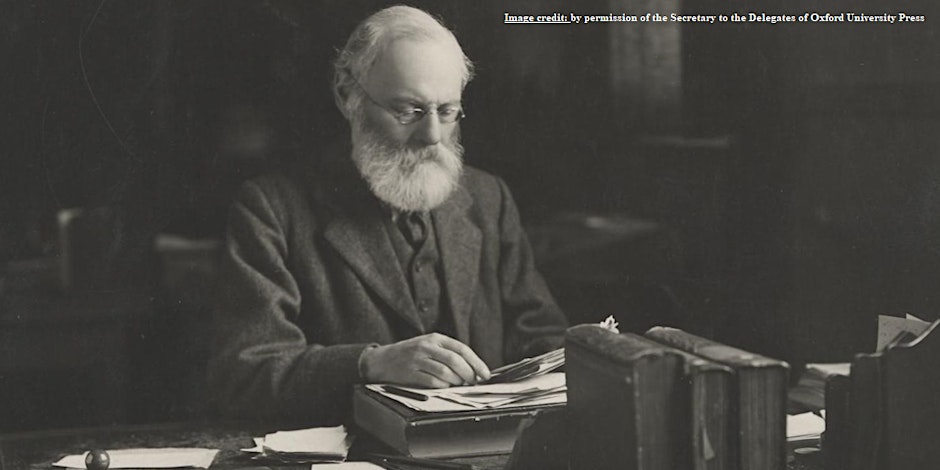
It has been Henry Bradley’s fate to be remembered as ‘only’ the second Editor of the Oxford English Dictionary, always overshadowed by James Murray. This event aims both to celebrate and recontextualize his achievements – not just as a lexicographer, but as a writer, historian, and scholar in a variety of contexts. When he died in 1923, his former OED assistant J. R. R. Tolkien paid tribute to him, in Old English, as a sméaþoncol mon (a ‘man of subtle thought’). One hundred years after his death we offer a long-overdue reappraisal of his life and scholarship in a series of papers.
written by Frances Dowle (University of Oxford), recipient of a travel and fieldwork bursary from the Philological Society
With the generous support of the Philological Society’s Travel Bursary, I was able to attend the 28th International Lexical-Functional Grammar (LFG) Conference, which took place this year at the University of Rochester, NY from 21st to 24th July this year.
The funding from the Philological Society allowed me to travel in person to present my poster on complementizer-verb interactions in Welsh.
Presenting my poster at the 28th International LFG Conference
My poster sought to provide an explanation for why the modern day main clause complementizers /mi/ and /vɛ/ cannot occur with certain forms of the verb ‘be’ in Welsh (Borsley et al., 2007: 35). I argued that the behaviour of the forms in question could be explained with reference to their diachronic development (Jones, unpublished). In south Welsh dialects, the forms excluded from occurring with a main clause complementizer have clearly developed as a result of the phonological erosion of the old affirmative complementizer /ə(r)/. The erosion leads to the complementizer surviving only as the onset consonant of the vowel-initial finite ‘be’ verb forms:
A similar process of erosion took place with the negative complementizer:
(2) nɪd + ɔɪð > dɔɪð
C.NEG + be.IMPERFECT.3SG > NEG.be.IMPERFECT.3SG
These phonological changes resulted in the development of specialised forms of the verb ‘be’: the affirmative ‘r-be’ forms and the negative ‘d-be’ forms. The old, vowel-initial forms of ‘be’ were retained only after other types of complementizer, such as os ‘if’. When new affirmative complementizers emerged in Welsh, speakers did not begin to use these complementizers with the ‘r-be’ form, even though the origin of these forms is opaque to modern speakers of the language. I argued that because forms like /rɔɪð/ occupy the same position in a clause as sequences of overt complementizers like os ‘if’ and a vowel-initial verb form, speakers can acquire the knowledge that forms like /rɔɪð/ function as both complementizer and verb. In other words, the ‘r-be’ forms like /rɔɪð/ are assigned two categories in the c-structure (tree structure in LFG): both C (complementizer) and I (inflected verb). In LFG, this dual category status of a single word can be modelled using Lexical Sharing (Wescoat 2002). Familiar principles of category assignment and complementary distribution then explain why this ‘r-be’ form cannot co-occur with either a complementizer or a finite verb (since words of the same category generally cannot cooccur outside of coordination structures). Further details can be found on the 28th International LFG Conference website (https://sas.rochester.edu/cls/lfg23/program/), where a .pdf version of my poster is available.
As well as having the opportunity to present my work, I also gained a lot from being able hear about others’ work, and from the many follow-up conversations that resulted from the huge range of interesting talks. I was particularly interested to hear about Elaine Ui Dhonnchadha’s work on implementing a computational grammar of Irish in XLE (a computational implementation of LFG). I was particularly interested to hear her proposals for modelling mutations in Irish, as this is an aspect of computational grammar development that presents unique challenges, and is also pertinent to Welsh. I left her talk feeling inspired and I hope to start exploring this aspect of LFG work more in the future. There was also a special session at the conference on the theme of lexical integrity, which is particularly relevant to my doctoral research and the poster that I presented, since Lexical Sharing is one of several recent challenges to the idea of lexical integrity that has surfaced within LFG.
I am very grateful to the ever welcoming and supportive LFG community for sharing their time, energy and expertise with me across this fantastic week. I had so many wonderful discussions, ranging from detailed theoretical topics to general advice on career development. This is truly a very special academic community.
Some of the in-person attendees of the 28th International LFG conference. I am second from the left. Photo by Dan Siddiqi.
I am incredibly grateful to the Philological Society for their generous travel bursary, without which I would not have been able to attend this wonderful conference.
References
Borsley, R., Tallerman, M. & Willis, D. (2007) The Syntax of Welsh. Cambridge: Cambridge University Press.
written by Vasiliki Vita (SOAS University of London), recipient of a travel and fieldwork bursary from the Philological Society
1. Introduction
As a Micronesianist, I was not sure how my contribution at a conference about African Linguistics would be significant. However, when I was invited to work with Tom Jelpke and John Kyamanywa in Uganda, I thought this would be an excellent opportunity to share knowledge and learn more about Uganda and its languages. Thanks to a Philological Society bursary, I managed to travel to Uganda for 10 days in order not only to fulfill the goals of a British Institute in Eastern Africa Thematic Research Grant, but also attend the Languages Association of Eastern Africa 3rd Conference on “Empowering Communities through Language Research and African Linguistics for Sustainable Development”. In the title, I use wayfinding as defined by Iosefo, Harris & Holman Jones (2020: 23), “an embodied, practical, adaptive and relationally driven practice, … [that] calls on researchers to immerse themselves in journeys of discovery and transformation that value [Indigenous] cultural knowledges and acknowledge [their] blind spots”. In the case of this journey, the war[1]was not our piko[2]. It was the Boda Bodas, local motorcycle taxis, that carried us through this journey. I am also using the plural “we” because I will be talking about this journey as one that “cannot be viewed as belonging to any one person, and wayfinding is never done on one’s own” (Iosefo, Harris & Holman Jones 2020: 21).
2. LiVanuma and stories
LiVanuma is a language spoken in Bundibugyo, Western Uganda, near the border with the Democratic Republic of Congo. According to CCFU (2015), the BaVanuma ethnic group is estimated to have fewer than 25,000 people in Uganda, many of whom do not speak the language (Kyamanywa & Jelpke forthcoming). Building on their research, Kyamanywa and I embarked on a journey to document family histories, experiences, and languages. The aim is to compile a biographical (hi)storybook to tell the stories of BaVanuma people in Uganda in their own language (Jelpke, Kyamanywa & Vita 2023).
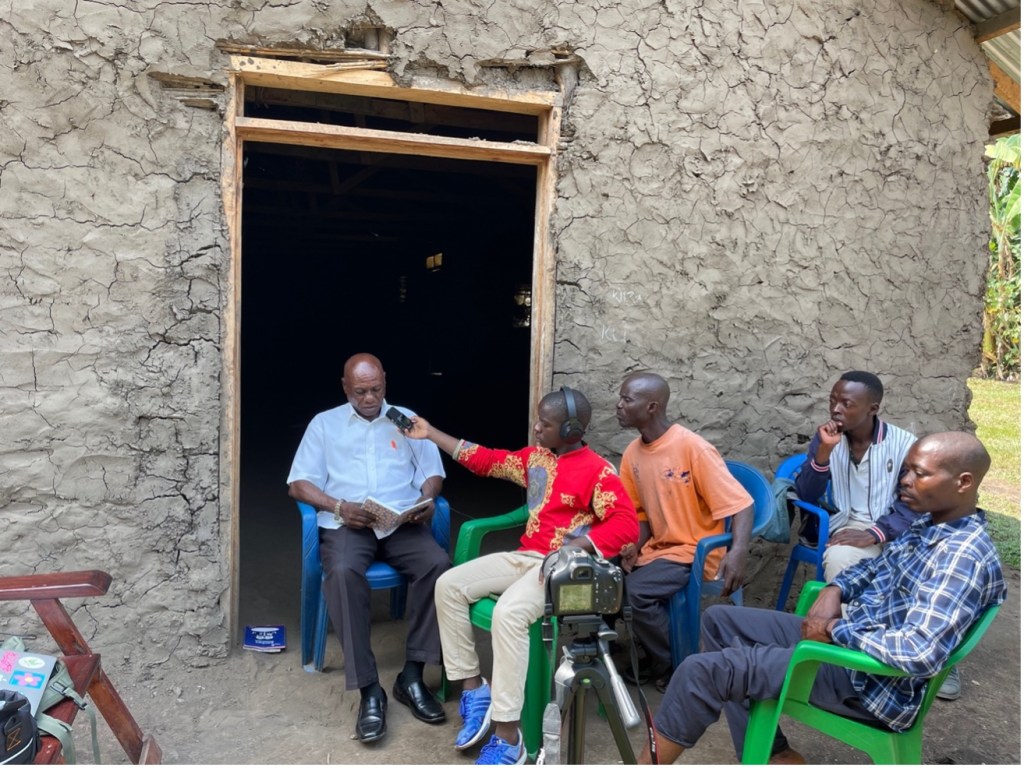
Figure 1. Making the first recording in Burondo 2 (from left to right: Bamuroho Masagazi, John Kyamanywa, Mustafa Katikiro, Michael Akiiza, Robert Musinguzi).
3. Wayfinding in Bundibugyo
To document these stories, we flexibly travelled on Boda Bodas from village to village to reach BaVanuma people who were willing to share their story (see Figure 1 for example). We must recognize the contribution of local coordinators for reaching out to various speakers and getting us in touch with them. Later, attending the conference, Wizlack-Makarevich (2023) referred to this kind of language documentation as the “helicopter method”, of going from place to place, gathering data, and relying on local intermediaries to help make the connections.
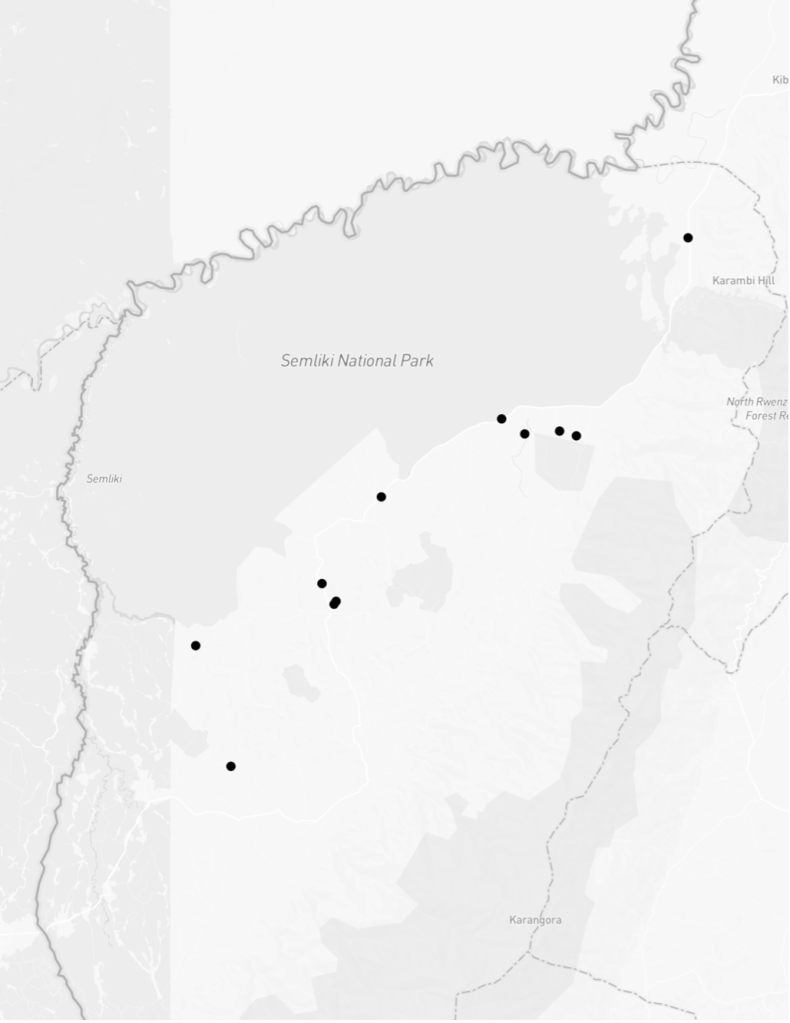
The piko here might physically be a different one, but it is still a war that allowed us “to stay in continual communication with the world around” us (Rogers 2020: 153), and “to move from stillness, bringing the island to [us] through ‘be-coming’” (Spiller 2016: 31). Like Pacific wayfinders we used our war as “the geographical centre of navigational orientation” (Eckstein & Schwarz 2019: 30) and removed “the lines on the map that segregate and compartmentalize” (Iosefo, Harris & Holman Jones 2020: 21) our world (see Figure 2 for a map of our journey with the black dots symbolizing the villages we visited).
The documentation process included making audio and video recordings of speakers narrating family stories, talking about their relatives, experiences living in Uganda and what the LiVanuma language means to them in terms of personal and community identity, as well as wellbeing. After narrating their story, speakers were encouraged to listen to their story and write it down (Figure 3). Participants in Kyamanywa and Jelpke (forthcoming)’s project had expressed an interest in writing the language.
Figure 3. Bamuroho Masagazi writing his family story (from left to right: Bamuroho Masagazi, John Kyamanywa, Mustafa Katikiro, Michael Akiiza, Robert Musinguzi).
4. Kampala and LAEA 3
The journey back to Kampala was a tiring one with us taking a different war this time and 10 hours to reach our destination. John and I talked about the mountains in the Bundibugyo District and reminisced about our journey through them. As Conquergood (2002: 146), Iosefo, Harris & Holman Jones (2020: 23) put it, our wayfinding was not just “moving and inhabiting”, but “a relational practice with the earth and sky”, “anchored in practice and circulated within a performance community”. After getting enough rest, we prepared for a full two days of conference talks learning about the work of colleagues in Africa.
In the first plenary talk, Nyaga (2023) focused on promoting mother tongue education and encouraged everyone to speak African languages at home. Kyamanywa and Jelpke’s talk then started, where they presented the preliminary results on documenting the LiVanuma sociolinguistic landscape. It was interesting to see people’s reactions in the audience, with many Ugandan researchers noting that they had never heard of the BaVanuma people and their language before. As wayfinders, we share stories in true embedded and embodied fashion through relationship and collective engagement with multiple ways of knowing (Gounder 2015).
What I found most interesting, was the plenary on the second day by Alena Witzlac-Makarevich. Wizlack-Makarevich (2023) encouraged for the multi-modal documentation of African languages, which comparatively to other places around the world is lagging (Lüpke 2019). She talked about the importance of data governance and recognizing the value of corpora in language maintenance and promotion, especially for endangered languages.
My talk was also on the second day. Listening to other researchers, I realized once again, that boundaries are fluid, and knowledge is to be shared regardless of where it was acquired. “Hyper-collaboration” in the sense used in Di Carlo et al. (2022) and Vita, Nestor & Marino (2023) focuses on the value of the network that can be activated at any time for activities that benefit the group most impacted. Language-related initiatives and activities presented at the conference also showcase the fact that they all start with documenting and reaching out to tradition but are borderless and rooted in the desire for belonging (see for example Okurut, Kiguli & Tibasiima (2023) discussing the music of an expatriate Ugandan artist).
5. Conclusion
Our wayfinding in Uganda was not limited by borders and lines on the map. It was active, intimate, hands-on, and participatory, like the ‘traditional’ knowledges of Pasifika people (Iosefo, Harris & Holman Jones 2020). Attending the 3rd Conference of the Languages Association of Eastern Africa was an invaluable experience not only for sharing our work, whether that is with John and Tom, the Young Historians of Sonsorol or the virALLanguages initiative, but also discovering the work of African colleagues and further work on the documentation and maintenance of linguistic diversity. My wayfinding continues and I am thankful for all the individuals who consider me worthy to invite to the journey.
Endnotes
[1] Sonsorolese word for “canoe” which is nowadays used to describe any means of transport, including airplane and car
Di Carlo, Pierpaolo, Leonore Lukschy, Sydney Rey & Vasiliki Vita. 2022. Documentary linguists and risk communication: views from the virALLanguages project experience. Linguistics Vanguard. De Gruyter Mouton. https://doi.org/10.1515/lingvan-2021-0021.
Eckstein, Lars & Anja Schwarz. 2019. The Making of Tupaia’s Map: A Story of the Extent and Mastery of Polynesian Navigation, Competing Systems of Wayfinding on James Cook’s Endeavour , and the Invention of an Ingenious Cartographic System. The Journal of Pacific History 54(1). 1–95. https://doi.org/10.1080/00223344.2018.1512369.
Gounder, Farzana (ed.). 2015. Narrative and Identity Construction in the Pacific Islands (Studies in Narrative). Vol. 21. Amsterdam: John Benjamins Publishing Company. https://doi.org/10.1075/sin.21.
Iosefo, Fetaui, Anne Harris & Stacy Holman Jones. 2020. Wayfinding as Pasifika, indigenous and critical autoethnographic knowledge. In Wayfinding and Critical Autoethnography. Routledge.
Jelpke, Tom, John Kyamanywa & Vasiliki Vita. 2023. Cultural-linguistic priorities of a minority community: folk history, language documentation, and orthography development with the BaVanuma people of Bundibugyo, Western Uganda. British Institute of Eastern Africa Annual Thematic Research Grants 2023-2024.
Kyamanywa, John & Tom Jelpke. forthcoming. LiVanuma linguistic vitality: A sociolinguistic documentary project.
Lüpke, Friederike. 2019. Language Endangerment and Language Documentation in Africa. In H. Ekkehard Wolff (ed.), The Cambridge Handbook of African Linguistics, 468–490. 1st edn. Cambridge University Press. https://doi.org/10.1017/9781108283991.015.
Nyaga, Susan. 2023. Comparative issues in mother tongue advocacy in Africa: can negative attitudes towards African languages be changed? In The Third Conference of the Language Association of Eastern Africa. Kampala, Uganda.
Okurut, Lazarus, Susan Kiguli & Isaac Tibasiima. 2023. Place and Belonging in the songs of Madoxx Ssemanda Ssematimba. In The Third Conference of the Language Association of Eastern Africa. Kampala, Uganda.
Rogers, Christine. 2020. Almost always clouds: Stitching a map of belonging. In Wayfinding and Critical Autoethnography. Routledge.
Vita, Vasiliki, Daphne Nestor & Lincy Marino. 2023. Experiences from documenting Ramari Dongosaro in a multilingual context. In. Online.
Wizlack-Makarevich, Alena. 2023. Creating and utilizing corpora for language description and development: lessons learned from three projects across the African continent. In The Third Conference of the Language Association of Eastern Africa. Kampala, Uganda.





 The Philological Society Blog