30th Germanic Linguistics Annual Conference (GLAC) at Indiana University, Bloomington, IN

written by William Thurlwell (University of Oxford), recipient of a travel and fieldwork bursary from the Philological Society.

With the generous support of the PhilSoc Travel and Fieldwork Bursary, I had the opportunity to attend the 30th Germanic Linguistics Annual Conference (GLAC) at Indiana University, Bloomington, IN in April 2024.

The conference is amongst the best attended and most prestigious in the annual calendar for Germanic linguists. Having previously attended the 28thand 29th GLACs in Athens, GA, and Banff, AB, I knew how enriching and engaging it can be to hear about the work undertaken by others in the field and to receive feedback about my own research. This year was no different: my experience at 2024’s GLAC, on both a professional and personal level, was extremely rewarding.
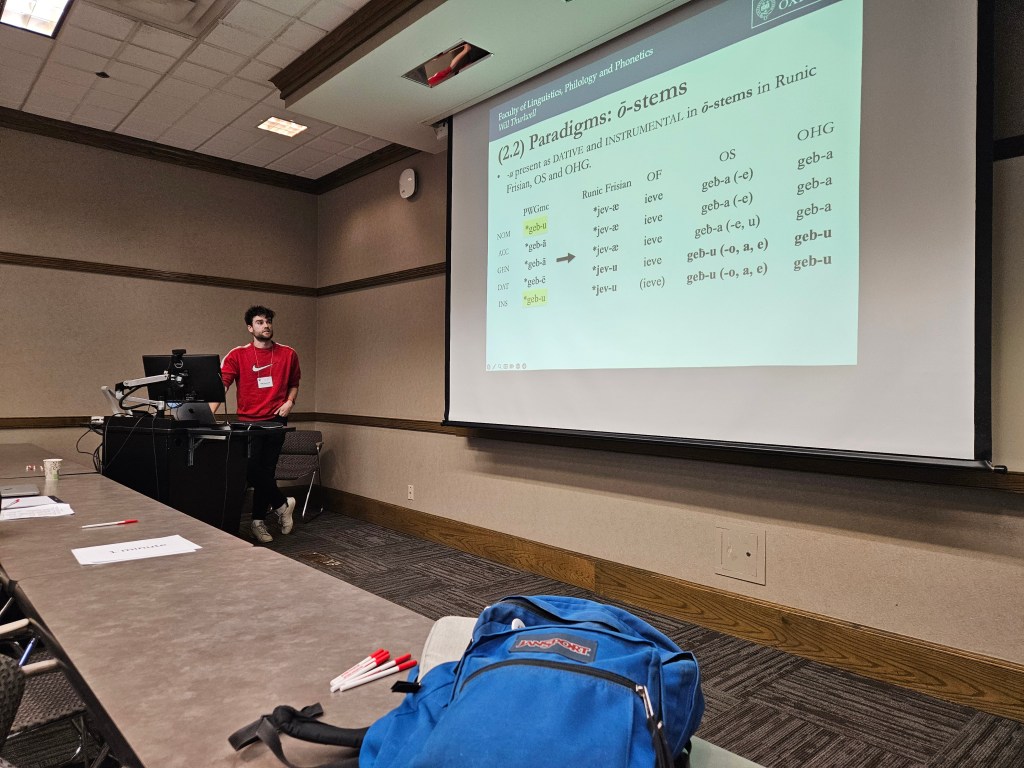
Presenting ‘Remnant Case Forms and Patterns of Syncretism in Early West Germanic’. Photo by Elijah Peters.

I presented two papers at this year’s conference.

The first paper pertained to a philological aspect of my DPhil research, titled ‘Remnant Case Forms and Patterns of Syncretism in Early West Germanic. In this paper, I examine the form and distribution minor morphological elements (-i and -u suffixes) which are used to convey remnant instrumental and locative functions in the a/ō-stem nouns of certain old West Germanic (WGmc) languages. Early Old English (OE) generalises its locative and instrumental functions under its ‘instrumental’ ­-i suffix (which later reduces to -e, the formally autonomous morpheme found in the strong inflection of masculine and neuter adjectives in later OE). By contrast, the continental WGmc languages (i.e. Old High German, Old Saxon, and Runic Frisian) generalise instrumental functions under the suffix -u, although some locative functions survive in a small number of tokens with an -i suffix. I propose that the divergent generalisations of the functions of the different instrumental morphemes are what motivate the dichotomy in the patterns of syncretism in the feminine ō-stems of continental WGmc and OE respectively. 

The bridging factor between the instrumental case and the ō-stem paradigms is the -u morpheme. In Proto-WGmc, the nominative and instrumental are reconstructed as being syncretic in the feminine ō-stems under the suffix *-u (< Proto-Gmc *-ō):

Table 1. Development of ō-stems from Proto Germanic to Proto West Germanic.

 Proto-GmcProto-WGmc
nom*geb-ō*geb-u
acc*geb-ǭ*geb-ā
gen*geb-ōz*geb-ā
dat*geb-ōi*geb-ē
ins*geb-ō*geb-u
Based on Ringe (2017: 312) and Ringe and Taylor (2014: 114).

There was a divergence in the salience of the -u morpheme across WGmc, since the historical -u is maintained as a marker for different cases in different parts of WGmc. OE favours the nominative function (at least in light-stemmed nouns) and continental WGmc favours the instrumental function. This can be seen in how the instrumental form was replaced in OE with -i, but not in continental WGmc, where the prominence of the -u morpheme persists and even proliferates, since the dative also merges under this ending.

Table 2. Paradigms of light-stemmed ō-stems in the West Germanic languages.

Old EnglishContinental WGmc
Pre-OEEarly WSLate WSRunic FrisianOSOHG
*geƀ-uġief-ugif-u*jev-ægeƀ-a (-e)geb-a
*geƀ-ǣġief-ǣgif-e*jev-ægeƀ-a (-e)geb-a
*geƀ-ǣġief-ǣgif-e*jev-ægeƀ-a (-e, u)geb-a
*geƀ-ǣġief-ǣgif-e*jev-ugeƀ-u (-o, a, e)geb-u
*?(ċæstr-i)gif-e*jev-ugeƀ-ugeb-u
Based (from left to right) on Ringe and Taylor (2014), Goering (2023), Versloot (2016a), (2016b), Gallée et al. (1993), and Braune and Heidermanns (2023). Forms marked with † are not explicitly provided in the paradigms of referenced source, but tokens fitting these cells are found in extant sources. WS = West Saxon.

All of WGmc was subject to the apocope of high vowels after heavy stems (Fulk 2018: 82-3), which would have led to the retention of *-u in light-stemmed ō-stems only. This suffix only survives in the nominative in OE, but would have also been expected to survive as the light-stemmed instrumental, based on reconstructions, but there is no evidence that an instrumental *geƀ-u form survives (hence the *? in the cell in the above table).Ringe and Taylor (2014) propose that OE generalises an instrumental -i in this cell from the interrogative pronoun, whereas continental WGmc clearly maintains the inherited -u.

The generalisation of -i and replacement of -u in OE suggests that the salience of -u—at the time when it would have likely still been a syncretic morpheme in pre-OE—was analysed as nominative over instrumental. In continental WGmc, the converse was true: -u was lost as a nominative marker (and the nominative becomes syncretic under the accusative and the genitive form), but spreads as the instrumental and dative marker. This demonstrates how changes to the instrumental case in these two separate subgroups of WGmc sit at the heart of the developments in the syncretism patterns of the feminine ō-stems. The divergent salience of the historically syncretic -u morpheme is the primary motivator for why the ō-stems syncretise differently in different parts of WGmc.

The second paper I presented was a joint submission with my supervisor, Howard Jones, and recent Oxford DPhil student, Luise Morawetz, to present our progress about the book we are writing together under contract with Oxford University Press: The Oxford Guide to Old High German and Old Saxon. The purpose of the talk was to show what we have done so far, explain the rationale for the grammar and reader sections of the book, and to get feedback from peers in the field to ensure that the remainder of the project will best fit the needs of our intended audience: students and researchers of Old High German (OHG) and Old Saxon (OS).

I was very pleased with the feedback and questions I received to both of my talks. I received constructive suggestions about how to refine the approach to my personal research. Several fellow students and scholars offered motivating words about the book project and made useful suggestions as to how we might make the OHG/OS volume maximally useful both to those new to old Germanic languages and those who already have considerable experience with them.

Connecting with colleagues both old and new, having the chance to discuss new research ideas, and getting informal career advice was invaluable for me as I conclude my DPhil and plan the next steps in my academic journey. After three days of busy conferencing, I also took some time to explore parts of the Midwest and beyond, enjoying the rich cultural offerings of Indiana, Kentucky, Tennessee, and Illinois: I saw grand natural wonders, such as Mammoth Cave, the bustling metropoles of Indianapolis, Nashville, and Chicago, and the downright weird and wonderful, such as the World’s Largest Rocking Chair in Casey, IL. A personal highlight was being able to take my newfound hobby of running to American pastures, taking first place at the Cornerstone Lakes parkrun, a timed 5k which takes place on a weekly basis in the outskirts of Chicago.

Running at Cornerstone Lakes parkrun in the outskirts of Chicago.

Being able to attend conferences during my time as a DPhil student has been nothing short of formative in developing my research methodology and—pardon the pun—‘instrumental’ in furthering my academic confidence. Most importantly, I have forged new professional relationships and personal friendships across disciplines and continental boundaries. I would like to thank the Society again for their incredibly generous support in facilitating my attendance at GLAC in 2024. 

References

Braune, Wilhelm & Heidermanns, Frank, 2023. Althochdeutsche Grammatik I, Berlin: De Gruyter.

Fulk, R. D., 2018. A Comparative Grammar of the Early Germanic Languages, Amsterdam: John Benjamins Publishing Company.

Gallée, Johan Hendrik, Lochner, Johannes & Tiefenbach, Heinrich, 1993. Altsächsische Grammatik, Tübingen: M. Niemeyer.

Goering, Nelson, 2023. Prosody in Medieval English and Norse, Oxford: Oxford University Press.

Ringe, Don, 2017. From Proto-Indo-European to Proto-Germanic, Oxford: Oxford University Press.

Ringe, Donald A. & Taylor, Ann A., 2014. The Development of Old English, Oxford: Oxford University Press.

Versloot, Arjen 2016a. ‘The Development of Old Frisian Unstressed –U in the Ns of Feminine Ō-Stems’. In: Bannink, A. & Honselaar, W. (eds.) From Variation to Iconicity: Festschrift for Olga Fischer on the Occasion of Her 65th Birthday, Amsterdam: Uitgeverij Pegasus.

Versloot, Arjen 2016b. ‘Unstressed Vowels in Runic Frisian. The History of Frisian in the Light of the Germanic ‘Auslautgesetze’’, Us Wurk, 65, 1-39.
Manchester Forum in Linguistics 2023 

written by Vanessa Fung (University of Manchester), recipient of funding from the Philological Society’s Public Events and Outreach fund.

The Manchester Forum in Linguistics (MFiL) is an annual two-day conference held at the University of Manchester. This year we celebrated the ten year anniversary of MFiL, which took place on 20th and 21st of April 2023, and marked a return to a fully in-person format following the pandemic. Each year, we invite talks from early career researchers and students from all areas of linguistics, with the aim of sharing current theoretical and methodological work within the field. The conference is especially interested in talks that employ novel empirical methods, and research that has wider implications for linguistic theory generally. MFiL is an opportunity for those at early stages of their careers to share their work and connect with other linguists. 

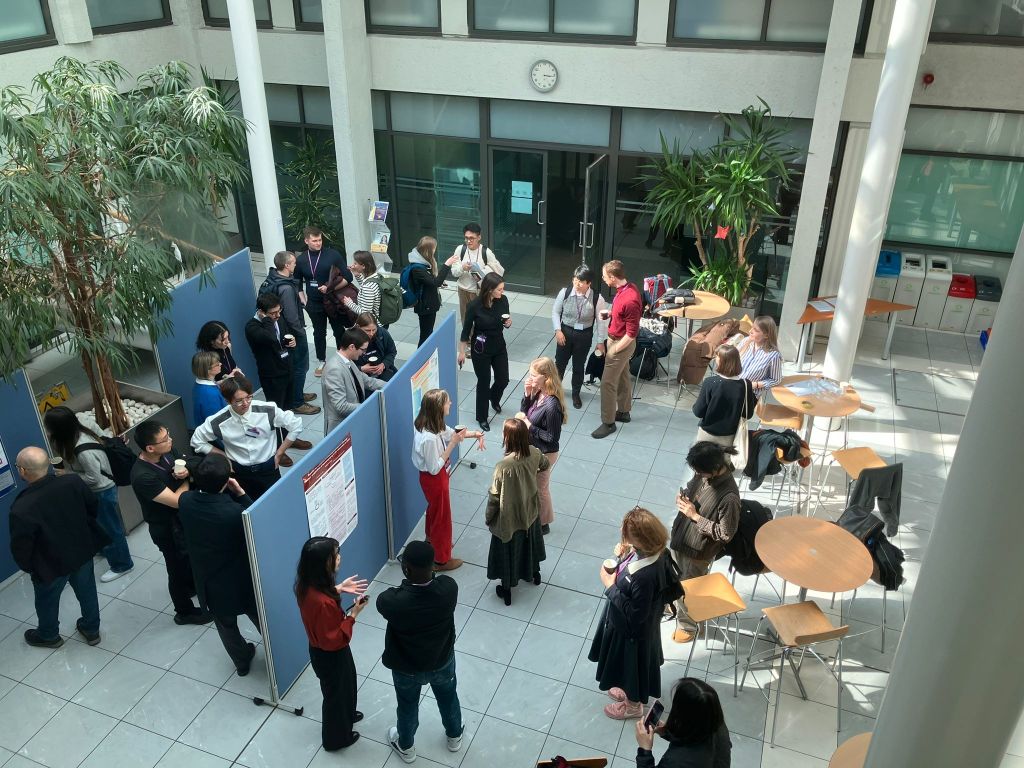
MFiL poster session.

The organising committee is entirely made up of volunteers, all postgraduate research students from the Department of Linguistics and English Language. Without financial support, it would not be possible to run MFiL. We gratefully acknowledge the Philological Society for their generous contribution to our event through the Public Events and Outreach fund. As a result, and in spite of the rising costs associated with organising the conference, we were able to avoid increasing the registration fee, therefore, keeping MFiL financially accessible to anyone with an interest in linguistics and the study of language generally. This year, we welcomed talks from four plenary speakers and twenty one presenters from a range of institutions, both in the UK and abroad. The areas covered by the conference included: sociolinguistics, semantic fieldwork, typology, historical syntax, and pragmatics (amongst others). In addition to the presentations, each year MFiL also includes a careers panel, which provides an open forum for conference attendees to ask the plenary speakers about career opportunities and gain insights into working in academia.

MFiL 2023 was a great success, achieving our goals of connecting linguists across a variety of disciplines, and prompting interesting discussions. We would like, again, warmly to thank the Philological Society for their financial support.

Workshop on the Afroasiatic Middle t-Morpheme

written by Iris Kamil (University of Edinburgh), recipient of a travel and fieldwork bursary from the Philological Society

The workshop on the Afroasiatic Middle t-Morpheme was held over two days, from the 8–9 of May 2024 at the University of Edinburgh’s Department of Linguistics and English Language. 

Across Afroasiatic, middle morphology (i.e. the expression of reflexives, passives and anticausatives) appears to be expressed by a uniform set of morphemes, n– and t-. However, no studies or joint efforts had previously been undertaken with the aim of compiling the different contexts and rules with which these morphemes may be used, nor of mapping out the morphemes’ diachronic development. Although these morphemes had received some past treatment (though mostly only in Semitic and Berber), the precise scope and function of the morphemes remained obscure and ambiguous. 

The goal of this workshop was thus a first attempt at compiling the patterns of middles across Afroasiatic, starting with the t-morpheme, bringing together scholars working in different methodologies and different fields of study. It was hoped that (a) the exchange of different approaches and (b) the exploration of various patterns across languages could help us to workshop the function and scope of the morpheme and better understand its diachronic development.

Our workshop featured a wide range of methodological frameworks, including generative grammar, diachronic typology, frameworks at the syntax-phonology interface, philology and the historical-comparative method. We had talks on Semitic, Berber, Cushitic and Egyptian, featuring over twenty different languages within these four families. The data presented ranged from corpora attestations as early as 2,500 BCE to recently-collected fieldwork data (some even collected within the last year). Among the participants were PhD students, post-doctoral researchers, lecturers and assistant and tenured professors. In regard to the exchange of information, the workshop was thus highly successful. It was held in hybrid format, in order to increase accessibility and enable participation from a global audience. Indeed, we drew an audience from five continents, with fourteen in-person participants and around 35 online attendees.

The final day concluded with a lengthy discussion (of around one and a half hours) concerning the recurring patterns explored throughout the two days, as well as hypotheses and approaches to how one might treat the morpheme both synchronically and diachronically.

Not only has the workshop been immensely useful to my own research and thesis, but it has hopefully also had an impact on Afroasiatic, theoretical and typological linguistics. We hope that this workshop improved our general understanding, not only of the t-morpheme in Afroasiatic, but also of Afroasiatic middle morphology in general. The workshop will have proceedings, likely in the form of a special edition journal, and will hopefully return for a second instalment in the future, again with the premise of special focus on only one grammatical form.

The workshop would not have been possible if not for the kind support of the Philological Society, which allowed us to cover the hospitality needed to welcome our speakers. The experience of organising an event of this magnitude, with the support of so many helpful hands, was furthermore immensely beneficial to my academic skills training, and an opportunity I am well aware not every PhD student gets.

Petitioning for poor relief in Scotland, 1750–1900

written by Hester Groot (Leiden University), recipient of a travel and fieldwork bursary from the Philological Society

With the generous support of the Philological Society’s Fieldwork and Travel Bursary, I was able to travel to Scotland for four weeks in January and February of 2024 to collect data for my PhD research. My research focuses on so-called pauper letters, written by the Scottish poor to request relief, and spans the period of 1750-1900. 

Hester Groot sorting through boxes of nineteenth-century letters in the Ewart Library in Dumfries.

The focus on lower-class writing is one that has come to the forefront of historical sociolinguistic research in recent years. Traditionally, research into historical language focused primarily on the language of the upper classes, those with wealth and power and names in history books. There are various reasons for this, one being that lower-class data simply isn’t as readily available as that of the upper classes. Selective archival practices, as well as low historical literacy levels, have left lower-class populations’ language use and written documents underrepresented in historical linguistic studies. Recent developments in historical sociolinguistics, however, have foregrounded a focus on ‘language from below’, which emphasises underrepresented, often lower-class historical language use in order to form more well-rounded, diverse, and nuanced perspectives on language histories (Elspaβ 2007). In the case of Scotland, looking at lower-class writing in eighteenth- and nineteenth-century letters may elucidate the origins and development of Scottish Standard English, as well as help us trace the trajectory and development of Scots. 

This focus relies on the availability of primary sources that can give us insight into the lower classes’ language. One type of source coming under increasing attention is that of the pauper letter. Pauper letters were written in the eighteenth and nineteenth century to request poor relief in countries such as England, Wales, and Germany, and are interesting from a ‘from below’ perspective: they are rooted in a lower-class environments and at times written by the petitioners themselves (though we often encounter petitions written by family, friends, or scribes too). In recent years, large numbers of these pauper letters have surfaced in different countries; these letters were often preserved in bundles as documentation of poor relief, saved by inspectors of the poor and parochial boards. This makes the avaibility of such letters an exciting and unique avenue for investigating the language of the lower classes. Scholars have made increasing use of them as a source over the last few years: among previous work on pauper letters are studies on English pauper letters (Sokoll 2006; Auer and Fairman 2013) and German letters (Gestrich and King 2011). In the case of Scotland, historians Peter Jones and Steven King discovered and wrote on bundles of pauper letters in the Scottish Highlands, and the ScotPP project (Gordon, Prokic, Groot and Strakova 2022) published a number more. These studies indicated the potential existence of large numbers of yet-to-be-discovered pauper letters. A larger set of these letters would allow for more substantial research and substantiated claims, and would increase the regional and diachronic spread of these materials, opening up yet more research possibilities.

With the Philological Society’s support, I was able to travel to Scotland in order to uncover as many pauper letters and related materials from the country’s archives as possible. Together with my supervisor, Dr. Moragh Gordon, I visited archives in, among others, Edinburgh, Perth, Aberdeen, Inverness, and Glasgow. Of course, while a lot of preparatory work can be done beforehand, scouring archive catalogues for hints that they might contain relevant materials (since items are not always described in a lot of detail in these catalogues), it is often when visiting archives themselves and manually going through boxes of old letters that the most useful material tends to show up. And while not every archive ended up holding the pauper letters and other lower-class writing that we were after, many of them did. Over the course of those four weeks, we laid eyes on documents upon documents—ranging from the well-preserved to the near-illegible—and wherever they proved relevant to the study of lower-class Scottish language use, we photographed them, ready for closer study upon return home. We took thousands of photographs in total, documenting more petitions than were previously imagined to survive in Scotland. Written by petitioners themselves, relatives of petitioners, scribes, and other individuals involved in the poor relief process, they offer a varied and fascinating look into the world of poor relief, the lives and voices of these populations, and of course, their language. 

This research trip was not just useful for collecting data: in January, Dr. Gordon and I were also able to visit the University of Glasgow, where we gave a presentation and had the chance to meet with other academics in the field and exchange ideas. This was a very valuable experience to have so early on in my PhD trajectory, and allowed me to gain useful feedback and establish a network beyond Leiden University, where I am doing my PhD.

Having returned to Leiden, I have begun the long process of cataloguing, transcribing, and digitising the materials collected during our visit. Digitisation will eventually make the materials vastly more searchable, and we hope to be able to publish a corpus of the transcriptions in the future, so that other researchers may benefit from these exciting and eye-opening sources. 

I am grateful to the Philological Society for supporting my PhD research with a travel bursary to collect this dataset of Scottish pauper letters. I hope that these materials will go a long way towards an understanding of Scotland’s historical linguistic development that is well-rounded and representative of all the voices that make up Scotland’s linguistic past. 

References

Elspaβ, Stephen. 2007. A twofold view ‘from below’: New perspectives on language histories and historical grammar. In Stephan Elspaβ, Nils Langer, Joachim Scharloth & Wim Vandenbussche (eds.), Germanic Language Histories ‘from below’ (1700-2000). Berlin: De Gruyter, pp. 3–9.

Gestrich, Andreas, & Steven King. 2011. Pauper letters and petitions for poor relief in Germany and Great Britain, 1770–1914. Accessed via: https://www.ghil.ac.uk/research/social_structures_practices_and_experiences/pauper_letters_and_petitions.html.

Sokoll, Thomas. 2006. Essex pauper letters, 1731–1837. Oxford: Oxford University Press.

Scottish Poor Petitions Corpus. 2022. Compiled by Moragh Gordon, Jelena Prokic, Hester Groot, and Alma Strakova.

Auer, Anita, & Tony Fairman. 2013. Letters of artisans and the labouring poor (England, c. 1750–1835). In Paul Bennett, Martin Durrell,  Silke Scheible & Richard J. Whitt (eds.), New methods in historical corpora. Tübingen: Narr, pp. 77–91.

Society of Classical Studies Annual Meeting

written by Tomaž Potočnik (UCL), recipient of a travel and fieldwork bursary from the Philological Society

This year, I travelled to Chicago for the Annual Meeting of the Society of Classical Studies, where I read my paper as part of the Greek and Latin Linguistics panel. While reading a paper in front of academics is the main reason to travel to a conference abroad, it is also a chance to experience a new city. I was just as eager to get a feel of the Windy City, to see whether it really is that windy (it is!) and whether that deep-dish Chicago pizza lives up to the hype (it does!).

After spending four years on my PhD thesis, I was anxious to get some feedback on my brand-new project—the interactional aspects of vagueness in Latin. Contrary to what we have been told in elementary school, vagueness is a desirable feature of human communication. Vagueness is, in fact, a part of the speaker’s communicative competence and knowing how to interpret vague expressions is a central feature of everyday conversation (Jucker et al. 2003: 1738). Since this is to some extent true for every language (case studies are accumulating), then it must have been true in Latin as well. The aim of my project, in the wider sense, is to see to what communicative ends vagueness strategies have been used by Latin authors: by Cicero in his letters, by Petronius in his linguistic depiction of different classes of society, and, of course, Plautus and Terence, in their imitations of conversation in Latin.

For the paper I read in Chicago, I focussed on one specific type of vague expressions: placeholders or dummy phrases—the Latin counterparts of words like stuffbusinessthingy, and, in the right context, shit! While it is hard to say what the Latin word for stuff was, I discussed examples such as the following one where Olympio is muttering something to himself. When he sees Chalinus, his rival, following him around, Olympio bursts out:

  • non mihi licere meam rem me solum, ut uolo, loqui atque cogitare sine ted arbitro?
    ‘I am not going to be allowed to talk and think about my own thing alone, as I please, without you looking over my shoulder?’ (Plautus, Casina 89–90; my free translation)

The speaker’s motivation to use rem is that he does not know how else to describe it—when you are muttering to yourself, thinking you are alone, and someone catches you, it is very hard to find a succinct way to describe what you were doing—in part because it may be quite embarrassing.

The question I was interested in was: Why do placeholders in conversation not interrupt the flow of conversation, since the speaker, semantically, has so little to go on? Why did Chalinus, for instance, not ask: “What thing?”

Part of the answer is that in natural communication, the precise referent assignment—knowing what is meant by each single word—is not a priority; in accordance with the principle of minimising collaborative effort (Clark 1986), both co-interactants exercise a certain degree of tolerance and are willing to sacrifice precise understanding for a higher ideal: that the conversation proceed to the next move as soon as possible—to maintain the flow of the conversation. If it turns out that precise understanding is essential, a speaker always has the option to ask for clarification. This suggests that placeholders, rather than hindering the flow of conversation, actually help to maintain it. This is made possible by rules on conversation structure which all (or most) speakers are implicitly familiar with. It is, ultimately, a manifestation of the fact that conversation is the primordial building block of society (Schegloff 1996: 54)—it is a socially motivated act, whose aim is rarely, if ever, limited to exchange of information.

As I continue working on the project on vagueness, I am grateful to the Philological Society’s Travel and Fieldwork Bursaries program, which enabled me to travel to Chicago and share this work with colleagues from the States—and, after the conference, to enjoy the blues scene that Chicago has to offer and to recreate that iconic scene from Ferris Bueller’s Day Off (1986), where Ferris, Sloane, and Cameron head up to the Sears Tower and lean on the glass panes to get a bird’s view of the city…

References

Clark, Herbert H., Wilkes-Gibbs, Deanna, 1986. Referring as a collaborative process. In: Clark, Herbert H. (Ed.), Arenas of Language Use. University of Chicago Press, Chicago, pp. 107–143.

Jucker, A., S. Smith and T. Lüdge. 2003. ‘Interactive aspects of vagueness in conversation.’ Journal of Pragmatics 35: 1737–1769.

Schegloff, Emanuel A. 1996. Turn organization: one intersection of grammar and interaction. In: Ochs et al., eds. Interaction and Grammar. Studies in Interactional Sociolinguistics. Cambridge University Press. 52-133.

Long Passives in Romance: Finding patterns in the chaos.

PhilSoc meeting of 17th February 2023 (online)

The recording of a past meeting of PhilSoc is now available to view on the Society’s YouTube channel. This meeting was held online and the speaker was Professor Michelle Sheehan (Newcastle).

Causative and perception verbs are highly promiscuous in Romance languages, often permitting many different kinds of reduced non-finite complements. A cross-linguistic comparison reveals that there are nonetheless robust patterns here, with agentive perception verbs permitting only larger Exceptional Case Marking complements and causative verbs tending to permit only smaller clause union complements, and permissive and non-agentive perception verbs sandwiched between these two extremes (see Davies 1995, Soares da Silva 2005). A consideration of long passivisation of these verbs further shows, however, that even complements which appear alike on the surface can behave differently with respect to passivisation both within and across languages. I offer an overview of long passivisation in French, Spanish, Italian and Portuguese and argue that we can nonetheless find patterns in this apparent chaos. Long passives are permitted either where the complements of these verbs are very small (VPs) or where they are large enough to contain a grammatical subject position (TP). Passivisation is blocked where the complements are phasal VoicePs and this follows for principled reasons if we adopt the analysis developed by Sheehan & Cyrino (2022) based on Chomsky’s (2001) Phase Theory. 

“It’s not what you said, it’s how you said it”: Recent advances in the study of intonation

PhilSoc meeting of 5th May 2023 (online)

The recording of a past meeting of PhilSoc is now available to view on the Society’s YouTube channel. This meeting was held in London, at UCL, and the speaker was Professor Amalia Arvaniti, Professor of English Linguistics at Radboud University.

Despite intonation’s relevance for understanding speech, language, and communication, its study is often neglected or reduced to atheoretical phonetic measurements. In the first part of the talk, I will briefly cover the nature and functions of intonation and discuss the reasons why it is often seen as challenging and difficult to study, leading to the aforementioned reductionist approaches. In the second part, I will showcase the ways in which in my research, I try to address these challenges by presenting two complementary studies on the phonological status of high and rising accents (H* and L+H* respectively, in AM terms) in the intonation system of Southern British English. The presence of distinct high and rising accents has been disputed in treatises of English intonation for at least a century, while recent empirical studies provide equally inconclusive evidence. Here, I will present findings on the phonetic nature and information-related function of these accents in spontaneous speech, and present experimental results showing that individual cognitive styles affect how high and rising accents are processed by native speakers. Finally, I will discuss how the combined evidence from production and perception can shed light on this long disputed accentual contrast.

Iambic Typology and Algonquian

PhilSoc meeting of Friday 16th February 2024 (online)

The recording of PhilSoc’s most recent meeting is now available to view on the Society’s YouTube channel. This meeting was held online and the speakers were Sarah Holmstrom, Joseph Salmons and Charlotte Vanhecke (University of Wisconsin – Madison).

Iambic metrical systems, which have weak-strong feet in contrast to trochaic strong-weak ones, are rare. They represent under 10% of the World Atlas of Language Structures sample and are concentrated in the Americas (Goedemans & van der Hulst 2013). They are generally under-described, and little diachronic research has been conducted on
iambic systems. Algonquian, a family of languages stretching over much of northern North America, is one of very few families with a large number of iambic daughters. We provide evidence from this family that can refine our typology of iambic languages. After arguing that Proto-Algonquian was iambic, we investigate how Algonquian languages behave in ways at odds with typological claims about iambic systems. First, iambic lengthening is claimed to be characteristic of iambic systems, but few Algonquian languages have it, while diametrically opposed processes like iambic shortening and change toward typologically dispreferred foot structures are widespread. Second, iambic systems are associated with duration as a cue to prominence while pitch and intensity are typically associated with trochaic systems. However, in Algonquian pitch is a common cue to prominence, which helps motivate the fact that numerous daughters have undergone tonogenesis. Algonquian metrical phonology, diachronic and synchronic, can sharpen our typology of iambic languages in general.

Sinn und Bedeutung 28 (SuB 28)

written by Runyi Yao (University of Oxford), recipient of a travel and fieldwork bursary from the Philological Society

With support from the Philological Society’s Travel Bursary, I presented my poster at Sinn und Bedeutung 28 (SuB 28, https://www.ruhr-uni-bochum.de/sub28/) at Ruhr University Bochum, Germany from 5th–8thSeptember 2023. SuB is a world-leading conference in semantics. The Travel Bursary allowed me to attend this conference, share and discuss my research with other linguists.

SuB 28 group photo

In my poster, I presented our study on clause-internal coherence (in collaboration with Prof Matt Husband & Prof Daniel Altshuler). Most studies of discourse coherence focus on relations like Result (cause-effect) and Explanation (effect-cause) that are established between two discourse units whose size is at least a single clause. Such relationships may, however, also be clause internal. We investigate clause-internal coherence triggered by resultative adjectives in examples like The broken window got struck with a stone ⇝ ‘the window was broken because of the stone.’ Based on the results of two comprehension tasks, we propose that topichood, signaled by definiteness and subjecthood, permits and constrains plausible causal inferences clause-internally. This analysis suggests a tighter relationship between (morpho)syntax and coherence than is currently assumed. The full version of this study will appear in Proceedings of Sinn & Bedeutung 28, with a preprint available on LingBuzz: https://ling.auf.net/lingbuzz/007850.

Presenting at SuB 28 was a great opportunity for me to receive feedback and comments on this coherence study, an integral part of my DPhil project. The insights that I gained from the conference contribute significantly to the advancement of my DPhil studies. This opportunity also enables me to learn about others’ work, network with colleagues from around the world and receive general advice on career development.

I am grateful to the Philological Society for providing me with a travel bursary to participate in SuB 28, a wonderful conference.