International Argument Alternation Workshop 2025, Kobe University

Thanks to the support of the Philological Society’s Travel and Fieldwork Bursary, I had the opportunity to attend the International Argument Alternation Workshop (IAAW 2025), held in Kobe, Japan, on 16-17 July 2025 and hosted by the Graduate School of Humanities at Kobe University. The workshop brought together researchers from across the globe, working in different theoretical frameworks, to discuss a wide range of phenomena where a verb’s arguments can appear in alternative syntactic configurations (i.e. argument alternations) across different languages. This diversity, spanning from generative syntax to corpus-based approaches, created a stimulating environment, especially for young researchers like myself.

My presentation, Argument Realisation in Italian Tough-Movement, explored how certain Italian sentences like (1) relate to their impersonal counterparts like (2) – one of the core phenomena (known as Tough-Movement) I am investigating for my PhD thesis at the University of Cambridge. 

(1) Questi libri sono difficili da leggere.

‘These books are tough to read.’

(2) È difficile leggere questi libri.

‘It is tough to read these books’

While the two look similar on the surface, my work shows that they behave differently in important ways: (1) is much more restrictive than (2) in which types of verbs are allowed, in what additional inflectional and discourse-related material can be added to the infinitival clause, and in the interpretation of the agent of the verb. Furthermore, the overlap between adjectives licensing (1) and (2) is far from perfect: for instance, although adjectives like facile (‘easy’) and impossibile (‘impossible’) are possible in both, pronto (‘ready’) is only grammatical in (1) whereas sbagliato (‘wrong’) is only acceptable in (2). This suggests that the semantic features of the adjectives might indeed play an important role. So, despite surface similarities, the two alternants above are best analysed as separate constructions. Finally, in light of these considerations, I discussed how the tough-movement alternation fits into the wider typology of passive-like configurations and how it relates to other infinitival constructions in the Indo-European family. 

Presenting at IAAW was a genuinely valuable experience for my doctoral journey. Receiving feedback from researchers working on a wide variety of languages (including Japanese, Basque, Hawaiian, and Turkish) and within different theoretical traditions made me think about my data and its broader significance in new ways. Many colleagues suggested parallels from languages they work on or alternative technical solutions, which will help me refine my analysis and perhaps expand its scope.

Beyond the academic side, the location was simply outstanding. Kobe offered a perfect mix of vibrant city life, ocean views, and green mountains in the background – which you have to partially climb to get to the campus! 

The view of Kobe and the ocean from the room hosting the workshop

The workshop was impeccably organised, with warm hospitality and an informal, friendly atmosphere. We also enjoyed fantastic Japanese food at the conference dinner (the unagi was particularly memorable) which provided plenty of opportunities for further discussions and building new connections over a glass of sake

I left Kobe with a notebook full of fresh ideas, a wider network of colleagues, and a renewed sense of direction for my research. I am deeply grateful to the Philological Society for making it possible for me to be part of such a rich and welcoming academic exchange.

University of Malawi 2025 School of Humanities and Social Sciences Conference 

Report by Mzati Nkolokosa, PhD Student in Linguistics, University of Essex

Thanks to the generous support of the Philological Society Travel and Fieldwork Bursary, I presented at the University of Malawi 2025 School of Humanities and Social Sciences Conference, held in the country’s first capital city of Zomba on 7 and 8 August. The conference was held under the theme ‘Reimagining Sustainable Futures: Voices from the Global South’ and was attended by nearly 150 researchers, NGO leaders, artists and private sector captains. 

The theme speaks to my PhD study which is on Cinyanja speakers’ mental health perspectives. The study is an investigation the conceptualisation of mental health among Cinyanja speakers in Malawi.  The main goal is to bring ‘voices from the global south’ not only to the attention of the rest of the world but also to the Global South itself. The Global South needs to listen to its own voice and before requiring the rest of the world to listen to pay attention to the voice. The conference was, therefore, a significant opportunity for me to present Cinyanja speakers’ perspectives on mental health to the speakers of the language and others. This is the first study to investigate mental health from a linguistic perspective among Cinyanja speakers. 

The conference had two objectives. The first was to highlight the critical contributions of the Humanities and Social Sciences in shaping our understanding of sustainability and informing pathways towards more equitable and resilient futures. The second objective was to enhance transdisciplinary dialogue and collaboration among scholars, researchers, policymakers and practitioners by examining the social and political practices related to sustainable futures. 

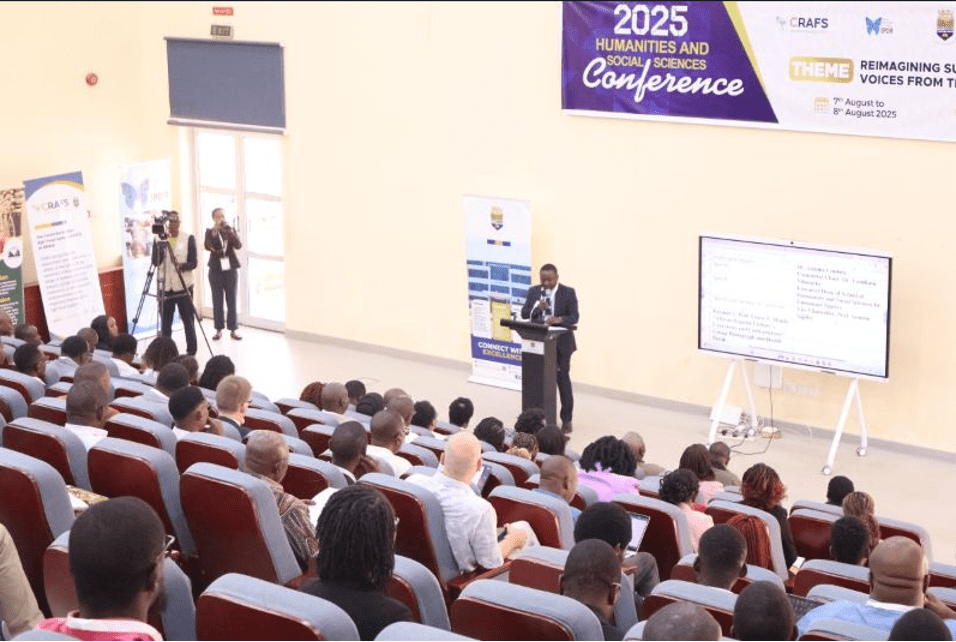
Figure 1: University of Malawi Vice Chancellor Professor Samson Sajidu opening the conference on 7 August 2025

I presented two papers. The first paper was titled ‘Ubuntu or Umunthu?: Decolonising from Dominant Postcolonial Perspectives in the Global South’. The paper, which is the theoretical framework of my study, attempts to define Umunthufrom a Malawian Cinyanja speakers’ perspective and contrast it with South Africa’s Ubuntu perspective from IsiZulu speakers. The main difference is that Umunthu perceives the individual as central to the existence of the community while Ubuntu perceives the community as central to the existence of the individual. Secondly, Umunthu is about economic independence of the individual while Ubuntu is about communitarianism. My study argues that Umunthu is the way Cinyanja speakers conceptualise mental health. Secondly, the study argues for an awakening to dominant perspectives within the Global South itself.  The second paper was titled ‘Maganizo: Cinyanja speakers’ way of conceptualising the stresses of life’. The paper investigates Umunthu-related language choices that Cinyanja speakers use to conceptualise and communicate mental problems. A key finding is that Umunthu communicates ‘mental health’ while maganizo is a concept that communicates the stresses of life that can lead to mental disorders. The findings of the study are significant because they bring to light the rich knowledge about mental health that Cinyanja speakers have stored in their language.   

Figure 2: presenting my study on Maganizo on 8 August 2025

I chose to present at the conference for two reasons. The first is that the conference offered me the opportunity to present in my home country, which is supposed to be the primary beneficiary of the study. Engaging with researchers and scholars from the study setting provided feedback that is useful for the completion of my thesis. The second is that the conference was an opportunity to grow my network of researchers with shared interests. Indeed, I am happy to report that I met two South Africa based researchers with whom I had meetings and agreed to remain in contact as we think of collaboration in future.  

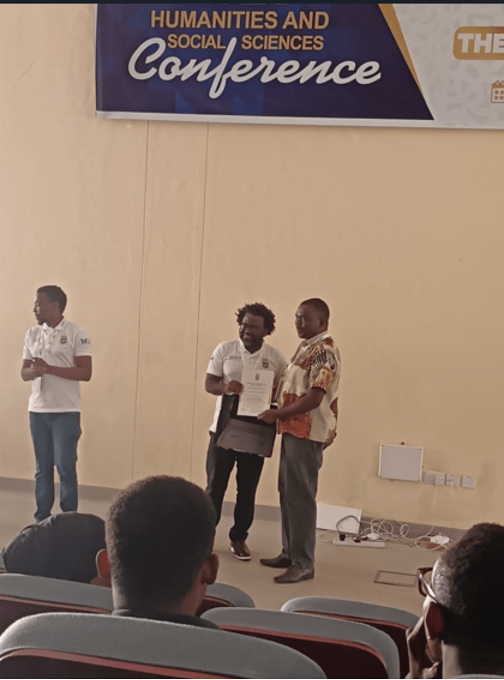
Figure 3: Receiving a certificate for best presenter in the category of PG students from Dean of Humanities and Social Sciences Dr. Emmanuel Ngwira

The following were two keynote speakers at the conference. Professor Grace A Musila who spoke on ‘African Popular Culture’s Currencies and Contradictions’ while on the second day, Dr Ronald Mangani spoke on ‘African Leadership and Sustainable Development’. 

I would like to thank the Philological Society for its support of £1000 which I used to purchase a flight ticket to Malawi for which I am very grateful. I am also grateful to my supervisor, Professor Hannah Gibson, for her support when I was preparing for the conference. 

Masters Bursary

Written by Joshua Coombs (University of York), recipient of the philological society’s Masters Bursary.

I am extremely grateful to the philological society for awarding me the Master’s Bursary for the 2024/25 academic year. Sociolinguistics has been my academic passion since I was first introduced to it at Sixth Form. After completing my undergraduate at the University of Gloucestershire in 2021, I dedicated the start of my career to teaching A Level English Language at a large sixth form college in Hampshire, as well as working as an examiner so I could contribute to the teaching and learning of sociolinguistics as much as possible. While I enjoyed teaching, I knew that I wanted to return to university one day to continue my own study of sociolinguistics, which is ultimately what led me to apply for the Msc in Linguistics at the University of York.

This course was far more scientific than I initially anticipated, which has honestly been a very welcome surprise. In semester one, for example, I took an introductory phonetics and phonology module where I learned how to use the speech processing software ‘praat’, in order to empirically study speech and quantitatively examine variation between speakers. Through taking this module, I gained skills that I would use throughout the remainder of the year, and became especially interested in the study of sociophonetics.

My research interests lie in language variation and change, especially in the South West of England. In a module titled ‘Advanced Topics in Language Variation & Change’, I conducted a research project using data from the Our Dialects website to examine language change and dialect levelling in three neighbouring cities in the South West: Salisbury, Southampton, and Bournemouth. I found that all three regions appeared to be experiencing supra-regional change, potentially spurred on by persistent dialect contact. This project acted as a spring-board for my dissertation, a sociophonetic investigation of apparent-time sound change in Wiltshire. Using data from paired sociolinguistic interviews with 12 male speakers, I investigated variation in two linguistic variables between younger and older speakers in Salisbury: the BATH vowel (i.e. b[a:]th vs b[ɑ:]th) and rhoticity. I found that [ɑ:] variants of BATH are a new innovation amongst younger speakers in the region, and that rhoticity is now a feature exclusive to older speakers who tend to use it more within careful speech.

Alongside my studies, I have also been extremely fortunate to have taken part in many extra-curricular activities this year. To name just a few: I attended a summer school led by Dr Ian Cushing at Manchester Metropolitan University about Linguistic Social Justice, worked on the ESRC-funded Generations of London English research project as a research associate, and sat on the organising committee for the A Level English Language ToolkitCPD event hosted by the University of York, where I presented a talk to teachers of A Level English Language across the country. I’ve also had the opportunity to disseminate my research at three conferences this year: An invited talk at the University of Alberta’s LCC graduate conference, and two posters at both the LAELPG at Lancaster University and LVC15, one of the largest variationist sociolinguistic conferences in the world.

Without this bursary, this year would have been much more of a financial burden than it ended up being. I have had an amazing year, and while I begin employment again next month as a data analyst at my local council, I am genuinely considering pursuing further study through a PhD in Linguistics in the next few years, something that up until now, I never thought I would have been able to do.

3rd International Conference on Tone and Intonation 

From 16th to 19th May 2025, I attended the 3rd International Conference on Tone and Intonation (TAI), made possible by the generous funding of the Philological Society.

Views of lake Ammersee a short walk from the venue.

The conference was held in Herrsching am Ammersee, a picturesque lakeside town just outside of Munich. We were fortunate enough to enjoy beautiful weather throughout, with clear views of the lake and the surrounding mountains providing a stunning backdrop to the event.

The TAI conference brings together researchers working on a wide range of topics related to tone and intonation, including language documentation, diachronic change, phonological theory, and, in my case, second language acquisition.  With 85 accepted papers (58 posters and 27 talks), this was the largest TAI to date, drawing participants from across the globe. Although it was my first time attending TAI, I was pleased to reconnect with researchers I had met at previous conferences and to meet new people whose work closely aligns with my own. 

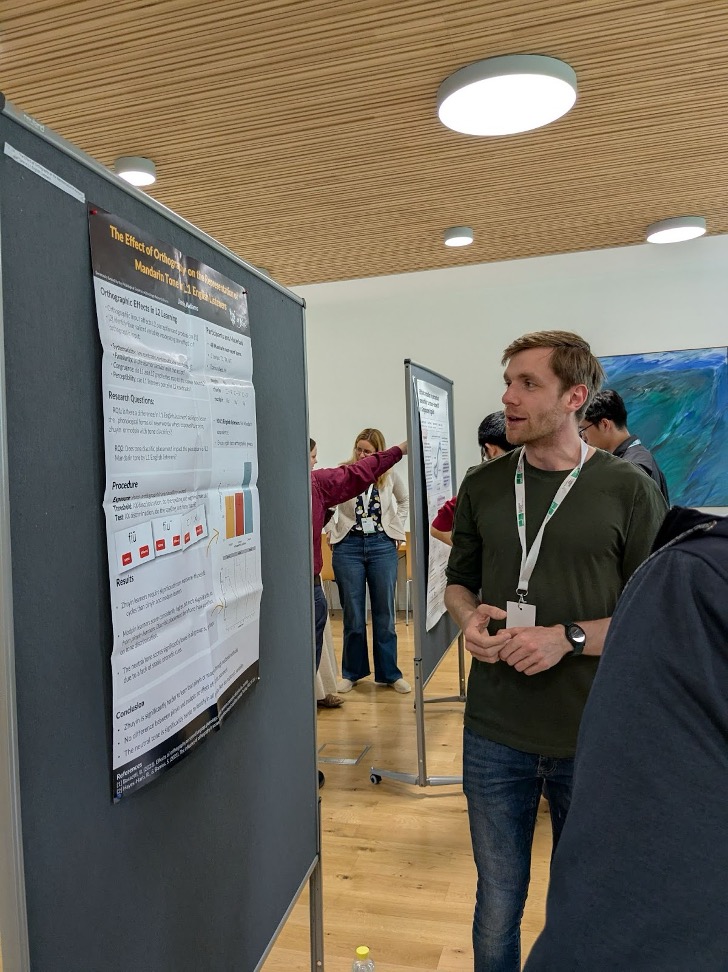
I presented a poster on orthographic effects in the perception of Mandarin tone by L1 English learners. This work forms a key part of my PhD project and focusses on how the visual representation of tone and the placement of tone diacritics can influence learners’ mental representation and perception of tone. Presenting a poster proved to be an ideal format for this topic as it allowed me to engage in in-depth discussions with a wide range of researchers. The feedback I received was both thoughtful and constructive and I left with new ideas and perspectives that will undoubtedly strengthen both my thesis and future research.

Presenting my (slightly creased!) poster.

Attending TAI was an immensely valuable experience, not only for disseminating the main findings of my doctoral research, but also for building and maintaining academic connections within the international tone and intonation community. I am deeply grateful to the Philological Society for their support. Without their funding, my trip to Germany would not have been possible.

Pacific Second Language Research Forum 2025

Thanks to the generous support of the PhilSoc Travel and Fieldwork Bursary, I had the opportunity to attend PacSLRF 2025 – Pacific Second Language Research Forum 2025 – that took place in Shanghai, China, from 30 May to 1 June 2025. PacSLRF is a key international conference that has been providing a forum for dissemination of Second Language Acquisition research in the Asia-Pacific region. At this conference, I presented my paper entitled “Online and Offline Anaphora Dependency Resolution with Mandarin Third-Person Pronoun ‘ta’ in L1-, L2-, and L3-Mandarin” based on a subset of my PhD research.

My PhD project investigates how Mandarin third person pronouns are interpreted by third language learners of Mandarin: native Japanese speakers who are learning Mandarin as a third language (L3) after learning English as a second language (L2). The aim is to explore the possible influence of both the first language (L1) and second language (L2) English — a compulsory language at school in Japan — on L3-Mandarin. 

In this presentation, I shared my findings obtained from Mandarin temporal biclausal sentences such as (1-2). Two types of anaphora are defined by the linear order of the pronoun “ta” (=s/he) and the potential sentence-internal referent: Backward (pronoun-first) (1) versus Forward (pronoun-second) (2). 

(1) Backward

Dang  ta    kan  zazhi        de-shihou, Lili zai-chi     xiangjiao.            (ta =  她 ‘she’)

When she read magazine at-time       Lili eat-PRG banana.

‘While she reads a magazine, Lili is eating a banana.’ 

(2) Forward

Dang  Lili kan  zazhi        de-shihou, ta   zai-chi     xiangjiao.             (ta =  她 ‘she’)

When Lili read magazine at-time      she eat-PRG banana.

‘While Lili reads a magazine, she is eating a banana.’ 

The structures were selected due to the unique similarity/dissimilarity of preferred interpretation of pronouns between the languages. Findings from existing L1 research on Mandarin, English, and Japanese are summarised in Table 1. 

The structures were selected due to the unique similarity/dissimilarity of preferred interpretation of pronouns between the languages. Findings from existing L1 research on Mandarin, English, and Japanese are summarised in Table 1. 

Table 1: L1 Findings in Mandarin, English, and Japanese on Acceptance of Sentence-internal Coreference Reading

 BackwardForward
MandarinNoYes
EnglishYesYes
JapaneseNoNo 

(Su et al., 2024; Su, 2020; Nagano, 2015; Zhao, 2014)

Yes means that sentence-internal coreference reading between the pronoun she and the sentence-internal referent Lili is accepted, and No represents that it is rejected. 

The varying interpretation patterns allow us to explore how the similarity/dissimilarity between learners’ L1/L2 and L3 on the interpretation of a particular property — in this case overt third person pronouns — affect their L3. We used a combination of a coreference judgement task and a real-time reading task on three groups of participants: L1-Japanese L2-English L3-Mandarin speakers; L1-English L2-Mandarin speakers; and L1-Mandarin speakers. The aim of using two different tasks was to shed light on the multifaceted nature of the prior language influences.

In the poster, I shared the results obtained from the L1-/L2-/L3-Mandarin speakers in both tasks, along with possible takeaways from the findings. I received many useful comments and feedback from audience members. Those included alternative point of views on my target Mandarin sentences, pros and cons of using certain L3 acquisition models to discuss my findings, and possible effects of task designs on pronoun interpretation in Mandarin. Importantly, due to the location, there were many L1-Mandarin-speaking researchers present at the conference, including those who are actually working on acquisition of Mandarin as an L3. It was such a great honour to have discussions with them. I truly appreciate the support from the PhilSoc travel grant, by giving me this valuable opportunity to attend the conference all the way from the UK!   

References:

Nagano, M. (2015). Interpretation of Overt Pronouns in L1 and L2 Japanese: The Role of Context [Doctor of Philosophy, The City University of New York]. 

Su, Y.-C. (2020). Backward/forward anaphora in child and adult Mandarin Chinese. Language Acquisition, 27(2), 187–216.

Su, Y.-C., Sorace, A., Hirose, Y., Mochizuki, K., Hirakawa, M., Nakayama, M., Chen, C.-H., & Hsieh, H.-Y. (2025). Backward anaphora in L2 acquisition of English, Mandarin and Japanese. Second Language Research. 

Zhao, L. X. (2014). Ultimate attainment of anaphora resolution in L2 Chinese. Second Language Research, 30(3), 381–407.

Oxford Postgraduate Conference in Linguistics

On 25–26 June 2025, we were very delighted to welcome over 50 early-career linguists from across the UK and beyond to Oxford for LingO 2025, the annual Postgraduate Conference in Linguistics is a student-led conference held by Faculty of Linguistics, Philology, and Phonetics, University of Oxford. The two-day event brought together students and researchers to share ideas, showcase ongoing research, and build connections in a very inclusive and friendly environment.

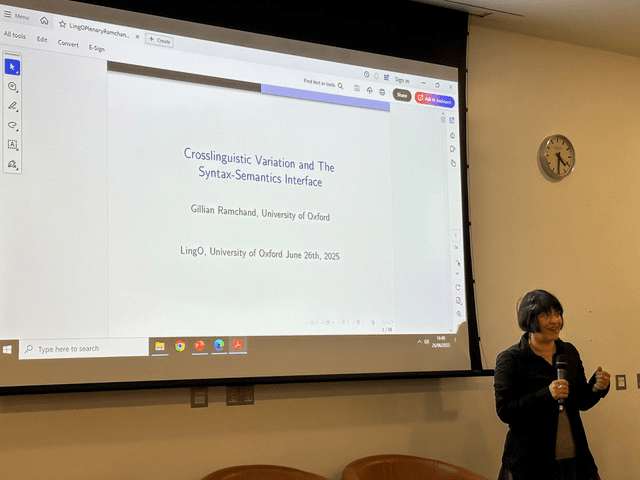
The conference opened with a warm welcome from the committee and our faculty chair, Prof. Colin Phillip. We were very honoured to have Dr. Sebastian Schuster (University College London) and Professor Gillian Ramchand (University of Oxford) as our keynote speakers. Dr. Schuster discussed the question ‘How Well do Large Language Models Encode Context-Sensitive Meaning?’, and Prof. Ramchand talked us through ‘Cross linguistic variation and the Syntax-Semantics Interface’. This year’s programme included 11 talks and 12 posters across various areas of linguistics. We were thrilled by the diversity of topics and research methods, and especially impressed by the enthusiastic engagement shown by all the presenters.

Beyond the academic programme, we organised a library tour of Oxford’s Taylor Institution Library and an informal drinks reception and student meet-up, which gave attendees the chance to explore the city and connect with peers in a relaxed setting.

We are very grateful to The Philological Society for making this event a great success. The support from PhilSoc greatly contributes to keeping the registration fee low, encouraging broader participation and enabling us to create an inclusive platform where students can share their research.

PhilSoc Bursary Support for The Edinburgh PGC 2025

LELPGC25 was held from 4th to 6th June 2025 at the University of Edinburgh. The conference provided a supportive and intellectually rich space for masters and PhD students in linguistics to share their work, develop professionally, and connect with others in the field. The programme featured plenary talks by Nadine Dietrich, Itamar Kastner, Tamar Keren-Portnoy, Dan Lassiter, and Marieke Meelen. These talks addressed a wide range of linguistic topics, from syntax and semantics to phonological development, and linguistic pedagogy.

The conference hosted student talks and posters, with broad range of subfields represented including psycholinguistics, phonology, historical linguistics, and computational linguistics. These sessions allowed students to engage with cutting-edge research and receive valuable feedback from both peers and more experienced scholars. A key aim of the LELPGC is to foster cross-subfield dialogue, and the variety of sessions helped ensure that participants could engage with ideas beyond their own specialisations, contributing to a more integrated and dynamic research environment. The LELPGC, which has been held annually since 1994, continues to serve as a key opportunity for students to present research in a constructive environment and build connections across institutions and research traditions.

In order to provide attendees with a range of development opportunities we hosted four workshops. Kenny Smith’s session on experimental design provided students with an introduction to key skills in experimental linguistics. The other workshops focused on career development with Anne Mucha discussing the ins and outs of postdoc applications, and current LEL PhD students leading panel discussions on making the most of your PhD and in conjunction with Chris Cummins, applying to PhDs. 

Thanks to the generous support of the Philological Society, we were able to offer bursaries to five student presenters. The recipients included masters and PhD students from Universities in the UK and mainland Europe. The bursaries helped mitigate travel and accommodation costs. For many students, especially those travelling from outside the UK or lacking institutional funding, the financial support was a decisive factor in their ability to attend. The support made it possible for students to take part in both the academic and social dimensions of the event thus facilitating professional development and the creation of a postgraduate research community in Linguistics. 

We are sincerely grateful to the Philological Society for their contribution to LELPGC25. Their support helped to ensure that the conference remained inclusive and accessible, enabling broader participation and supporting the development of the next generation of researchers in linguistics.

Edinburgh Theoretical Historical Linguistics (ETHL) Seminar

The 2025 Edinburgh Theoretical Historical Linguistics (ETHL) Seminar was the first event organised under the ETHL name (although we hope there will be more!). The two day mini-summer school ran on the 16th and 17th of April at the University of Edinburgh and was created by PhD students there. ETHL aimed to promote study at the intersection of Theoretical and Historical linguistics by providing historical linguists an opportunity to develop their understanding of theory in historical work as well as encouraging theoretical linguists to consider the relevance of diachronic development to linguistic theory. 

Four masterclasses in various aspects of theoretical historical linguistics were taught by leading theoretical historical linguists: Laura Grestenberger, Patrick Honeybone, Ranjan Sen, and George Walkden. Laura and Ranjan taught specific masterclasses in historical theories, respectively, Distributed Morphology and the Life Cycle of Phonological Processes. While George and Patrick discussed philosophical issues of theoretical historical linguistics addressing the locus of change and what it means to do reconstruction (spoiler: historical reconstruction is not all that different to modelling the synchronic grammar). Finally, Theresa Biberauer’s plenary talk synthesised some of the ideas raised in the masterclasses in addressing the position of generative historical linguistics within 21st century linguistics. 

In addition to the taught sessions, students were given the opportunity to present their own research in the innovative ‘snap-talk’ sessions. These 10 minute talk sessions served the same purpose as a poster but tailored to theoretical research which relies more heavily on verbal argumentation.

ETHL was widely attended with around 50 academics from all career stages, from undergraduate to professor! As such ETHL reached its target audience with the sessions being expertly pitched so every audience member could gain something from it – regardless of their linguistic background. ETHL also proved to be an excellent community building event bringing together theoretical and historical linguists in a specialised venue, the first of its kind. 

ETHL would not have been possible without the support of the Philological Society for which we are very grateful. Funding from PhilSoc contributed to the expenses of our three (in person) external speakers allowing us to broaden the scope of expertise beyond that at Edinburgh. Furthermore, this support allowed us to keep the registration fee low for our attendees making the event widely accessible. 

MFiL 2025

On the first and second of May we, the committee of the Manchester Forum in Linguistics, had the pleasure of seeing our hard work come to fruition. The Manchester Forum in Linguistics (MFiL) is a yearly two-day conference aimed at PhD students and early career researchers. We are thankful to The Philological Society for providing financial support for this event. 

At nine on the first of May our first presenters registered, suddenly it felt real! Our conference had officially started. After our first plenary talk by Dr Alexander Göbel on ‘Intonation and its meanings: Three case studies’, we had our first round of oral presentations. We had three parallel sessions: one on phonetics & phonology, one on semantics and one on forensic & experimental linguistics. Lunch proved a great opportunity for attendees to ask further questions and to discuss these first talks and academic life in general with each other. It was very beneficial to talk with researchers outside our own institution about these things; the international perspective that our global presenters could provide was especially insightful.  

In the afternoon we had two more parallel sessions on psycholinguistics and discourse analysis. It was then time for our poster session. We had four wonderful posters on a variety of topics. We finished the first successful day with another plenary talk ‘RP or more? A way forwards for understanding social stratification and English accent variation’ by Dr Caitlin Halfacre. However, the conference fun had not ended quite yet! We were able to continue interesting and thought-provoking conversations over dinner. 

The following day we started with a plenary talk ‘Appraisal for intelligence analysis: Exploring the utility of a qualitative methodology in forensic and security contexts’ by Dr Madison Hunter, after which we had our final round of oral presentations. We had two parallel sessions on sociolinguistics and language acquisition. All presenters and attendees could then attend two workshops: ‘Academic Publishing in Linguistics’ which was organised in cooperation with the Languages Editorial Office and delivered by MDPI UK and ‘How to use LaTex in Linguistics Writings’ which was delivered by Eve Suharwardy. These workshops gave practical guidance that will benefit the research that people are undertaking.

It was then time for our final plenary talk by Dr Mathew Gillings on ‘(Im)politeness variation and corpus linguistics’. We finished the day with a career panel ‘Insights into starting a career in academia’ with our plenary speakers Dr Alexander Göbel, Dr Caitlin Halfacre, Dr Madison Hunter and Dr Mathew Gillings. They gave honest and thoughtful advice, leaving everyone with a better understanding of the current job market. After officially closing the conference, we went over to the pub to unofficially close the conference in the sunshine as well. It was a fitting ending to an amazing two days.

We would like to thank all our presenters and attendees for coming, we had a great time!This conference was funded by the North West Consortium Doctoral Training Partnership, part of the Arts and Humanities Research Council. We would also like to thank our other funders, namely the Linguistics and English Language department and ArtsMethods of the University of Manchester, and of course The Philological Society.

We were able to waive fees for the conference due to the funding that we received
Careers panel with Dr Alexander Göbel, Dr Mathew Gillings, Dr Madison Hunter and Dr Caitlin Halfacre (from left to right)
Post-conference drinks