Written by Yutong Wang and Yuri Makarov.
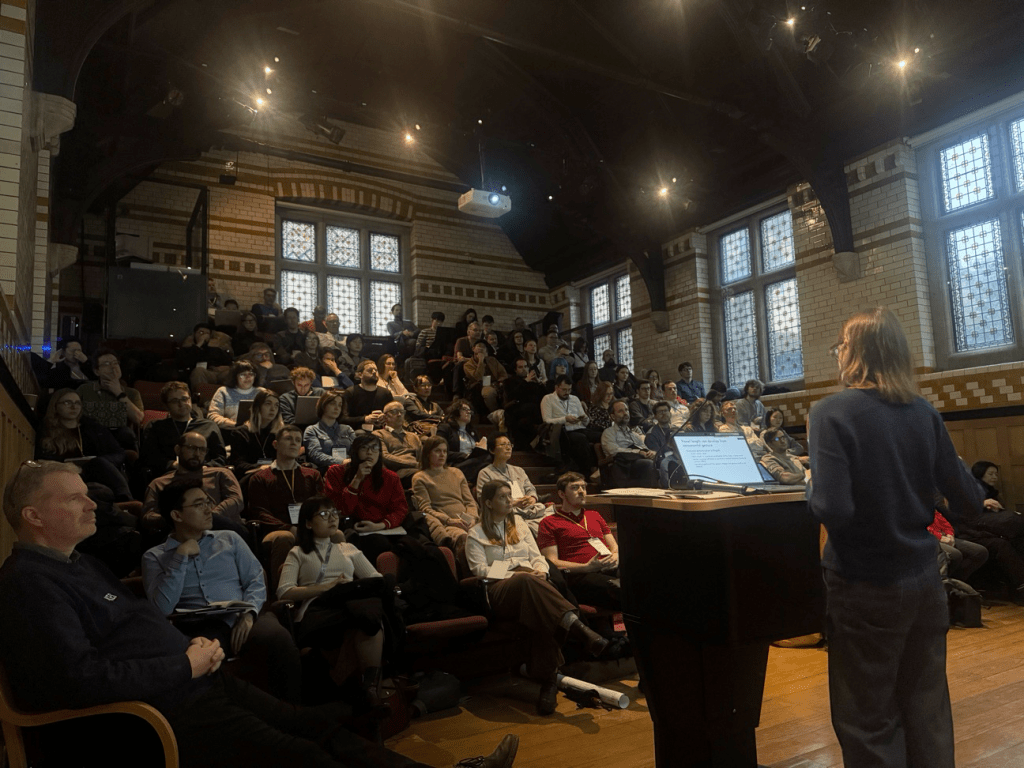
The organising committee of the 23rd Old-World Conference in Phonology (OCP23) wishes to record its gratitude to the Philological Society for its support of the meeting, which took place in Cambridge from 13 to 16 January. The conference brought together speakers and participants from across the international phonological community to discuss contemporary research in the field.
The programme commenced on 13 January with a workshop at the Provost’s Lodge, King’s College, focused on foundational questions regarding phonological representation and its computational consequences. The sessions addressed the structural form of representations—including linear strings, autosegmental tiers, and hierarchical configurations—and the relationship between representational choice and analytic complexity in phonological modelling. Discussions drew on specific phenomena, such as feature-spreading, to examine how theoretical assumptions shape both descriptive analyses and computational frameworks.
The main conference was held in the Bateman Auditorium at Gonville and Caius College, following welcoming remarks from Professor Brechtje Post and Professor Bert Vaux (University of Cambridge) on 14 January. The three-day programme comprised 41 oral presentations, and 46 poster sessions covering a diverse range of topics, including:
- Segmental and prosodic structure
- Tone and intonation
- Morphophonological patterning
- Phonological learning
- Theoretical and computational approaches to sound systems
The invited programme featured two keynote presentations that provided both historical and theoretical perspectives on the discipline:
- Professor Pavel Iosad (University of Edinburgh): Presented a reflection on the development of phonological theory, revisiting the Jakobsonian inheritance through the lens of Slavic phonology. The talk argued for a more pluralistic understanding of the intellectual lineage of generative phonology.
- Dr Patrycja Strycharczuk (University of Manchester): Examined phonological representation and sound change using a gestural model of vowel structure. The presentation explored the distinction between true monophthongs and pseudo-diphthongs and its consequences for phonetic realisation and diachronic change.
Poster sessions provided an essential space for the discussion of work in progress, facilitating exchange between researchers at various career stages. Formal sessions were complemented by sustained discussion during breaks and a conference dinner held in the Gonville and Caius College dining hall. These interactions highlighted a shared engagement with foundational questions of representation and empirical evidence, marking a successful iteration of the OCP series.
The conference attracted an audience of approximately 150 people, including both in-person attendees and those participating remotely via Zoom. The event’s geographic scope was extensive, featuring contributors from over 50 academic institutions across 18 countries and territories. This diversity facilitated a broad international exchange, drawing together researchers from across Europe, North America, and Asia.
 The Philological Society Blog