Written by Fae Hicks (University of Edinburgh), recipient of a travel and fieldwork bursary from the Philological Society.
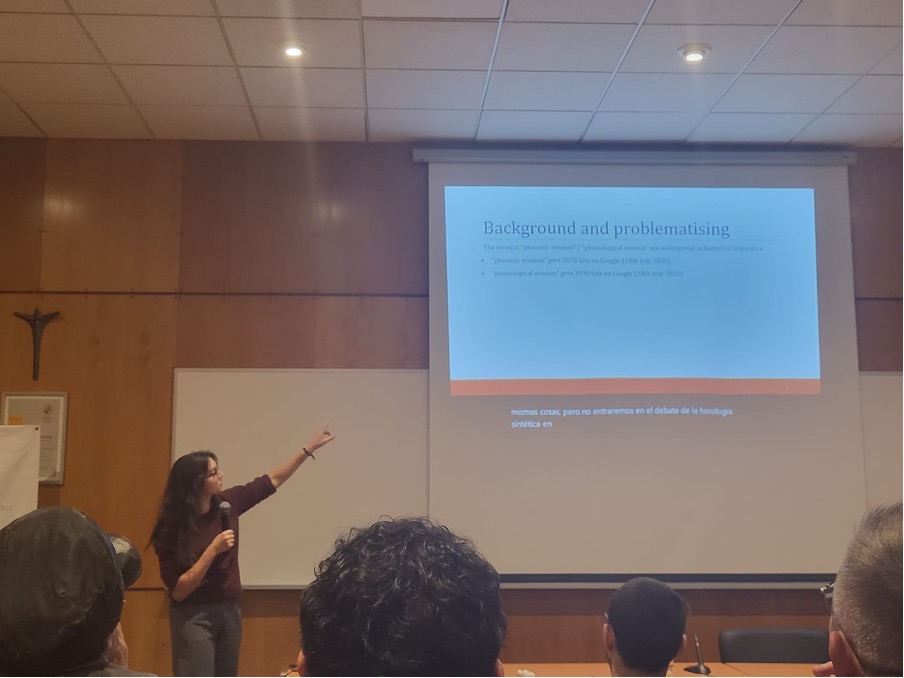
Thanks to the support of PhilSoc’s Travel and Fieldwork bursary I was able to present my research, The myth of phonetic erosion: grammaticalisation, causality, phonology and syntax, at the International Conference of Historical Linguistics (ICHL) in Santiago de Chile from the 18th – 22nd of August.
ICHL brings together researchers in Historical Linguistics from all areas of the field encouraging discussion between data driven linguistics and both formal and functional theorists alike. The conference facilitates discussion between theoretical silos which in turn promotes an environment where researchers are encouraged to challenge the assumptions of their own frameworks and methodologies. As the largest conference in Historical Linguistics, ICHL was the ideal venue for me to present my research and meet other historical linguists thus beginning to establish myself in the field.
At ICHL I presented a talk written in collaboration with my supervisor, Patrick Honeybone, investigating the conception ‘phonetic erosion’ in Historical Linguistics, arguing that the uses of the term are so disparate that it cannot possibly mean anything phonologically and is instead characterised by its supposed link to grammaticalisation. We went on to argue that there is no clear causal link between erosion and grammaticalisation which makes the term ultimately meaningless. The content of this presentation pertains to the first section of my PhD which questions the purported relationship between phonological and syntactic changes in grammaticalisation processes. In the ICHL talk I highlighted a need for precision and clarity in the use of terminology within the field and questioned the causal link between phonological and syntactic change presenting a number of open questions for the field such as:
- If we except that they are useful concepts, where does grammaticalisation end and erosion begin?
- How close (in time) do two changes have to be for there to be causal relationship?
- How do we extract the proposed ‘cause’ from the rest of the historical context?
The ICHL talk sets the stage for the rest of my PhD where I attempt to address such questions with particular focus on the notion of causality and historical process – i.e., what must be true in order for us to say that one change ‘caused’ another and how far back can we trace cause.
Presenting this, somewhat controversial work, at ICHL sparked informative conversations with people working in various branches of Historical Linguistics providing me a number of fresh perspectives that I will bear in mind going forward. Moreover, several audience members have said that my argument encouraged them to reflect on their own usage of the terms – thus, I hope that sharing my presentation at ICHL has had some non-zero impact of the field of Historical Linguistics.
I am incredibly grateful to the Philological Society for their travel bursary without which none of this would have been possible! This bursary came at a crucial time for me, as ICHL is a biannual conference this was the only time it is happening during my PhD and as the largest conference in my field it was vital that I attend, but I would not have been able to finance a trip to the Southern Hemisphere without PhilSoc’s generous support.
 The Philological Society Blog
It could be worse, it could be Times New Roman – but please don’t use serif fonts for projected presentations. The thin parts of the letters just disappear if you aren’t sitting very close (or if the optics of the projector are a bit off).
I also strongly recommend turning the ceiling lights off, at least the ones closest to the screen. They shine into the eyes of most of the audience.
LikeLike