Written by Kitty Liu
In January 2025, I attended the annual meeting of the Linguistics Society of America (LSA) through the generous support of PhilSoc’s Martin Burr Fund. The 2025 LSA meeting convened in Philadelphia for four days, where researchers from North America and beyond met to discuss issues in all areas of linguistics. I attended the LSA to give a joint conference presentation with Samuel Andersson, postdoc working on phonology at Yale University.
Our presentation was on the historical morphophonology of Tibetic verbs, investigating two instances of morphological neutralisation. Old Tibetan had highly complex syllable structure, and different cells in the paradigm are associated with overlapping sets of exponents (e.g. in Table 1 below, where b- is seen in both the past and future stems, g- in both the present and future stems, etc). Modern Tibetic varieties all exhibit erosion of the Old Tibetan syllable structure, and also restructure the verbal paradigm by losing the future stem and shifting from Old Tibetan’s tense-and-mood-based paradigm into an aspect-and-mood-based one (Table 2).
Table 1. Example verbs from Old Tibetan.
| Present | Past | Future | Imperative | |
| to revere | ‘khur | bkurd | bkur | khurd |
| to trickle | gtig | btigs | btig | gtigs |
| to cross a river | rgol | brgald | brgal | rgold |
| to scatter | ‘gyed | bkyes | dgye | khyes |
Table 2. Reflexes of Old Tibetan verbs into two modern Amdo varieties, Themchen (data from Haller, 2004) and Labrang (data from Liu, 2024).
| Gloss | Pres > Impf | Past > Pf | Fut > ∅ | Ipv > Ipv | |
| Old Tibetan | to beg (for food or money) | slong | bslangs | bslang | slongs |
| Themchen | /ʂtsuŋ/ | /ɸtsaŋ/ | –– | /ʂtsuŋ/ | |
| Old Tibetan | to pour | blug | blugs | blug | blugs |
| Labrang | /lə/ | /lux/ | –– | /lux/ | |
| Old Tibetan | to make descend | ‘bebs | phab | dbab | phobs |
| Labrang | /pʰa/ | /pʰu/ | –– | /pʰu/ |
The features make the Tibetic verbal system a prime locus for examining diachronic interactions between form and function. The two phenomena we discussed demonstrated different ways in which the two interact.
The first phenomenon we examined was the loss of the future stem, which we argued was due to the form of the future stem being the least ‘morphologically informative’ than the other paradigm cells. We quantified the informativity of different verb stems using the measure of ‘conditional entropy’ proposed by Ackerman and Malouf (2013). Conditional entropy is calculated from a morphological paradigm and its possible forms (we used a table of different known verb classes in Old Tibetan), uses information on how many different ways the same paradigm cell can be expressed (e.g. in the verb class summary we used, the Old Tibetan present stem can be expressed in nine different ways, which combine the exponents ‘-, g-, -d, -o-, and [+voice] in different ways), and calculates how difficult it is to correctly guess a verb’s realisation in one paradigm cell, given knowledge of that verb’s realisation in a different paradigm cell (e.g. the Old Tibetan present stem is hard to guess, because it has more possible realisations than the other stems). Our conditional entropy calculations showed that the future stem of an Old Tibetan verb is the most easily guessable when one knows one of the verb’s other stems, and knowing the future stem is the least condusive to guessing the verb’s other stem forms. We suggested that the future stem’s lesser informativity according to conditional entropy may have contributed to its loss. For example, when the verb paradigm restructured from a tense-and-mood-based one to an aspect-and-mood-based one, speakers may have preferred to repurpose the other more morphologically informative stems.
The second phenomenon we looked at was the causes of paradigm syncretisms in modern varieties of the Amdo subgroup. We found that modern Amdo varieties allow for all patterns of morphological syncretism (i.e. all three stems have the same form, any two of the three stems have the same form to the exclusion of the third stem, all three stems have different forms). Syncretisms occur either through regular sound change (Table 3, Example 1), or through paradigm extention (Table 3, Example 2). Surprisingly, while regular sound change can give rise to all syncretism patterns, levelling never leads to syncretisms between the imperfective and imperative stems at the exclusion of the perfective stem). We hypothesised that this is an instance of semantic dissimilarity constraining the syncretism of paradigm forms. We also linked this to the literature on *ABA constraints, i.e. the idea that three-cell morphological paradigms often have a dispreferred pattern of two-cell syncretisms (e.g. Andersson, 2018), since Amdo verbs provide an instance of a synchronic ABA syncretism that is diachronically dispreferred.
Table 3. Regular sound change and paradigm extension as causes of verb stem syncretism in modern Amdo varieties.
| Gloss | Pres > Impf | Past > Pf | Fut > ∅ | Ipv > Ipv | |
| Example 1: the imperfective and perfective stems syncretise because -n and -nd are neutralised by regular sound change. | |||||
| Old Tibetan | to listen (hon) | gsan | gsand | gsan | gsand |
| Themchen | /çsan/ | /çsan/ | –– | /çson/ | |
| Example 2: the imperfective and perfective stems syncretise. This must be through extension of the perfective form /ɖʐaŋ/, since the regular reflex of Old Tibetan present sbyong is */ɖʐoŋ/. | |||||
| Old Tibetan | to learn | sbyong | sbyangs | sbyang | sbyongs |
| Labrang | /ɖʐaŋ/ | /ɖʐaŋ/ | –– | /ɖʐoŋ/ | |
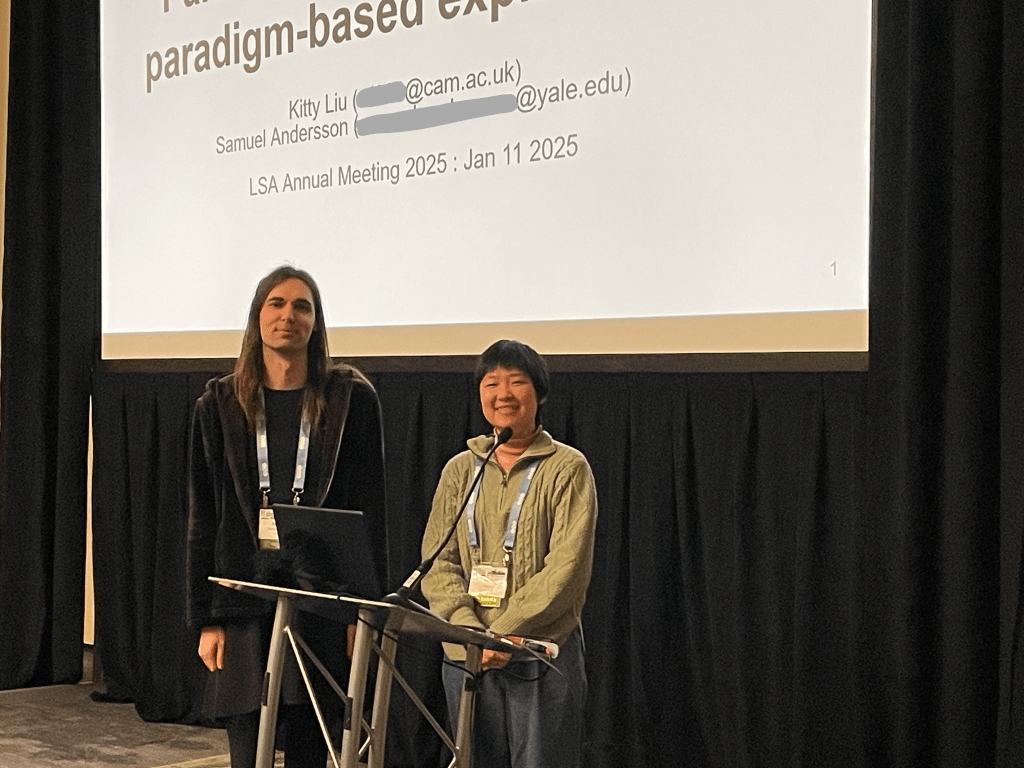
We got lots of positive feedback to our presentation (including from Ackerman and Malouf, whose 2013 paper we drew on), as well as comments on additional Tibetic-internal diachronic factors that we should take into account. Since our presentation lay at the intersection of several subfields (Tibetic linguistics, language change, theoretical linguistics), it was a very valuable opportunity to present at the LSA where our audience had a broad range of interests and specialties.
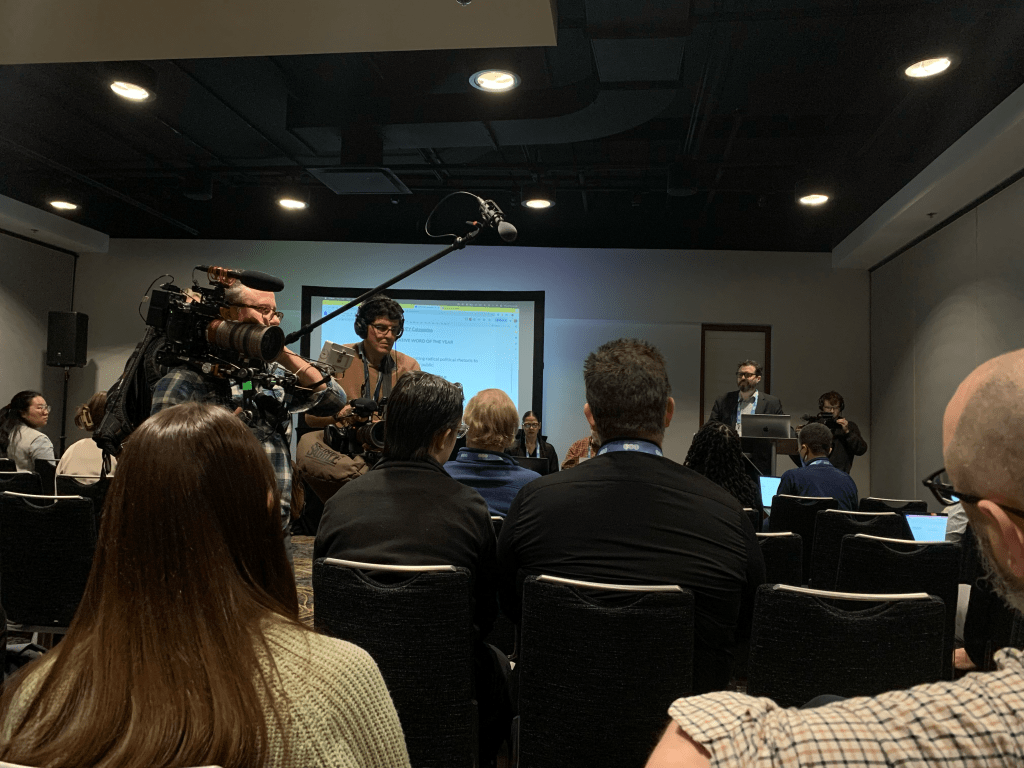
The material for our presentation came from my research for my MPhil thesis, which I completed at the University of Cambridge in 2024, supported by one of PhilSoc’s Masters bursaries. Samuel had contributed to some of the analyses in my MPhil through many inspiring conversations about morphological paradigms, as well as their superior grasp of Python, so we decided to give a joint presentation on those findings to acknowledge their collaborative nature. On top of giving our presentation and receiving feedback, I also greatly enjoyed attending a wide range of event at the LSA, including Chris Geissler’s presentation on the consonant classification system described by medieval Tibetan grammarians, and LSA President Marlyse Baptista’s plenary on a postcolonial and non-exceptionalist reconceptualisation of creole languages. I also got to attend the American Dialect Society’s Word of the Year selection process, which is held at the LSA each year. Nominations for 2024’s Word of the Year included brat (after Charli XCX’s 2024 album), sanewashing (presenting extreme political rhetoric as reasonable), yap (to chatter), and the overall winner rawdog (to undertake an action without customary protection) (Zimmer, 2025).
I am very grateful to PhilSoc for enabling me to attend the 2025 LSA meeting. I am very happy to have presented my research there and connected with other attendees about our work.
References
Ackerman, F., & Malouf, R. (2013). Morphological organization: The Low Conditional Entropy Conjecture. Language, 89(3), 429–464. https://doi.org/10.1353/lan.2013.0054
Andersson, S. (2018). (*)ABA in Germanic verbs. Glossa: A Journal of General Linguistics, 3(1). https://doi.org/10.5334/gjgl.733
Haller, F. (2004). Dialekt und Erzählungen von Themchen: sprachwissenschaftliche Beschreibung eines Nomadendialektes aus Nord-Amdo. Bonn: VGH Wissenschaftsverlag.
Liu, K. W. (2024). Verb paradigms in Tibetic: Morphophonology in diachronic perspective (MPhil thesis). University of Cambridge. Retrieved from https://doi.org/10.17605/osf.io/z9sr2
Zimmer, B. (2025, January 11). 2024 Word of the Year. Retrieved from American Dialect Society website: https://americandialect.org/2024-word-of-the-year-is-rawdog/
 The Philological Society Blog