written by Nicola Swinburne (University of Oxford)
In present day standard English, an auxiliary ‘do’ is employed to support almost all main verbs in the interrogative and negative declarative, exceptions being ‘be’ and (in some dialects) ‘have’. For example:
1. I do not catch the bus to work regularly.
2. I don’t know what the answer is.
3. Did you see Fred last night?
4. Do you have any bananas? (cf. Have you any bananas?)
5. Are you still drinking that tea? (NOT: Do you be still drinking that tea?)
However, in the history of English, as ‘do’-support (DS) was coming into the language, it was used less with stative verbs such as ‘know’ (Ellegård 1953), as if it held on to the remnant active semantics of ‘do’.
Although ‘do’-support is fairly widespread cross-linguistically (Jäger 2006), it was almost unknown in Romance languages until the report by Benincà & Poletto (2004) of an auxiliary fa ‘do’ in the interrogative of the Camuno dialect of Upper Val Camonica at Monno. In the Monno dialect fa ‘do’-support (FS) is largely obligatory and used with all main verbs except ‘have’ and ‘be’ (and ‘know’: Swinburne, 2021)
In work for my recent DPhil thesis, I showed that in fact FS is more widespread than just the Monno dialect, and can be found in communities along 45 km of the Oglio valley and several side valleys (Figures 1, 2, 3).

Interestingly, in many of the Middle Valley dialects, e.g. Esine (1), interrogatives may be formed in two ways, either with fa, the ‘do’ support verb (FS) (1a: ‘Does she eat the fish for supper’), or with just main verb (SCI) (1b: ‘Eats she the fish for supper’). As Camuno (like Italian) is a null-subject language, the subject is represented by a clitic, (probably just an agreement marker) on the finite verb and any lexical subject is at the end of the sentence.
| 1. | (a) | Fa=la | mangià | ‘l peh | da hena, | Maria? | [FS] | ||
| does=scl.3f.sg | eat.infin | the fish | for supper | Maria | |||||
| (b) | Màngia=la | ‘l peh | da hena, | Maria? | [SCI] | ||||
| eats=scl.3f.sg | the fish | for supper | Maria |
When such an FS/SCI contrast is available, FS serves pragmatic functions, and is used by the speaker to indicate they have an expectation of the answer and are asking the question to engage the interlocutor and ask for their opinion.
In dialects where use of fa is optional, the support verb appears to be at a lower stage of grammaticalisation. In these dialects it still has — to varying degrees — the meaning of ‘do’, or of ‘activity’, as prototypically carried out by an agentive subject. This is evidenced by the likelihood that FS will be used to support verbs of different semantic classes.
I recently carried out additional fieldwork, supported by a Martin Burr Fund award, to further investigate this variation. I measured the frequency of use of FS through an elicitation experiment (which I had used previously) but with new selection of verbs to define more precisely what speakers considered most important in their choice to use FS. Results (Figure 2), firmly established that primary difference in use of FS is the role that the subject is perceived to take in the event.

Greatest percentage FS use is with verbs with effector subjects (red); least FS use is with verbs with experiencer subjects (green: stative verbs). Verbs with theme subjects (blue: unaccusative verbs) are approximately between the two. Causative verbs (yellow) pattern among the non-statives, with most use with verbs where activity, particularly motion, is perceived as part of the causing action (e.g. ‘open X’) and less where any such activity is less prominent (e.g. ‘give X’). The version of ‘open’ without the causing action (anticausative: light blue), ‘open’ (by itself), patterns among the stative verbs. Main verb ‘do’ (darker red) is used with FS at a lower rate than other effector-subject verbs and often considered unnecessary with a support verb that still seems to have the semantic content of ‘do’.
The new fieldwork involved additional speakers from communities where greatest optionality in FS use (i.e. most semantic restrictions) had previously been found, and sampled communities located between zones of optional and obligatory areas in the hope of a better understanding of the final stages of grammaticalisation (Figure 3, 4).
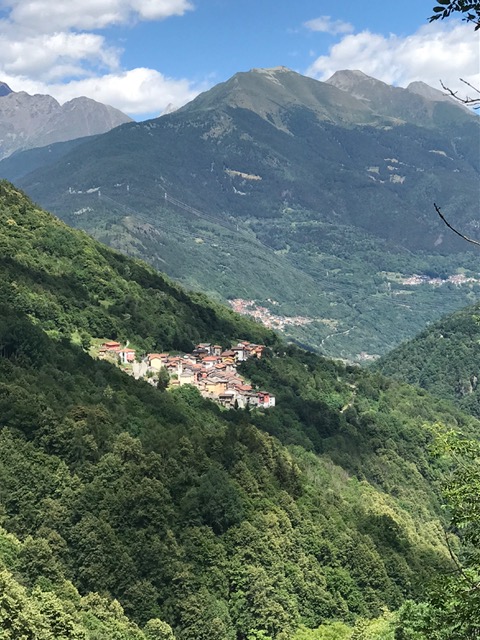

What can generally be said is that speakers with most generalised use of FS are found within the more isolated communities although these may be just the people who, during their working lives, interacted mostly with neighbours (who also used FS) rather than outsiders (who didn’t). Speakers with lowest use of FS are from communities with high through-traffic and thus had most contact with outsiders, but there are two different influences: a slow and persistent effect (that built up the pattern), and a more recent and rapid one (that is destroying it).
Speakers who have preserved the most restrictive and highly selective FS use are displaying an original pattern that developed because these communities always were in a dialect contact zone. On top of this, in communities have experienced a rapid recent influx of outsiders due to post-war valley industrialisation, some speakers have changed their dialects during their lifetimes and the overall effect has been to entirely obliterate FS.
The additional phase of the research has helped confirm how use of a ‘do’ support generalises across different types of verbs, and how interactions among speakers can either hasten this generalisation, or stop it in its tracks.
References
Benincà, Paola & Cecilia Poletto. 2004. A Case of do-Support in Romance. Natural Language & Linguistic Theory 22(1), 51–94. https://doi.org/10.1023/B:NALA.0000005565.12630.c1.
Ellegård, A. (1953). The auxiliary do: The establishment and regulation of its use in English. Stockholm: Almqvist & Wiksell.
Jäger, A. (2006). Typology of periphrastic ‘do’-constructions. Bochum: Brockmeyer.
Swinburne, N. (2021). The grammaticalization of do-support in the northern Italian Camuno dialect. DPhil thesis, University of Oxford. https://ora.ox.ac.uk/objects/uuid:d4e7bb98-ff1a-4ffa-8e10-6a8875631241
 The Philological Society Blog